




A block is placed over a large plank (plank is kept on a horizontal surface). The coefficient of friction between the block and the plank is $\mu =0.2$. Initially both are at rest, suddenly the plank starts moving horizontally with acceleration ${{a}_{0}}=4m/{{s}^{2}}$ with the help of some external force. The displacement of the block in 1 s is $\left( g=10m/{{s}^{2}} \right)$
A. 1 m relative to ground
B. 1 m relative to plank
C. zero relative to plank
D. 2 m relative to ground
Answer
 Verified
639.9k+ views
Hint: We are given a block kept on a plank and the coefficient of friction between them is given. We need to find the displacement of the block in time 1 s when the plank moves forward horizontally with an acceleration. The displacement of the block will be in opposite to the direction of motion of the plank. We can find this displacement using equations of motion.
Formula used:
Equation of motion
$s=ut+\dfrac{1}{2}a{{t}^{2}}$
Complete answer:
We have a block placed over a plank.
Let ‘m’ be the mass of the block and ‘M’ be the mass of the plank.
The coefficient of friction, $'\mu '$ between the block and plank is given to us,
$\mu =0.2$
It is said the block was at rest initially, therefore the initial velocity of the
$u=0m/s$
After a certain time, the plank starts to move forward horizontally, and the acceleration of plank is given
${{a}_{0}}=4m/{{s}^{2}}$
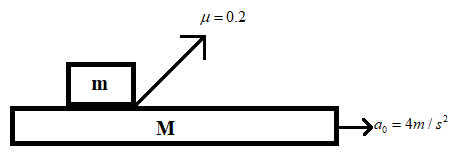
We have to find the displacement of the block, ‘s’ in time 1 s.
Since the plank is moving towards right in a horizontal direction, the block will be displaced in a direction opposite to that of the motion of the plank.
Hence the block will move towards the left horizontally.
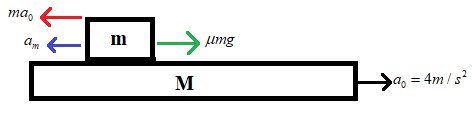
Consider the above figure.
It shows the direction of displacement of the block with respect to plank.
Acceleration of the block is given as $'{{a}_{m}}'$ .
The two forces acting on the block are frictional force, $'\mu mg'$ and a force due to the motion of plank, $m{{a}_{0}}$
These two forces are opposite; hence the resultant force will be,
$F=m{{a}_{0}}-\mu mg$
The force acting on the body due to its own motion is
$F=m{{a}_{m}}$
By equating these two forces acting on the body, we get
$m{{a}_{m}}=m{{a}_{0}}-\mu mg$
Substituting the known values in the above equation, we get $'{{a}_{m}}'$ as,
$\begin{align}
& {{a}_{m}}={{a}_{0}}-\mu g \\
& {{a}_{m}}=4-\left( 0.2\times 10 \right) \\
& \implies {{a}_{m}}=4-2 \\
& \implies {{a}_{m}}=2m/{{s}^{2}} \\
\end{align}$
Now that we have the acceleration of the block, we have to find the displacement of the block.
According to the third equation of motion, we have displacement as
$s=ut+\dfrac{1}{2}a{{t}^{2}}$
We know
$\begin{align}
& u=0 \\
& \implies {{a}_{m}}=2m/{{s}^{2}} \\
& \implies t=1s \\
\end{align}$
Therefore,
$\begin{align}
& s=0\times t+\dfrac{1}{2}\times 2\times 1 \\
& \implies s=1m \\
\end{align}$
Therefore displacement of the block in 1 s is 1 m relative to plank.
So, the correct answer is “Option B”.
Note:
The resistance to motion shown by a body with respect to another body is known as friction.
Static friction is the friction experienced by a body at rest when it tries to move another body on its surface.
Coefficient of friction is the ratio of frictional force required to move two sliding surfaces over one another and the total force that is holding them together.
Formula used:
Equation of motion
$s=ut+\dfrac{1}{2}a{{t}^{2}}$
Complete answer:
We have a block placed over a plank.
Let ‘m’ be the mass of the block and ‘M’ be the mass of the plank.
The coefficient of friction, $'\mu '$ between the block and plank is given to us,
$\mu =0.2$
It is said the block was at rest initially, therefore the initial velocity of the
$u=0m/s$
After a certain time, the plank starts to move forward horizontally, and the acceleration of plank is given
${{a}_{0}}=4m/{{s}^{2}}$
We have to find the displacement of the block, ‘s’ in time 1 s.
Since the plank is moving towards right in a horizontal direction, the block will be displaced in a direction opposite to that of the motion of the plank.
Hence the block will move towards the left horizontally.
Consider the above figure.
It shows the direction of displacement of the block with respect to plank.
Acceleration of the block is given as $'{{a}_{m}}'$ .
The two forces acting on the block are frictional force, $'\mu mg'$ and a force due to the motion of plank, $m{{a}_{0}}$
These two forces are opposite; hence the resultant force will be,
$F=m{{a}_{0}}-\mu mg$
The force acting on the body due to its own motion is
$F=m{{a}_{m}}$
By equating these two forces acting on the body, we get
$m{{a}_{m}}=m{{a}_{0}}-\mu mg$
Substituting the known values in the above equation, we get $'{{a}_{m}}'$ as,
$\begin{align}
& {{a}_{m}}={{a}_{0}}-\mu g \\
& {{a}_{m}}=4-\left( 0.2\times 10 \right) \\
& \implies {{a}_{m}}=4-2 \\
& \implies {{a}_{m}}=2m/{{s}^{2}} \\
\end{align}$
Now that we have the acceleration of the block, we have to find the displacement of the block.
According to the third equation of motion, we have displacement as
$s=ut+\dfrac{1}{2}a{{t}^{2}}$
We know
$\begin{align}
& u=0 \\
& \implies {{a}_{m}}=2m/{{s}^{2}} \\
& \implies t=1s \\
\end{align}$
Therefore,
$\begin{align}
& s=0\times t+\dfrac{1}{2}\times 2\times 1 \\
& \implies s=1m \\
\end{align}$
Therefore displacement of the block in 1 s is 1 m relative to plank.
So, the correct answer is “Option B”.
Note:
The resistance to motion shown by a body with respect to another body is known as friction.
Static friction is the friction experienced by a body at rest when it tries to move another body on its surface.
Coefficient of friction is the ratio of frictional force required to move two sliding surfaces over one another and the total force that is holding them together.
Recently Updated Pages
Basicity of sulphurous acid and sulphuric acid are

Master Class 11 English: Engaging Questions & Answers for Success
Master Class 11 Physics: Engaging Questions & Answers for Success
Master Class 11 Computer Science: Engaging Questions & Answers for Success
Master Class 11 Chemistry: Engaging Questions & Answers for Success
Master Class 11 Social Science: Engaging Questions & Answers for Success
Trending doubts
Difference Between Prokaryotic Cells and Eukaryotic Cells
Two of the body parts which do not appear in MRI are class 11 biology CBSE
One Metric ton is equal to kg A 10000 B 1000 C 100 class 11 physics CBSE
10 examples of friction in our daily life
Draw a diagram of nephron and explain its structur class 11 biology CBSE
What will happen if the mucus is not secreted by the class 11 biology CBSE