




A block is placed on an inclined plane moving towards right horizontally with an acceleration \[{a_o} = g\]. The length of the plane \[AC = 1m\]. Friction is absent everywhere. Find the time taken (in seconds) by the block to reach from \[C\] to \[A\] .
(A) 1
(B) 3
(C) 2
(D) 5
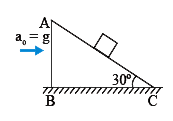
Answer
 Verified
561.3k+ views
Hint: In this question, first we will make the free body diagram and then make the two components of the force acting on the block. With the help of the free body diagram, we will calculate the acceleration and then with the help of the second equation of motion, we will find the time taken by the block to reach from C to A.
Complete step by step answer:
Resolution of Forces is the process of breaking a force into two components, basically horizontal and vertical components. On the other hand, we can also say that the process of substituting a force by its components so that the net effect on the body remains the same is called resolution of a force.
The forces acting on the block in the free body diagram is:
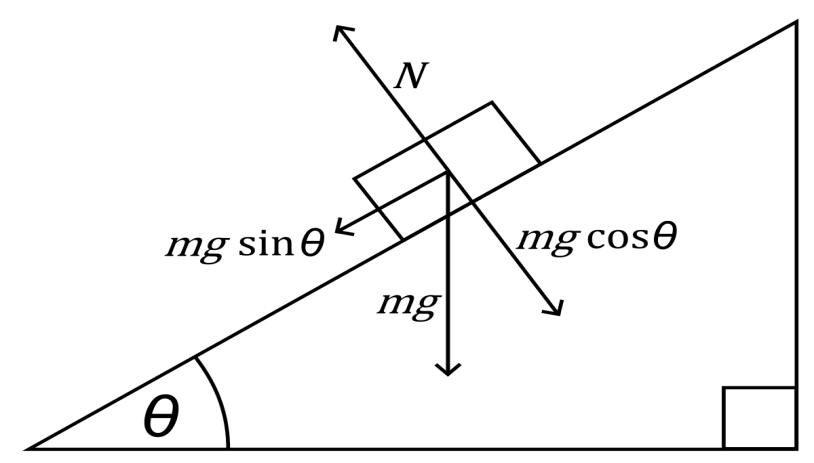
In the above free body diagram we can see that the friction is absent as it is mentioned in the question that the surface is frictionless.
Now, the effective acceleration will be given by the expression,
\[a = g\cos {30^ \circ } - g\sin {30^ \circ }\]
On putting the values of the trigonometric functions, we get,
\[a = 10\left( {\dfrac{{\sqrt 3 }}{2} - \dfrac{1}{2}} \right)\]
(here we have taken the value of g as \[10\dfrac{m}{{{s^2}}}\] for making calculations easy)
\[a = 5(0.732)\]
\[a = 3.660\]
Now we will put the value of \[a = 3.660\] in the second equation of motion,
\[s = ut + \dfrac{1}{2}a{t^2}\]
Here, the value of \[u = 0\dfrac{m}{s}\] as there is no initial velocity.
\[1 = 0(t) + \dfrac{1}{2}(3.66)({t^2})\]
\[1 = 1.83{t^2}\]
On taking \[1.83\] on the other side,
\[{t^2} = \dfrac{1}{{1.83}}\]
\[{t^2} = 0.546\]
\[t = 0.74\sec \]
Now, \[t = 0.74\sec \] can be approximated as \[t = 1\sec \]
So, the correct answer is (A) 1.
Note: It is important to note that in this question, we are given a frictionless surface so that the problem does not get complicated and so that the question can easily be solved. But in real practical life, a proper frictionless surface does not exist. If there was no friction everything would slide to the lowest point.
Complete step by step answer:
Resolution of Forces is the process of breaking a force into two components, basically horizontal and vertical components. On the other hand, we can also say that the process of substituting a force by its components so that the net effect on the body remains the same is called resolution of a force.
The forces acting on the block in the free body diagram is:
In the above free body diagram we can see that the friction is absent as it is mentioned in the question that the surface is frictionless.
Now, the effective acceleration will be given by the expression,
\[a = g\cos {30^ \circ } - g\sin {30^ \circ }\]
On putting the values of the trigonometric functions, we get,
\[a = 10\left( {\dfrac{{\sqrt 3 }}{2} - \dfrac{1}{2}} \right)\]
(here we have taken the value of g as \[10\dfrac{m}{{{s^2}}}\] for making calculations easy)
\[a = 5(0.732)\]
\[a = 3.660\]
Now we will put the value of \[a = 3.660\] in the second equation of motion,
\[s = ut + \dfrac{1}{2}a{t^2}\]
Here, the value of \[u = 0\dfrac{m}{s}\] as there is no initial velocity.
\[1 = 0(t) + \dfrac{1}{2}(3.66)({t^2})\]
\[1 = 1.83{t^2}\]
On taking \[1.83\] on the other side,
\[{t^2} = \dfrac{1}{{1.83}}\]
\[{t^2} = 0.546\]
\[t = 0.74\sec \]
Now, \[t = 0.74\sec \] can be approximated as \[t = 1\sec \]
So, the correct answer is (A) 1.
Note: It is important to note that in this question, we are given a frictionless surface so that the problem does not get complicated and so that the question can easily be solved. But in real practical life, a proper frictionless surface does not exist. If there was no friction everything would slide to the lowest point.
Recently Updated Pages
If x a + bt + ct2 where x is in meters and t is in class 11 physics CBSE

A car covers the first half distance between two places class 11 physics CBSE
The resultant of two vectors overrightarrow P and overrightarrow class 11 physics CBSE
Find the value of cos 135 class 11 maths CBSE
A mass M is held in place by an applied force F and class 11 physics CBSE
A solution of glucose in water is labelled as 10 dfracwv class 11 chemistry CBSE
Trending doubts
One Metric ton is equal to kg A 10000 B 1000 C 100 class 11 physics CBSE
Find the value of the expression given below sin 30circ class 11 maths CBSE
What do you mean by retardation What is its SI uni class 11 physics CBSE
Draw a diagram of nephron and explain its structur class 11 biology CBSE
10 examples of friction in our daily life
Difference between physical and chemical change class 11 chemistry CBSE