




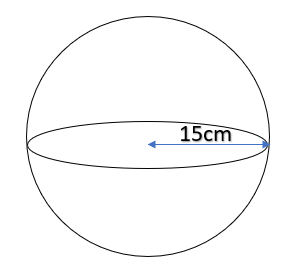
A balloon, which always remains spherical on inflation, is being inflated by pumping in 900 cubic centimeters of gas per second. Find the rate at which the radius of the balloon increases when the radius is 15cm.
Answer
 Verified
652.5k+ views
Hint-In this question, the rate of pumping is given to us. Directly use formula for volume of sphere and find the rate of change of volume of sphere with respect to time(t) solve for rate of change of radius with respect to time(t).
Complete step by step answer:
Volume of sphere, V = $\dfrac{4}{3}\pi {r^3}$
Rate of change of volume V w.r.t to time(t)=
$
\dfrac{{dv}}{{dt}} = \left( {\dfrac{{dv}}{{dr}}} \right) \times \left( {\dfrac{{dr}}{{dt}}} \right) \\
\dfrac{{dv}}{{dt}} = \dfrac{4}{3}\pi \times 3{r^2} \times \dfrac{{dr}}{{dt}} \\
\dfrac{{dv}}{{dt}} = 4\pi {r^2}\dfrac{{dr}}{{dt}} \\
$
Given, $
\dfrac{{dv}}{{dt}} = {\text{ Rate of pumping = 900c}}{{\text{m}}^3}/s \\
{\text{and }}r = 15cm \\
$
$
\Rightarrow \dfrac{{dv}}{{dt}} = 4\pi \times \left( {{{15}^2}} \right)\left( {\dfrac{{dr}}{{dt}}} \right) \\
900 = 900\pi \left( {\dfrac{{dr}}{{dt}}} \right) \\
\left( {\dfrac{{dr}}{{dt}}} \right) = \dfrac{{900}}{{900\pi }} = \dfrac{1}{\pi }cm/s \\
$
Note- In order to solve such types of problems students must remember the formula for the volume of common geometrical shapes such as sphere. The major source of mistakes in such types of problems is due to the difference in the units given at different places, so students must take extra care of the units mentioned. Students should try to convert all the values in one common unit to avoid mistakes.
Complete step by step answer:
Volume of sphere, V = $\dfrac{4}{3}\pi {r^3}$
Rate of change of volume V w.r.t to time(t)=
$
\dfrac{{dv}}{{dt}} = \left( {\dfrac{{dv}}{{dr}}} \right) \times \left( {\dfrac{{dr}}{{dt}}} \right) \\
\dfrac{{dv}}{{dt}} = \dfrac{4}{3}\pi \times 3{r^2} \times \dfrac{{dr}}{{dt}} \\
\dfrac{{dv}}{{dt}} = 4\pi {r^2}\dfrac{{dr}}{{dt}} \\
$
Given, $
\dfrac{{dv}}{{dt}} = {\text{ Rate of pumping = 900c}}{{\text{m}}^3}/s \\
{\text{and }}r = 15cm \\
$
$
\Rightarrow \dfrac{{dv}}{{dt}} = 4\pi \times \left( {{{15}^2}} \right)\left( {\dfrac{{dr}}{{dt}}} \right) \\
900 = 900\pi \left( {\dfrac{{dr}}{{dt}}} \right) \\
\left( {\dfrac{{dr}}{{dt}}} \right) = \dfrac{{900}}{{900\pi }} = \dfrac{1}{\pi }cm/s \\
$
Note- In order to solve such types of problems students must remember the formula for the volume of common geometrical shapes such as sphere. The major source of mistakes in such types of problems is due to the difference in the units given at different places, so students must take extra care of the units mentioned. Students should try to convert all the values in one common unit to avoid mistakes.
Recently Updated Pages
Master Class 11 English: Engaging Questions & Answers for Success

Master Class 11 Social Science: Engaging Questions & Answers for Success
Master Class 11 Maths: Engaging Questions & Answers for Success
Master Class 11 Biology: Engaging Questions & Answers for Success
Master Class 11 Physics: Engaging Questions & Answers for Success
Master Class 11 Chemistry: Engaging Questions & Answers for Success
Trending doubts
Explain the Treaty of Vienna of 1815 class 10 social science CBSE
What is the full form of POSCO class 10 social science CBSE
Define Potential, Developed, Stock and Reserved resources
The diagonals of a rhombus are 10cm and 24cm Find the class 10 maths CBSE
Fill the blanks with proper collective nouns 1 A of class 10 english CBSE
What planets have no moons Which one has only one moon class 10 physics CBSE