




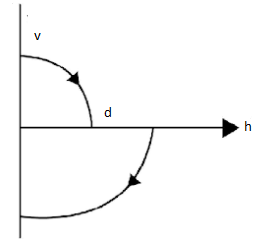
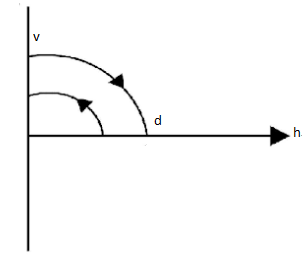
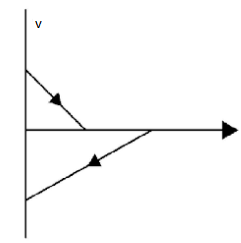
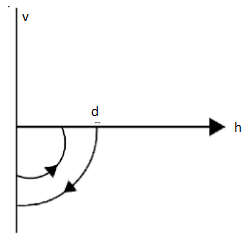
A ball is dropped vertically from a height $d$ above the ground it hits the ground and bounces up vertically to a height $\dfrac{d}{2}$. Neglecting subsequent motion and air resistances, its velocity $v$ varies with the height $h$ above the ground as:
A.
B.
C.
D.
Answer
 Verified
607.5k+ views
Hint:Here we have to use the third equation of motion to get the answer.
In physics, equations of motion are classified as equations that characterise a physical system’s behaviour in terms of its motion as a function of time. For deriving components such as displacement, velocity, time and acceleration, there are three motion equations that can be used.
The equations of motion can also be said as the equations of kinematics.
Complete step by step solution:
Let $u$ be the initial velocity and $v$ be the final velocity.
Let $a$ be the acceleration and $s$ be the distance.
Now we use the third equation of motion.
The third equation of motion gives the final velocity of an object under uniform acceleration given the distance travelled and an initial velocity.
The third equation of motion is especially used to find the distance.
The third equation of motion is given mathematically as:
${v^2} - {u^2} = 2as$
Since the initial velocity is zero.
So,
${v^2} = 2as$
So, the graph is parabolic.
The velocity is going to be negative when the ball sinks while it is going to be positive as it bounces up i.e. they are going to get opposite direction, even the ultimate height will be $\dfrac{d}{2}$ .
Hence, option A is correct.
Additional information:
During uniformly accelerated, straight-line motion, the relation between velocity and time is a clear one. The longer the acceleration, the greater the velocity variation. Velocity shift is strictly proportional to the time that continuous acceleration occurs. If velocity increases for a given time by a certain amount, twice the time, it can increase by twice the amount. If an object had already begun at a certain velocity, so the old velocity plus this adjustment would be its current velocity.
Note:
Here we have to take the initial velocity as zero since it is not provided in the question. So, while solving the question we have to see if initial velocity is provided or not and what is asked in the question.
In physics, equations of motion are classified as equations that characterise a physical system’s behaviour in terms of its motion as a function of time. For deriving components such as displacement, velocity, time and acceleration, there are three motion equations that can be used.
The equations of motion can also be said as the equations of kinematics.
Complete step by step solution:
Let $u$ be the initial velocity and $v$ be the final velocity.
Let $a$ be the acceleration and $s$ be the distance.
Now we use the third equation of motion.
The third equation of motion gives the final velocity of an object under uniform acceleration given the distance travelled and an initial velocity.
The third equation of motion is especially used to find the distance.
The third equation of motion is given mathematically as:
${v^2} - {u^2} = 2as$
Since the initial velocity is zero.
So,
${v^2} = 2as$
So, the graph is parabolic.
The velocity is going to be negative when the ball sinks while it is going to be positive as it bounces up i.e. they are going to get opposite direction, even the ultimate height will be $\dfrac{d}{2}$ .
Hence, option A is correct.
Additional information:
During uniformly accelerated, straight-line motion, the relation between velocity and time is a clear one. The longer the acceleration, the greater the velocity variation. Velocity shift is strictly proportional to the time that continuous acceleration occurs. If velocity increases for a given time by a certain amount, twice the time, it can increase by twice the amount. If an object had already begun at a certain velocity, so the old velocity plus this adjustment would be its current velocity.
Note:
Here we have to take the initial velocity as zero since it is not provided in the question. So, while solving the question we have to see if initial velocity is provided or not and what is asked in the question.
Recently Updated Pages
Master Class 11 Social Science: Engaging Questions & Answers for Success

Master Class 11 English: Engaging Questions & Answers for Success
Master Class 11 Maths: Engaging Questions & Answers for Success
Master Class 11 Chemistry: Engaging Questions & Answers for Success
Master Class 11 Biology: Engaging Questions & Answers for Success
Master Class 11 Physics: Engaging Questions & Answers for Success
Trending doubts
One Metric ton is equal to kg A 10000 B 1000 C 100 class 11 physics CBSE
Difference Between Prokaryotic Cells and Eukaryotic Cells
How many of the following diseases can be studied with class 11 biology CBSE
Two of the body parts which do not appear in MRI are class 11 biology CBSE
Which of the following enzymes is used for carboxylation class 11 biology CBSE
Explain zero factorial class 11 maths CBSE