




A ball is dropped on the ground from the height of 1m. The coefficient of restitution is 0.6. The height to which the ball will rebound is (in m)
A. 0.6
B. 0.4
C. 0.36
D. 0.16
Answer
 Verified
612.3k+ views
Hint: We have a ball that is dropped from a height. The ball reaches the ground and rebounds. We need to find the height to which the ball rebounds. We know the equation for velocity of a body falling from a height and a relation between velocity and coefficient of restitution. Substituting values in these equations we get the required solution.
Formula Used:
Velocity of a body falling from a height ‘H’ is given by,
$v=\sqrt{2gH}$
Coefficient of restitution and velocity,
${{v}_{f}}=ev$
Complete step-by-step answer:
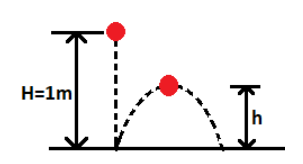
In the question a ball is dropped from a height 1m
This is the initial height of the ball.
Let us denote this height by ‘H’
H = 1m
The ball reaches the ground and bounces from the surface.
Let the height to which the ball rebounds be denoted as ‘h’
We know that when a body falls from a height ‘H’, the velocity of that body is given by the equation,
$v=\sqrt{2gH}$
In this case, value of H is 1m
Therefore, velocity of the ball will be
$v=\sqrt{2g}$
This is the velocity of the ball when it strikes the ground.
After striking the ground the ball will rebound with a velocity. Let this velocity be the final velocity.
Final velocity is given by the equation,
${{v}_{f}}=ev$, were ‘${{v}_{f}}$’ is final velocity, ‘e’ is coefficient of restitution and ‘v’ is the striking velocity.
When the ball strikes the ground and rebounds to a height h, the velocity with which the body rebounds, i.e. the final velocity will become,
${{v}_{f}}=\sqrt{2gh}$
Since ${{v}_{f}}=ev$, we get
$\begin{align}
& \sqrt{2gh}=e\sqrt{2g} \\
& 2gh={{e}^{2}}2g \\
& h={{e}^{2}} \\
\end{align}$
In the question we are given the value of coefficient of restitution, e = 0.6
Therefore the height to which the ball rebounds ‘h’ will become,
$\begin{align}
& h={{0.6}^{2}} \\
& h=0.36m \\
\end{align}$
Hence the correct answer is option C.
Note: When two objects collide, the coefficient of restitution is the ratio of the final velocity to the initial relative velocity of the two objects after collision.
In the case of a bouncing ball, the coefficient of restitution is calculated by taking the square root of the ratio of one bounce to the height of the next bounce.
Formula Used:
Velocity of a body falling from a height ‘H’ is given by,
$v=\sqrt{2gH}$
Coefficient of restitution and velocity,
${{v}_{f}}=ev$
Complete step-by-step answer:
In the question a ball is dropped from a height 1m
This is the initial height of the ball.
Let us denote this height by ‘H’
H = 1m
The ball reaches the ground and bounces from the surface.
Let the height to which the ball rebounds be denoted as ‘h’
We know that when a body falls from a height ‘H’, the velocity of that body is given by the equation,
$v=\sqrt{2gH}$
In this case, value of H is 1m
Therefore, velocity of the ball will be
$v=\sqrt{2g}$
This is the velocity of the ball when it strikes the ground.
After striking the ground the ball will rebound with a velocity. Let this velocity be the final velocity.
Final velocity is given by the equation,
${{v}_{f}}=ev$, were ‘${{v}_{f}}$’ is final velocity, ‘e’ is coefficient of restitution and ‘v’ is the striking velocity.
When the ball strikes the ground and rebounds to a height h, the velocity with which the body rebounds, i.e. the final velocity will become,
${{v}_{f}}=\sqrt{2gh}$
Since ${{v}_{f}}=ev$, we get
$\begin{align}
& \sqrt{2gh}=e\sqrt{2g} \\
& 2gh={{e}^{2}}2g \\
& h={{e}^{2}} \\
\end{align}$
In the question we are given the value of coefficient of restitution, e = 0.6
Therefore the height to which the ball rebounds ‘h’ will become,
$\begin{align}
& h={{0.6}^{2}} \\
& h=0.36m \\
\end{align}$
Hence the correct answer is option C.
Note: When two objects collide, the coefficient of restitution is the ratio of the final velocity to the initial relative velocity of the two objects after collision.
In the case of a bouncing ball, the coefficient of restitution is calculated by taking the square root of the ratio of one bounce to the height of the next bounce.
Recently Updated Pages
Master Class 11 Social Science: Engaging Questions & Answers for Success

Master Class 11 English: Engaging Questions & Answers for Success
Master Class 11 Maths: Engaging Questions & Answers for Success
Master Class 11 Chemistry: Engaging Questions & Answers for Success
Master Class 11 Biology: Engaging Questions & Answers for Success
Master Class 11 Physics: Engaging Questions & Answers for Success
Trending doubts
Differentiate between an exothermic and an endothermic class 11 chemistry CBSE
One Metric ton is equal to kg A 10000 B 1000 C 100 class 11 physics CBSE
Difference Between Prokaryotic Cells and Eukaryotic Cells
There are 720 permutations of the digits 1 2 3 4 5 class 11 maths CBSE
Draw a diagram of a plant cell and label at least eight class 11 biology CBSE
Two of the body parts which do not appear in MRI are class 11 biology CBSE