




(a) A narrow beam of white light is incident on three glass objects as shown below. Comment on the nature of the behavior of the emergent beam in all three cases.
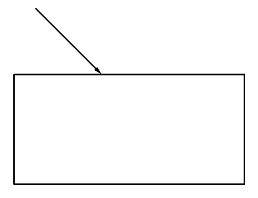
(i)
(ii)
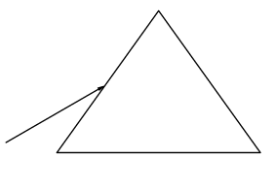
(iii)
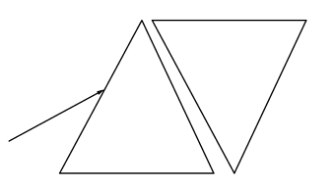
(b) There is a similarity between two of the emergent beams. Identify the two.
Answer
 Verified
519.3k+ views
Hint:We will use the concept of refraction and then try to draw the diagram of the behavior of the beam in the given three cases. Then, we will compare the emergent rays and conclude on which two of the emergent rays behave similarly, and finally, we will answer the second part of the question.
Complete answer:
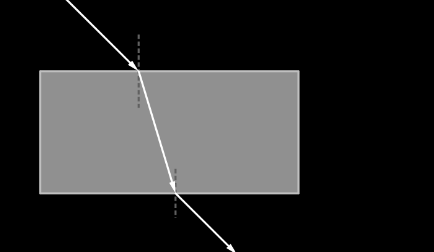
(a) We will answer the first question one by one. For the first situation, the beam will get refracted but the speed will not be varied to a great extent and thus the white light will not disperse into its component colors.
(i) In the first interface, the light changes its medium from an optically rarer to denser medium and thus will get deviated towards the normal, and reaching the second interface, the light changes its medium from an optically denser to a rarer medium and thus will emerge deviating away from the normal. Thus, the diagram for this will be.
(ii) Now, for the second case, the speed of the light gets varied enough that the white light gets dispersed into its component colors. In the first interface, the light changes its medium from an optically rarer to denser medium and thus will get deviated towards the normal, and reaching the second interface, the light changes its medium from an optically denser to a rarer medium and thus will emerge deviating away from the normal. Thus, the diagram will be.
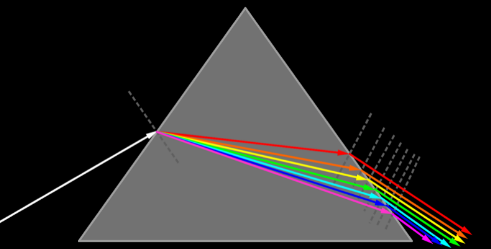
(iii) And,Finally, for the third case, the speed of the light gets varied enough that the white light gets dispersed into its component colors. Then again going to the second prism, the dispersed rays come so close and again refract such that the final emergent beam is white light.
In the first interface, the light changes its medium from an optically rarer to a denser medium and thus will get deviated towards the normal, and reaching the second interface, the light changes its medium from an optically denser to a rarer medium and thus will emerge deviating away from the normal.
Again, in the first interface of the second prism, the light changes its medium from an optically rarer to denser medium and thus will get deviated towards the normal and reaching the second interface, the light changes its medium from an optically denser to rarer medium and thus will emerge deviating away from the normal. Thus, the diagram is
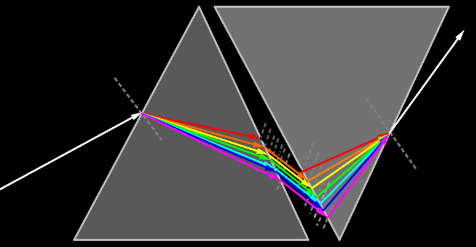
(b) Clearly, we can see that the emergent ray in the first and the third case is a white light and thus they are similar.
Note: Students should be very careful while drawing the diagram of the cases. Students make an error while drawing the refracted beams as they get confused whether the beam will move away from the normal or towards it.
Complete answer:
(a) We will answer the first question one by one. For the first situation, the beam will get refracted but the speed will not be varied to a great extent and thus the white light will not disperse into its component colors.
(i) In the first interface, the light changes its medium from an optically rarer to denser medium and thus will get deviated towards the normal, and reaching the second interface, the light changes its medium from an optically denser to a rarer medium and thus will emerge deviating away from the normal. Thus, the diagram for this will be.
(ii) Now, for the second case, the speed of the light gets varied enough that the white light gets dispersed into its component colors. In the first interface, the light changes its medium from an optically rarer to denser medium and thus will get deviated towards the normal, and reaching the second interface, the light changes its medium from an optically denser to a rarer medium and thus will emerge deviating away from the normal. Thus, the diagram will be.
(iii) And,Finally, for the third case, the speed of the light gets varied enough that the white light gets dispersed into its component colors. Then again going to the second prism, the dispersed rays come so close and again refract such that the final emergent beam is white light.
In the first interface, the light changes its medium from an optically rarer to a denser medium and thus will get deviated towards the normal, and reaching the second interface, the light changes its medium from an optically denser to a rarer medium and thus will emerge deviating away from the normal.
Again, in the first interface of the second prism, the light changes its medium from an optically rarer to denser medium and thus will get deviated towards the normal and reaching the second interface, the light changes its medium from an optically denser to rarer medium and thus will emerge deviating away from the normal. Thus, the diagram is
(b) Clearly, we can see that the emergent ray in the first and the third case is a white light and thus they are similar.
Note: Students should be very careful while drawing the diagram of the cases. Students make an error while drawing the refracted beams as they get confused whether the beam will move away from the normal or towards it.
Recently Updated Pages
Master Class 12 Business Studies: Engaging Questions & Answers for Success

Master Class 12 Biology: Engaging Questions & Answers for Success
Master Class 12 Chemistry: Engaging Questions & Answers for Success
Class 12 Question and Answer - Your Ultimate Solutions Guide
Master Class 11 Social Science: Engaging Questions & Answers for Success
Master Class 11 English: Engaging Questions & Answers for Success
Trending doubts
Explain the Treaty of Vienna of 1815 class 10 social science CBSE
Which Indian city is known as the "City of Victory"?
Which instrument is used to measure the Blood Pressure?
Who Won 36 Oscar Awards? Record Holder Revealed
What is the median of the first 10 natural numbers class 10 maths CBSE
Why is it 530 pm in india when it is 1200 afternoon class 10 social science CBSE