




A 4 cm cube is cut into 1 cm cubes. Calculate the total surface area of all the small cubes.
Answer
 Verified
642k+ views
Hint: Volume of a cube is \[{{a}^{3}}\] where \[a\] is the edge of the cube. So, we will calculate the volume of the cube for 4 cm and 1 cm and then use these two volumes to get the number of cubes of 1 cm edge.
Complete step-by-step answer:
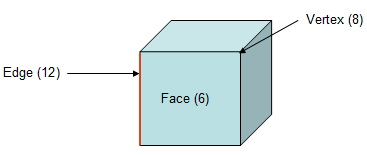
Before proceeding with the question we should know about cube. A cube is a three-dimensional solid object bounded by six square faces, facets or sides, with three meeting at each vertex. It has 6 faces, 12 edges, and 8 vertices.
Volume of a cube \[=V={{a}^{3}}........(1)\]
So now finding the volume of a 4 cm cube by putting \[a=4\,cm\] in equation (1) we get,
\[\Rightarrow V={{4}^{3}}=64\,c{{m}^{3}}..........(2)\]
As it is mentioned in the question that a 4 cm cube is cut into 1 cm cubes, so now finding the volume of a 1 cm cube by putting \[a=1\,cm\] in equation (1) we get,
\[\Rightarrow V={{1}^{3}}=1\,c{{m}^{3}}.........(3)\]
If we divide the volume of a 4 cm cube by the volume of a 1 cm cube we get the total number of 1 cm cubes. So for doing this, we divide equation (2) by equation (3) and we get,
Total number of 1 cm cubes \[=\dfrac{64}{1}=64.........(4)\]
Surface area of a cube \[=6\times {{a}^{2}}.......(5)\]
So now finding the surface area of a 1 cm cube by putting \[a=1\]cm in equation (5) we get,
Surface area of a 1 cm cube \[=6\times {{1}^{2}}=6\,c{{m}^{2}}.........(6)\]
Now by multiplying equation (4) with equation (6) we get,
Total surface area of all 64 small cubes \[=64\times 6\,c{{m}^{2}}=384\,c{{m}^{2}}\]
Hence the answer is \[384\,c{{m}^{2}}\].
Note: Remembering the formula of volume and surface area of a cube is the key here. We can make a mistake in a hurry in calculating the total number of 1 cm cubes. And as we are calculating area and unit of area is \[c{{m}^{2}}\] so we should not forget to write the unit otherwise marks will be deducted.
Complete step-by-step answer:
Before proceeding with the question we should know about cube. A cube is a three-dimensional solid object bounded by six square faces, facets or sides, with three meeting at each vertex. It has 6 faces, 12 edges, and 8 vertices.
Volume of a cube \[=V={{a}^{3}}........(1)\]
So now finding the volume of a 4 cm cube by putting \[a=4\,cm\] in equation (1) we get,
\[\Rightarrow V={{4}^{3}}=64\,c{{m}^{3}}..........(2)\]
As it is mentioned in the question that a 4 cm cube is cut into 1 cm cubes, so now finding the volume of a 1 cm cube by putting \[a=1\,cm\] in equation (1) we get,
\[\Rightarrow V={{1}^{3}}=1\,c{{m}^{3}}.........(3)\]
If we divide the volume of a 4 cm cube by the volume of a 1 cm cube we get the total number of 1 cm cubes. So for doing this, we divide equation (2) by equation (3) and we get,
Total number of 1 cm cubes \[=\dfrac{64}{1}=64.........(4)\]
Surface area of a cube \[=6\times {{a}^{2}}.......(5)\]
So now finding the surface area of a 1 cm cube by putting \[a=1\]cm in equation (5) we get,
Surface area of a 1 cm cube \[=6\times {{1}^{2}}=6\,c{{m}^{2}}.........(6)\]
Now by multiplying equation (4) with equation (6) we get,
Total surface area of all 64 small cubes \[=64\times 6\,c{{m}^{2}}=384\,c{{m}^{2}}\]
Hence the answer is \[384\,c{{m}^{2}}\].
Note: Remembering the formula of volume and surface area of a cube is the key here. We can make a mistake in a hurry in calculating the total number of 1 cm cubes. And as we are calculating area and unit of area is \[c{{m}^{2}}\] so we should not forget to write the unit otherwise marks will be deducted.
Recently Updated Pages
Master Class 12 Business Studies: Engaging Questions & Answers for Success

Master Class 12 Biology: Engaging Questions & Answers for Success
Master Class 12 Chemistry: Engaging Questions & Answers for Success
Class 12 Question and Answer - Your Ultimate Solutions Guide
Master Class 11 Social Science: Engaging Questions & Answers for Success
Master Class 11 English: Engaging Questions & Answers for Success
Trending doubts
Explain the Treaty of Vienna of 1815 class 10 social science CBSE
Which Indian city is known as the "City of Victory"?
Which instrument is used to measure the Blood Pressure?
Who Won 36 Oscar Awards? Record Holder Revealed
What is the median of the first 10 natural numbers class 10 maths CBSE
Why is it 530 pm in india when it is 1200 afternoon class 10 social science CBSE