




A 24 volt battery of internal resistance 4 ohm is connected to a variable resistor at what value of the current from the battery is the rate of heat produced in the resistor maximum ?
Answer
 Verified
532.5k+ views
Hint: To answer this question we will first find current using voltage, resistance and internal resistance. Then we will find power In the circuit, and then we will find the heat in the circuit using power and time. Then we will apply a condition to get the current required to get maximum heat in the circuit.
Formula used:
\[I = \dfrac{E}{{R + r}}\]
where \[I\] is current, \[E\] is the voltage, \[R\] is resistance and $r$ is internal resistance.
\[P = {I^2}R\]
Where \[P\]= power.
\[Q = {I^2}Rt\]
Where \[Q\] is heat and \[t\] is time.
Complete step by step answer:
Look at the following diagram:
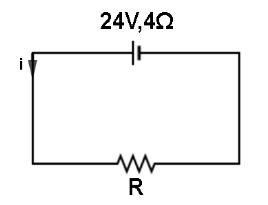
Using the formula for the current we get:
\[I = \dfrac{E}{{R + r}}\]
\[ \Rightarrow I = \dfrac{{24}}{{R + 4}}\]
Now we will find power: we know that electric power is the rate per unit time at which electrical energy is transferred by an electric circuit. Hence it is given mathematically as a product of square of current and resistance through the circuit,
\[P = {I^2}R\]
\[ \Rightarrow P = {\left( {\dfrac{{24}}{{R + 4}}} \right)^2}R\]
\[ \Rightarrow P = \dfrac{{{{24}^2}}}{{{{\left( {R + 4} \right)}^2}}}R\]
Now we will find heat: we know that heat is the form of energy that is transferred between two substances at different temperatures. But in terms of power heat is mathematically expressed as a product of power and time.
\[Q = {I^2}Rt\]
\[ \Rightarrow Q = P \times t\]
\[ \Rightarrow Q = \dfrac{{{{24}^2}}}{{{{\left( {R + 4} \right)}^2}}}R \times t\]
Now we want this heat to be maximum. Hence the condition will be that \[{\left( {R + 4} \right)^2}\] should be minimum.
\[ \Rightarrow Q = \dfrac{{{{24}^2}}}{{\left( {R + \dfrac{{16}}{R} + 8} \right)}}R \times t\]
Hence \[\left( {R + \dfrac{{16}}{R} + 8} \right)\] should be minimum. And for this to be minimum \[R = 4\Omega \]. Now we can easily find the current in the circuit. Current will be:
\[I = \dfrac{E}{{R + r}}\]
\[\Rightarrow I = \dfrac{{24}}{{4 + 4}}\]
\[\Rightarrow I = \dfrac{{24}}{8}\]
\[\therefore I = 3A\]
Hence a 24V battery will produce maximum heat when current through it is 3 amperes.
Note: We usually find current in a circuit by dividing potential by resistance, but here the cell itself has an internal resistance. Hence it should also be considered. hence Do not forget to consider internal resistance while finding current.
Formula used:
\[I = \dfrac{E}{{R + r}}\]
where \[I\] is current, \[E\] is the voltage, \[R\] is resistance and $r$ is internal resistance.
\[P = {I^2}R\]
Where \[P\]= power.
\[Q = {I^2}Rt\]
Where \[Q\] is heat and \[t\] is time.
Complete step by step answer:
Look at the following diagram:
Using the formula for the current we get:
\[I = \dfrac{E}{{R + r}}\]
\[ \Rightarrow I = \dfrac{{24}}{{R + 4}}\]
Now we will find power: we know that electric power is the rate per unit time at which electrical energy is transferred by an electric circuit. Hence it is given mathematically as a product of square of current and resistance through the circuit,
\[P = {I^2}R\]
\[ \Rightarrow P = {\left( {\dfrac{{24}}{{R + 4}}} \right)^2}R\]
\[ \Rightarrow P = \dfrac{{{{24}^2}}}{{{{\left( {R + 4} \right)}^2}}}R\]
Now we will find heat: we know that heat is the form of energy that is transferred between two substances at different temperatures. But in terms of power heat is mathematically expressed as a product of power and time.
\[Q = {I^2}Rt\]
\[ \Rightarrow Q = P \times t\]
\[ \Rightarrow Q = \dfrac{{{{24}^2}}}{{{{\left( {R + 4} \right)}^2}}}R \times t\]
Now we want this heat to be maximum. Hence the condition will be that \[{\left( {R + 4} \right)^2}\] should be minimum.
\[ \Rightarrow Q = \dfrac{{{{24}^2}}}{{\left( {R + \dfrac{{16}}{R} + 8} \right)}}R \times t\]
Hence \[\left( {R + \dfrac{{16}}{R} + 8} \right)\] should be minimum. And for this to be minimum \[R = 4\Omega \]. Now we can easily find the current in the circuit. Current will be:
\[I = \dfrac{E}{{R + r}}\]
\[\Rightarrow I = \dfrac{{24}}{{4 + 4}}\]
\[\Rightarrow I = \dfrac{{24}}{8}\]
\[\therefore I = 3A\]
Hence a 24V battery will produce maximum heat when current through it is 3 amperes.
Note: We usually find current in a circuit by dividing potential by resistance, but here the cell itself has an internal resistance. Hence it should also be considered. hence Do not forget to consider internal resistance while finding current.
Recently Updated Pages
Master Class 12 Business Studies: Engaging Questions & Answers for Success

Master Class 12 Biology: Engaging Questions & Answers for Success
Master Class 12 Chemistry: Engaging Questions & Answers for Success
Class 12 Question and Answer - Your Ultimate Solutions Guide
Master Class 11 Social Science: Engaging Questions & Answers for Success
Master Class 11 English: Engaging Questions & Answers for Success
Trending doubts
Ribosomal RNA is actively synthesised in A Nucleoplasm class 12 biology CBSE
How many molecules of ATP and NADPH are required information class 12 biology CBSE
The number of chromosomes in male grasshopper is a class 12 biology CBSE
Verhulst Pearl logistic growth described by the equation class 12 biology CBSE
Cry II Ab and cry I Ab produce toxins that control class 12 biology CBSE
Give reasons for the following Aquatic animals are class 12 chemistry CBSE