




A ${{2}^{0}}$ alcohol as shown can be obtained by the reaction of di-t-butyl ketone and:
a.) Isopropyl magnesium bromide
b.) t-butyl magnesium bromide
c.) EtMgBr
d.) MeMgBr
Answer
 Verified
589.2k+ views
Hint: Secondary alcohol is a compound in which the hydroxyl group that is a $-OH$ group is attached to a saturated carbon which also has two other carbons attached to it. A saturated carbon is a carbon which is bonded to other atoms by a single bond.
Complete step by step answer:
The di-t-butyl group is a bulky group and due to the steric hindrance of the di-t-butyl group in ketone the group containing bulky group or the group having beta hydrogen does not react with it which means that (${{3}^{0}}$) tertiary alcohol cannot be obtained.
But if there is transfer of hydride ion i.e. ${{H}^{-}}$ from the beta position of the RMgX group to the $C=O$group takes place then there is formation of cyclic transition state which produce secondary alcohol and alkene.
Hence MeMgBr does not react with di-t-butyl ketone which means that it will not produce secondary alcohol and alkene.
Reactions involves is shown below:
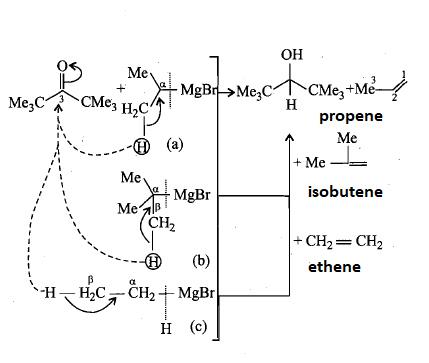
Hence the correct answer is option (A), option (B) and option (C) i.e. A ${{2}^{0}}$ alcohol can be obtained by the reaction of di-t-butyl ketone and, Isopropyl magnesium bromide, t-butyl magnesium bromide, EtMgBr.
So, the correct answer is “Option A,B and C”.
Note: Alcohol is a homologous series having the functional group $-OH$ also known as hydroxyl group. The general molecular formula for alcohols is ${{C}_{n}}{{H}_{2n+1}}OH$. The secondary alcohol isopropanol is a very important chemical which is used for the sustainable production of fuels and some other substances. Secondary alcohol can be oxidized to aldehydes and ketones using jones reagent.
Complete step by step answer:
The di-t-butyl group is a bulky group and due to the steric hindrance of the di-t-butyl group in ketone the group containing bulky group or the group having beta hydrogen does not react with it which means that (${{3}^{0}}$) tertiary alcohol cannot be obtained.
But if there is transfer of hydride ion i.e. ${{H}^{-}}$ from the beta position of the RMgX group to the $C=O$group takes place then there is formation of cyclic transition state which produce secondary alcohol and alkene.
Hence MeMgBr does not react with di-t-butyl ketone which means that it will not produce secondary alcohol and alkene.
Reactions involves is shown below:
Hence the correct answer is option (A), option (B) and option (C) i.e. A ${{2}^{0}}$ alcohol can be obtained by the reaction of di-t-butyl ketone and, Isopropyl magnesium bromide, t-butyl magnesium bromide, EtMgBr.
So, the correct answer is “Option A,B and C”.
Note: Alcohol is a homologous series having the functional group $-OH$ also known as hydroxyl group. The general molecular formula for alcohols is ${{C}_{n}}{{H}_{2n+1}}OH$. The secondary alcohol isopropanol is a very important chemical which is used for the sustainable production of fuels and some other substances. Secondary alcohol can be oxidized to aldehydes and ketones using jones reagent.
Recently Updated Pages
Basicity of sulphurous acid and sulphuric acid are

Master Class 12 English: Engaging Questions & Answers for Success
Master Class 12 Social Science: Engaging Questions & Answers for Success
Master Class 12 Maths: Engaging Questions & Answers for Success
Master Class 12 Economics: Engaging Questions & Answers for Success
Master Class 12 Physics: Engaging Questions & Answers for Success
Trending doubts
Which are the Top 10 Largest Countries of the World?
Draw a labelled sketch of the human eye class 12 physics CBSE
Draw ray diagrams each showing i myopic eye and ii class 12 physics CBSE
Give 10 examples of unisexual and bisexual flowers
Coming together federation is practiced in A India class 12 social science CBSE
How was the Civil Disobedience Movement different from class 12 social science CBSE