




9+0 arrangement is found in
(a) Flagellum
(b) Centriole
(c) Cilium
(d) Spindle fibers
Answer
 Verified
618.3k+ views
Hint: 9+0 arrangement is found in an organelle that is not present in plant cells. They are cylindrical structures and exist as pairs arranged perpendicularly to each other. They participate in the process of cell division.
Complete answer:
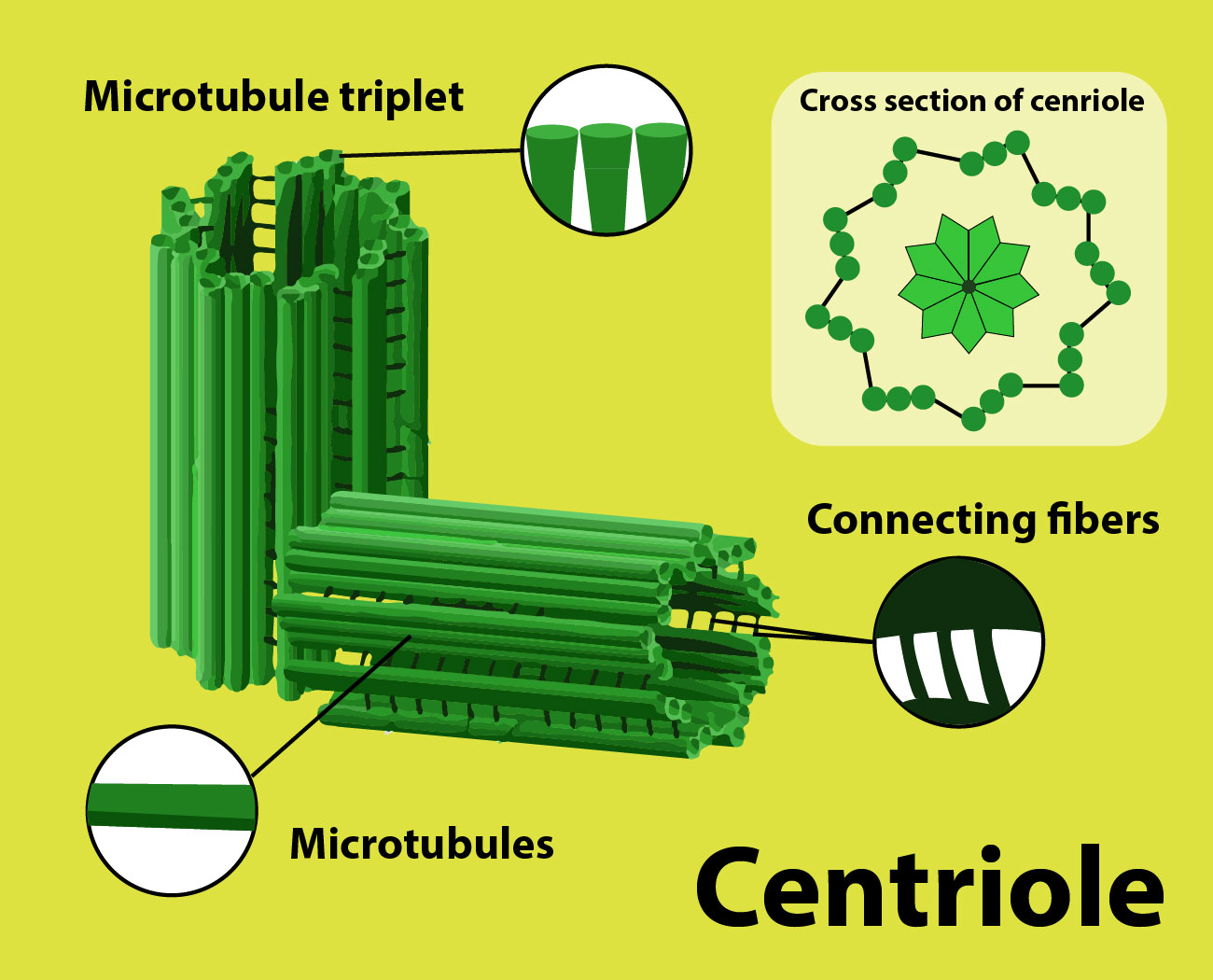
A centriole is a barrel-shaped polarized structure made up of microtubules. They are present mostly in animal cells and some fungi but not in plant cells. The walls of each centriole are composed of nine triplet microtubules arranged peripherally without any central microtubules. The central part of the centriole is proteinaceous and called the hub, which is connected with the peripheral triplets via radial spokes made up of protein. This is known as the 9+ 0 arrangement.
Additional Information: The cell organelle centrosome contains these perpendicularly arranged centrioles surrounded with a centrosome matrix.
-Prior to mitosis in animal cells, centrioles duplicate in a centrosome and later in the M-phase migrate to opposite poles. They initiate the process of bipolar spindle synthesis wherein they give rise to spindle fibers during cell division. They also form the basal body of cilia or flagella.
-Eukaryotic flagella and cilia share a common structural organization of 9+2 arrangement. Here, nine doublet microtubules are arranged peripherally surrounding a central pair of singlet microtubules. But they differ in length, number per cell, and even the beating pattern.
So, the correct answer is ‘Centrioles.’
Note: -A flagellum has a wave-like motion driving a cell in the same direction as the axis of the flagellum. A cilium generates alternating power and recovery strokes. These strokes move a cell perpendicular to the axis of the cilium.
-Cilia are many in number as compared to flagellum and occur all over the surface of the cell. A flagellum is usually longer and only 1-4 per cell.
Complete answer:
A centriole is a barrel-shaped polarized structure made up of microtubules. They are present mostly in animal cells and some fungi but not in plant cells. The walls of each centriole are composed of nine triplet microtubules arranged peripherally without any central microtubules. The central part of the centriole is proteinaceous and called the hub, which is connected with the peripheral triplets via radial spokes made up of protein. This is known as the 9+ 0 arrangement.
Additional Information: The cell organelle centrosome contains these perpendicularly arranged centrioles surrounded with a centrosome matrix.
-Prior to mitosis in animal cells, centrioles duplicate in a centrosome and later in the M-phase migrate to opposite poles. They initiate the process of bipolar spindle synthesis wherein they give rise to spindle fibers during cell division. They also form the basal body of cilia or flagella.
-Eukaryotic flagella and cilia share a common structural organization of 9+2 arrangement. Here, nine doublet microtubules are arranged peripherally surrounding a central pair of singlet microtubules. But they differ in length, number per cell, and even the beating pattern.
So, the correct answer is ‘Centrioles.’
Note: -A flagellum has a wave-like motion driving a cell in the same direction as the axis of the flagellum. A cilium generates alternating power and recovery strokes. These strokes move a cell perpendicular to the axis of the cilium.
-Cilia are many in number as compared to flagellum and occur all over the surface of the cell. A flagellum is usually longer and only 1-4 per cell.
Recently Updated Pages
Master Class 12 Economics: Engaging Questions & Answers for Success

Master Class 12 English: Engaging Questions & Answers for Success
Master Class 12 Social Science: Engaging Questions & Answers for Success
Master Class 12 Maths: Engaging Questions & Answers for Success
Master Class 12 Physics: Engaging Questions & Answers for Success
Master Class 9 General Knowledge: Engaging Questions & Answers for Success
Trending doubts
One Metric ton is equal to kg A 10000 B 1000 C 100 class 11 physics CBSE
Difference Between Prokaryotic Cells and Eukaryotic Cells
Two of the body parts which do not appear in MRI are class 11 biology CBSE
Find the value of the expression given below sin 30circ class 11 maths CBSE
1 ton equals to A 100 kg B 1000 kg C 10 kg D 10000 class 11 physics CBSE
Draw a diagram of nephron and explain its structur class 11 biology CBSE