




4 dice are thrown (the dice are regular). Find the probability for getting the following results.
(a) If 4 even results (not odd) are obtained such that all of them are greater than 3.
(b) If at least 2 even results (not odd) are obtained such that at least one result is equal to 6.
Answer
 Verified
544.8k+ views
Hint: We solve this problem by finding the total number of possible combinations we get when 4 dice are rolled. Then we find the possible values for each sub part asked in the question and then we use the formula of probability to get the required answer.
The standard formula probability is given as,
$P=\dfrac{\text{Number of possible outcomes}}{\text{Total number of outcomes}}$
Complete step-by-step solution:
We are told that 4 dice are rolled which are regular dice.
Let us assume that there are 4 boxes that represent the value outcome on each dice as follows,

We know that each dice has 6 numbers.
Here, we can see that each box has 6 possible outcomes.
Let us assume that the total number of outcomes when 4 dice are rolled as $T$ then we get the total outcomes as,
$\begin{align}
& \Rightarrow T=6\times 6\times 6\times 6 \\
& \Rightarrow T={{6}^{4}} \\
\end{align}$
Now, let us solve the first question.
(a) 4 even results are obtained in which all results are greater than 3.
We know that the even numbers on dice that are greater than 3 are 4 and 6.
Here, we can see that there is a possibility of repeating numbers such that each box has 2 possibilities.
Now, let us write the number of possibilities for each box in the box as,
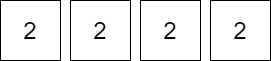
Now, let us assume that the number of possible outcomes in this condition as $X$ then we get the possible outcomes by using permutations as,
$\begin{align}
& \Rightarrow X=2\times 2\times 2\times 2 \\
& \Rightarrow X={{2}^{4}} \\
\end{align}$
Now, let us assume that he probability in this case as ${{P}_{1}}$
We know that the formula of probability of an event is given as,
$P=\dfrac{\text{Number of possible outcomes}}{\text{Total number of outcomes}}$
Now, by using this formula of probability we get the required probability for this first condition as,
$\begin{align}
& \Rightarrow {{P}_{1}}=\dfrac{X}{T} \\
& \Rightarrow {{P}_{1}}=\dfrac{{{2}^{4}}}{{{6}^{4}}} \\
\end{align}$
Here, we can see that the number ${{6}^{4}}$ can be represented as ${{2}^{4}}\times {{3}^{4}}$ then we get,
$\begin{align}
& \Rightarrow {{P}_{1}}=\dfrac{{{2}^{4}}}{{{2}^{4}}\times {{3}^{4}}} \\
& \Rightarrow {{P}_{1}}=\dfrac{1}{{{3}^{4}}}=\dfrac{1}{81} \\
\end{align}$
Therefore, we can conclude that the probability of getting all 4 even results which are greater than 3 is given as
$\therefore {{P}_{1}}=\dfrac{1}{81}$
(b) Getting at least 2 even results (not odd) such that at least one result is 6.
Here we can see that the outcomes are at least 2 even results without odd numbers which is the same as getting 4 even results which are either 2 or 4 or 6.
We are given that at least one result is 6.
Now, let us divide the number of possibilities to 4 parts as,
(1) Getting one result as 6.
Let us assume that the number of possibilities in this case as ${{y}_{1}}$
Here, we can see that the result 6 can be obtained in any dice.
So, we need to select one box from 4 boxes and give it as 6 and then 2 and 4 are arranged in the remaining three boxes.
We know that selection of $'r'$ objects from $'n'$ objects is given as ${}^{n}{{C}_{r}}$ where,
${}^{n}{{C}_{r}}=\dfrac{n!}{r!\left( n-r \right)!}$
By using this condition we get the number of ways of selecting 1 box from 4 boxes as ${}^{4}{{C}_{1}}$
Now, we can see that the remaining boxes have 2 possibilities so that by using the permutations for all sub cases we get the value of ${{y}_{1}}$ as,
$\begin{align}
& \Rightarrow {{y}_{1}}={}^{4}{{C}_{1}}\times 2\times 2\times 2 \\
& \Rightarrow {{y}_{1}}=\dfrac{4!}{1!\left( 3! \right)}\times 8 \\
& \Rightarrow {{y}_{1}}=4\times 8=32 \\
\end{align}$
(2) Getting two results as 6.
Let us assume that the number of possibilities in this case as ${{y}_{2}}$
Here, we can see that the result 6 can be obtained in any two dice.
So, we need to select two boxes from 4 boxes and give it as 6 and then 2 and 4 are arranged in the remaining two boxes.
By using the selection of objects we get the number of ways of selecting 2 boxes from 4 boxes as ${}^{4}{{C}_{2}}$
Now, we can see that the remaining boxes have 2 possibilities so that by using the permutations for all sub cases we get the value of ${{y}_{2}}$ as,
$\begin{align}
& \Rightarrow {{y}_{2}}={}^{4}{{C}_{2}}\times 2\times 2 \\
& \Rightarrow {{y}_{2}}=\dfrac{4!}{2!\left( 2! \right)}\times 4 \\
& \Rightarrow {{y}_{2}}=6\times 4=24 \\
\end{align}$
(2) Getting three results as 6.
Let us assume that the number of possibilities in this case as ${{y}_{3}}$
Here, we can see that the result 6 can be obtained in any three dice.
So, we need to select three boxes from 4 boxes and give it as 6 and then 2 and 4 are arranged in the remaining one box.
By using the selection of objects we get the number of ways of selecting 3 boxes from 4 boxes as ${}^{4}{{C}_{3}}$
Now, we can see that the remaining box have 2 possibilities so that by using the permutations for all sub cases we get the value of ${{y}_{3}}$ as,
$\begin{align}
& \Rightarrow {{y}_{3}}={}^{4}{{C}_{3}}\times 2 \\
& \Rightarrow {{y}_{3}}=\dfrac{4!}{3!\left( 1! \right)}\times 2 \\
& \Rightarrow {{y}_{3}}=4\times 2=8 \\
\end{align}$
(4) Getting all results as 6
Let us assume that the number of possibilities in this case as ${{y}_{4}}$
Here, we can see that getting 6 in all dice can be done in only one way so,
$\Rightarrow {{y}_{4}}=1$
Now, let us assume that the total number of possibilities in this case as $Y$ then we get,
$\begin{align}
& \Rightarrow Y={{y}_{1}}+{{y}_{2}}+{{y}_{3}}+{{y}_{4}} \\
& \Rightarrow Y=32+24+8+1 \\
& \Rightarrow Y=65 \\
\end{align}$
Now, let us assume that he probability in this case as ${{P}_{2}}$
Now, by using the formula of probability we get the required probability for this condition as,
$\begin{align}
& \Rightarrow {{P}_{2}}=\dfrac{Y}{T} \\
& \Rightarrow {{P}_{2}}=\dfrac{65}{{{6}^{4}}}=\dfrac{65}{1296} \\
\end{align}$
Therefore, we can conclude that the probability of getting at least 2 even results (not odd) in which at least one of the results is 6 is given as,
$\therefore {{P}_{2}}=\dfrac{65}{1296}$
Note: We can solve the second part of the question using some shortcut.
Let $E$ be the event of getting at least 2 even results (not odd) such that at least one result is 6.
Let us assume that possible outcomes as $Z$
Here, we can see that we can obtain the possible outcomes by subtracting the possible outcomes where there is no 6 from the possible outcomes of getting even results.
Let us find the possible outcomes of getting even numbers 2, 4 and 6.
Here, we can see that each box have 3 possibilities so that total possible values of getting even results is ${{3}^{4}}$
Now, let us find the possible outcomes of not getting 6.
Here, we can see that each box have 2 possibilities either 2 or 4 so that the possible outcomes of not getting 6 is ${{2}^{4}}$
Now, by using the above condition of total possible outcomes in this case we get the value of $Z$ as,
$\begin{align}
& \Rightarrow Z={{3}^{4}}-{{2}^{4}} \\
& \Rightarrow Z=81-16 \\
& \Rightarrow Z=65 \\
\end{align}$
Now, let us assume that he probability in this case as $P\left( E \right)$
Now, by using the formula of probability we get the required probability for this condition as,
\[\begin{align}
& \Rightarrow P\left( E \right)=\dfrac{Z}{T} \\
& \Rightarrow P\left( E \right)=\dfrac{65}{{{6}^{4}}}=\dfrac{65}{1296} \\
\end{align}\]
Therefore, we can conclude that the probability of getting at least 2 even results (not odd) in which at least one of the results is 6 is given as,
$\therefore P\left( E \right)=\dfrac{65}{1296}$
The standard formula probability is given as,
$P=\dfrac{\text{Number of possible outcomes}}{\text{Total number of outcomes}}$
Complete step-by-step solution:
We are told that 4 dice are rolled which are regular dice.
Let us assume that there are 4 boxes that represent the value outcome on each dice as follows,
We know that each dice has 6 numbers.
Here, we can see that each box has 6 possible outcomes.
Let us assume that the total number of outcomes when 4 dice are rolled as $T$ then we get the total outcomes as,
$\begin{align}
& \Rightarrow T=6\times 6\times 6\times 6 \\
& \Rightarrow T={{6}^{4}} \\
\end{align}$
Now, let us solve the first question.
(a) 4 even results are obtained in which all results are greater than 3.
We know that the even numbers on dice that are greater than 3 are 4 and 6.
Here, we can see that there is a possibility of repeating numbers such that each box has 2 possibilities.
Now, let us write the number of possibilities for each box in the box as,
Now, let us assume that the number of possible outcomes in this condition as $X$ then we get the possible outcomes by using permutations as,
$\begin{align}
& \Rightarrow X=2\times 2\times 2\times 2 \\
& \Rightarrow X={{2}^{4}} \\
\end{align}$
Now, let us assume that he probability in this case as ${{P}_{1}}$
We know that the formula of probability of an event is given as,
$P=\dfrac{\text{Number of possible outcomes}}{\text{Total number of outcomes}}$
Now, by using this formula of probability we get the required probability for this first condition as,
$\begin{align}
& \Rightarrow {{P}_{1}}=\dfrac{X}{T} \\
& \Rightarrow {{P}_{1}}=\dfrac{{{2}^{4}}}{{{6}^{4}}} \\
\end{align}$
Here, we can see that the number ${{6}^{4}}$ can be represented as ${{2}^{4}}\times {{3}^{4}}$ then we get,
$\begin{align}
& \Rightarrow {{P}_{1}}=\dfrac{{{2}^{4}}}{{{2}^{4}}\times {{3}^{4}}} \\
& \Rightarrow {{P}_{1}}=\dfrac{1}{{{3}^{4}}}=\dfrac{1}{81} \\
\end{align}$
Therefore, we can conclude that the probability of getting all 4 even results which are greater than 3 is given as
$\therefore {{P}_{1}}=\dfrac{1}{81}$
(b) Getting at least 2 even results (not odd) such that at least one result is 6.
Here we can see that the outcomes are at least 2 even results without odd numbers which is the same as getting 4 even results which are either 2 or 4 or 6.
We are given that at least one result is 6.
Now, let us divide the number of possibilities to 4 parts as,
(1) Getting one result as 6.
Let us assume that the number of possibilities in this case as ${{y}_{1}}$
Here, we can see that the result 6 can be obtained in any dice.
So, we need to select one box from 4 boxes and give it as 6 and then 2 and 4 are arranged in the remaining three boxes.
We know that selection of $'r'$ objects from $'n'$ objects is given as ${}^{n}{{C}_{r}}$ where,
${}^{n}{{C}_{r}}=\dfrac{n!}{r!\left( n-r \right)!}$
By using this condition we get the number of ways of selecting 1 box from 4 boxes as ${}^{4}{{C}_{1}}$
Now, we can see that the remaining boxes have 2 possibilities so that by using the permutations for all sub cases we get the value of ${{y}_{1}}$ as,
$\begin{align}
& \Rightarrow {{y}_{1}}={}^{4}{{C}_{1}}\times 2\times 2\times 2 \\
& \Rightarrow {{y}_{1}}=\dfrac{4!}{1!\left( 3! \right)}\times 8 \\
& \Rightarrow {{y}_{1}}=4\times 8=32 \\
\end{align}$
(2) Getting two results as 6.
Let us assume that the number of possibilities in this case as ${{y}_{2}}$
Here, we can see that the result 6 can be obtained in any two dice.
So, we need to select two boxes from 4 boxes and give it as 6 and then 2 and 4 are arranged in the remaining two boxes.
By using the selection of objects we get the number of ways of selecting 2 boxes from 4 boxes as ${}^{4}{{C}_{2}}$
Now, we can see that the remaining boxes have 2 possibilities so that by using the permutations for all sub cases we get the value of ${{y}_{2}}$ as,
$\begin{align}
& \Rightarrow {{y}_{2}}={}^{4}{{C}_{2}}\times 2\times 2 \\
& \Rightarrow {{y}_{2}}=\dfrac{4!}{2!\left( 2! \right)}\times 4 \\
& \Rightarrow {{y}_{2}}=6\times 4=24 \\
\end{align}$
(2) Getting three results as 6.
Let us assume that the number of possibilities in this case as ${{y}_{3}}$
Here, we can see that the result 6 can be obtained in any three dice.
So, we need to select three boxes from 4 boxes and give it as 6 and then 2 and 4 are arranged in the remaining one box.
By using the selection of objects we get the number of ways of selecting 3 boxes from 4 boxes as ${}^{4}{{C}_{3}}$
Now, we can see that the remaining box have 2 possibilities so that by using the permutations for all sub cases we get the value of ${{y}_{3}}$ as,
$\begin{align}
& \Rightarrow {{y}_{3}}={}^{4}{{C}_{3}}\times 2 \\
& \Rightarrow {{y}_{3}}=\dfrac{4!}{3!\left( 1! \right)}\times 2 \\
& \Rightarrow {{y}_{3}}=4\times 2=8 \\
\end{align}$
(4) Getting all results as 6
Let us assume that the number of possibilities in this case as ${{y}_{4}}$
Here, we can see that getting 6 in all dice can be done in only one way so,
$\Rightarrow {{y}_{4}}=1$
Now, let us assume that the total number of possibilities in this case as $Y$ then we get,
$\begin{align}
& \Rightarrow Y={{y}_{1}}+{{y}_{2}}+{{y}_{3}}+{{y}_{4}} \\
& \Rightarrow Y=32+24+8+1 \\
& \Rightarrow Y=65 \\
\end{align}$
Now, let us assume that he probability in this case as ${{P}_{2}}$
Now, by using the formula of probability we get the required probability for this condition as,
$\begin{align}
& \Rightarrow {{P}_{2}}=\dfrac{Y}{T} \\
& \Rightarrow {{P}_{2}}=\dfrac{65}{{{6}^{4}}}=\dfrac{65}{1296} \\
\end{align}$
Therefore, we can conclude that the probability of getting at least 2 even results (not odd) in which at least one of the results is 6 is given as,
$\therefore {{P}_{2}}=\dfrac{65}{1296}$
Note: We can solve the second part of the question using some shortcut.
Let $E$ be the event of getting at least 2 even results (not odd) such that at least one result is 6.
Let us assume that possible outcomes as $Z$
Here, we can see that we can obtain the possible outcomes by subtracting the possible outcomes where there is no 6 from the possible outcomes of getting even results.
Let us find the possible outcomes of getting even numbers 2, 4 and 6.
Here, we can see that each box have 3 possibilities so that total possible values of getting even results is ${{3}^{4}}$
Now, let us find the possible outcomes of not getting 6.
Here, we can see that each box have 2 possibilities either 2 or 4 so that the possible outcomes of not getting 6 is ${{2}^{4}}$
Now, by using the above condition of total possible outcomes in this case we get the value of $Z$ as,
$\begin{align}
& \Rightarrow Z={{3}^{4}}-{{2}^{4}} \\
& \Rightarrow Z=81-16 \\
& \Rightarrow Z=65 \\
\end{align}$
Now, let us assume that he probability in this case as $P\left( E \right)$
Now, by using the formula of probability we get the required probability for this condition as,
\[\begin{align}
& \Rightarrow P\left( E \right)=\dfrac{Z}{T} \\
& \Rightarrow P\left( E \right)=\dfrac{65}{{{6}^{4}}}=\dfrac{65}{1296} \\
\end{align}\]
Therefore, we can conclude that the probability of getting at least 2 even results (not odd) in which at least one of the results is 6 is given as,
$\therefore P\left( E \right)=\dfrac{65}{1296}$
Recently Updated Pages
Master Class 11 Social Science: Engaging Questions & Answers for Success

Master Class 11 Physics: Engaging Questions & Answers for Success
Master Class 11 Maths: Engaging Questions & Answers for Success
Master Class 11 Economics: Engaging Questions & Answers for Success
Master Class 11 Computer Science: Engaging Questions & Answers for Success
Master Class 11 Chemistry: Engaging Questions & Answers for Success
Trending doubts
One Metric ton is equal to kg A 10000 B 1000 C 100 class 11 physics CBSE
There are 720 permutations of the digits 1 2 3 4 5 class 11 maths CBSE
1 Quintal is equal to a 110 kg b 10 kg c 100kg d 1000 class 11 physics CBSE
State and prove Bernoullis theorem class 11 physics CBSE
Difference Between Prokaryotic Cells and Eukaryotic Cells
Which among the following are examples of coming together class 11 social science CBSE