




When 1-iodo-1-methylcyclohexane is treated with $ NaOC{H_2}C{H_3} $ as the base, the more highly substituted alkene product predominates. When $ KOC{(C{H_3})_3} $ is used as the base, then less substituted alkene predominates. Why? What are the structures of the two products?
Answer
 Verified
561.6k+ views
Hint: Steric effects are the nonbonding interactions which influence the conformation and reactivity of the ions and molecules in a chemical reaction. The products in the elimination reaction are influenced by the steric effect of the base considered in the reaction and form products accordingly.
Complete answer:
The product in the given reaction conditions follows Saytzeff’s rule and Hoffman rule. Saytzeff’s rule states that in an elimination reaction, the more substituted alkene is most favoured. But, steric interaction within the substrate prevents the formation of Saytzeff product and in that case, the formation of least substituted alkene takes place which is referred to as the Hoffman rule.
Now, as per question, the two bases considered in the reaction are $ NaOC{H_2}C{H_3} $ and $ KOC{(C{H_3})_3} $ . The ethoxide ion i.e., $ C{H_3}C{H_2}{O^ - } $ is small and sterically unhindered while the tertiary butoxide ion i.e., $ (C{H_3})C{O^ - } $ is bulky and sterically hindered.
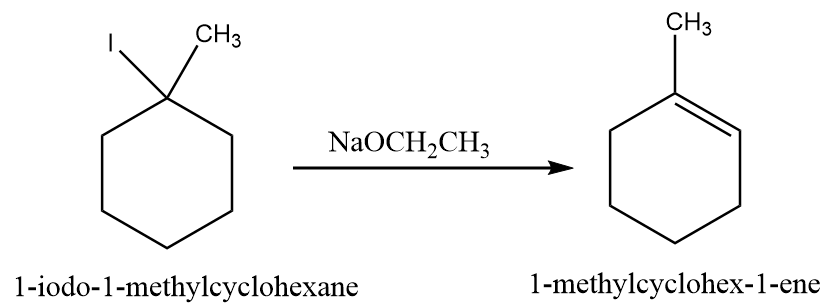
Thus, in case of $ NaOC{H_2}C{H_3} $ , the product is formed as per Saytzeff’s rule and the reaction takes place as follows:
While in case of $ KOC{(C{H_3})_3} $ , the product is formed as per Hoffman’s rule and the reaction takes place as follows:
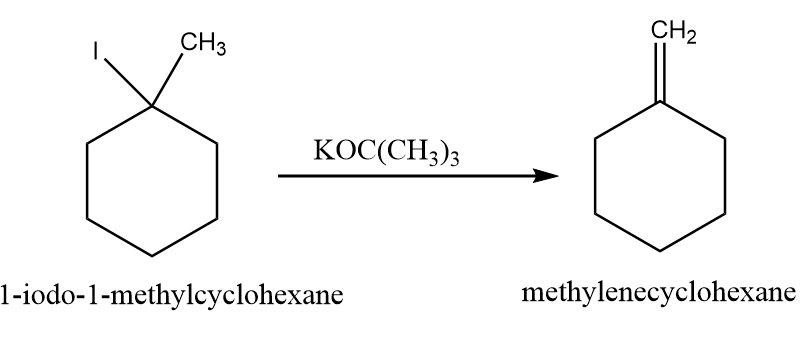
Hence, due to steric hindrance, $ NaOC{H_2}C{H_3} $ favours more substituted alkene whereas when $ KOC{(C{H_3})_3} $ is taken as base, then less substituted alkene predominates and the products formed in both the case are 1-methylcyclohex-1-ene and methylenecyclohexane respectively.
Note:
It is important to note that the elimination reactions are always regioselective, that means the products formed in the reaction are constitutional isomers to each other. During the reaction, the more stable product (either Saytzeff or Hoffman as per reaction conditions) is major while its less stable constitutional isomer is considered as a minor product.
Complete answer:
The product in the given reaction conditions follows Saytzeff’s rule and Hoffman rule. Saytzeff’s rule states that in an elimination reaction, the more substituted alkene is most favoured. But, steric interaction within the substrate prevents the formation of Saytzeff product and in that case, the formation of least substituted alkene takes place which is referred to as the Hoffman rule.
Now, as per question, the two bases considered in the reaction are $ NaOC{H_2}C{H_3} $ and $ KOC{(C{H_3})_3} $ . The ethoxide ion i.e., $ C{H_3}C{H_2}{O^ - } $ is small and sterically unhindered while the tertiary butoxide ion i.e., $ (C{H_3})C{O^ - } $ is bulky and sterically hindered.
Thus, in case of $ NaOC{H_2}C{H_3} $ , the product is formed as per Saytzeff’s rule and the reaction takes place as follows:
While in case of $ KOC{(C{H_3})_3} $ , the product is formed as per Hoffman’s rule and the reaction takes place as follows:
Hence, due to steric hindrance, $ NaOC{H_2}C{H_3} $ favours more substituted alkene whereas when $ KOC{(C{H_3})_3} $ is taken as base, then less substituted alkene predominates and the products formed in both the case are 1-methylcyclohex-1-ene and methylenecyclohexane respectively.
Note:
It is important to note that the elimination reactions are always regioselective, that means the products formed in the reaction are constitutional isomers to each other. During the reaction, the more stable product (either Saytzeff or Hoffman as per reaction conditions) is major while its less stable constitutional isomer is considered as a minor product.
Recently Updated Pages
If x a + bt + ct2 where x is in meters and t is in class 11 physics CBSE

A car covers the first half distance between two places class 11 physics CBSE
The resultant of two vectors overrightarrow P and overrightarrow class 11 physics CBSE
Find the value of cos 135 class 11 maths CBSE
A mass M is held in place by an applied force F and class 11 physics CBSE
A solution of glucose in water is labelled as 10 dfracwv class 11 chemistry CBSE
Trending doubts
One Metric ton is equal to kg A 10000 B 1000 C 100 class 11 physics CBSE
Find the value of the expression given below sin 30circ class 11 maths CBSE
Draw a diagram of nephron and explain its structur class 11 biology CBSE
10 examples of friction in our daily life
Proton was discovered by A Thomson B Rutherford C Chadwick class 11 chemistry CBSE
Bond order ofO2 O2+ O2 and O22 is in order A O2 langle class 11 chemistry CBSE