



When ${{1}}{{.20 g}}$ of sulfur is melted with ${{15 g}}$ of naphthalene, the solution freezes at ${{77}}{{.2^\circ C}}$. What is the molar mass of this form of sulfur?
Data of naphthalene:
Melting point , M.P = ${{80^\circ C}}$
Freezing point depression constant : ${{{K}}_{{f}}}{{ = 6}}{{.80^\circ C }}{{{m}}^{{{ - 1}}}}$
(A) ${{180 g mo}}{{{l}}^{{{ - 1}}}}$
(B) ${{194 g mo}}{{{l}}^{{{ - 1}}}}$
(C) ${{260 g mo}}{{{l}}^{{{ - 1}}}}$
(D) ${{450 g mo}}{{{l}}^{{{ - 1}}}}$
Answer
 Verified
569.7k+ views
Hint: When we mix a solute in solvent there is a change in some properties of the solution. One of them is the freezing point of the solution which changes. There are many colligative properties of a solution that changes.
Complete answer:
we mix a non-volatile solute in water there is a change in the colligative properties of the solution. Colligative properties are the properties which depend on the number of particles like ions or molecules or atoms of the solute in a definite amount of solvent but not on the nature of the solute. The most important change that occurs is a decrease of vapor pressure. This decrease in vapour occurs due to reduction of the surface area of the solvent molecules which are occupied by the solute particles. So, when the surface area of the solvent molecules decrease the number of solvent molecules escaping from the surface is also decreased which leads to decrease in the vapour pressure.
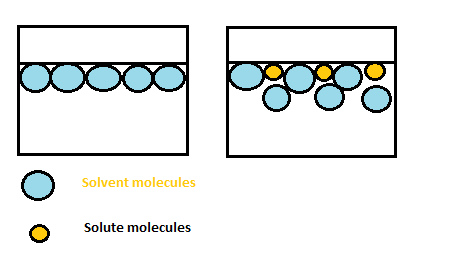
The question asks about the freezing point. Freezing point decreases when we mix solute in solvent because of lowering in vapour pressure. We know that freezing point is the temperature at which the vapour pressure of the substance in its liquid phase is equal to the vapour pressure in its solid phase. A solution will freeze when its vapour pressure will be equal to vapour pressure of the pure solvent. So, given the Raoult's law it is stated that when a non-volatile solute is added to the solvent its vapour pressure will decrease and it will become equal to that of the solid solvent at low temperature. Thus, the freezing point of the solvent decreases.
Let the ${{{T}}_{{f}}}{{^\circ }}$ be the freezing point of the pure solvent and ${{{T}}_{{f}}}$be the freezing point of the solution when non-volatile solute is added. So the decrease in the freezing point will be
${{\Delta }}{{{T}}_{{f}}}{{ = }}{{{T}}_{{f}}}{{^\circ - }}{{{T}}_{{f}}}$
This is known as depression in the freezing point.
The depression of freezing point is directly proportional to molarity of the solution
${{\Delta }}{{{T}}_{{f}}}{{ }} \propto {{ molality}}$
after removing proportionality constant, a new constant is added ${{\Delta }}{{{T}}_{{f}}}{{ = }}{{{K}}_{{f}}}{{ \times m}}$
Here ${{{K}}_{{f}}}$ is called the Freezing point depression constant or Cryoscopy constant which depends on nature of solvent,
We know that molality of a solution is ${{molality(m) = }}\dfrac{{{{{w}}_{{2}}}{{ \times 1000}}}}{{{{{m}}_{{2}}}{{ \times }}{{{w}}_{{1}}}}}$
here ${{{w}}_{{2}}}$ =mass of solute
${{{w}}_{{1}}}$ = mass of solvent
${{{M}}_{{2}}}$ = molar mass of solute
and 1000 is used if the mass of solvent $W_1$ is in grams so we convert it into Kg.
So, after substituting molality equation we get the depression in freezing point.
${{\Delta }}{{{T}}_{{f}}}{{ = }}\dfrac{{{{1000 \times }}{{{K}}_{{f}}}{{ \times }}{{{w}}_{{2}}}}}{{{{{M}}_{{2}}}{{ \times }}{{{w}}_{{1}}}}}$
So in question it is given
weight of sulfur ($w_2$)= ${{1}}{{.20 g}}$
weight of naphthalene ($W_1$) = ${{15 g}}$
cryoscopic constant ( $K_f$ ) = ${{6}}{{.80 C g mo}}{{{l}}^{{{ - 1}}}}$
here ${{{T}}_{{f}}}^{{^\circ }}$ (naphthalene freezing point) = ${{80^\circ C}}$
so ${{\Delta }}{{{T}}_{{f}}}{{ = 80 - 77}}{{.2}}$
${{\Delta }}{{{T}}_{{f}}}{{ = 2}}{{.8^\circ C}}$
${{{M}}_{{2}}}{{ = }}\dfrac{{{{1000 \times }}{{{K}}_{{f}}}{{ \times }}{{{w}}_{{2}}}}}{{{{\Delta }}{{{T}}_{{f}}}{{ \times }}{{{w}}_{{1}}}}}$
${{{M}}_{{2}}}{{ = }}\dfrac{{{{1000 \times 6}}{{.8 \times 1}}{{.2}}}}{{{{2}}{{.8 \times 15}}}}{{ = 194}}{{.3 g mo}}{{{l}}^{{{ - 1}}}}$
Hence, the correct answer is option B.
Additional information:
There are many properties connected to decrease in vapour pressure which also changes. Ex: Relative lowering in vapour pressure, elevation in boiling point, depression in freezing point and osmotic pressure
Note: Here confusion is created about using 1000 in molality so it is recommended to provide attention on the unit of mass of solvent. If mass of solvent is substituted in grams then 1000 will be used. If mass of solvent is used in Kg then 1000 is omitted.
Complete answer:
we mix a non-volatile solute in water there is a change in the colligative properties of the solution. Colligative properties are the properties which depend on the number of particles like ions or molecules or atoms of the solute in a definite amount of solvent but not on the nature of the solute. The most important change that occurs is a decrease of vapor pressure. This decrease in vapour occurs due to reduction of the surface area of the solvent molecules which are occupied by the solute particles. So, when the surface area of the solvent molecules decrease the number of solvent molecules escaping from the surface is also decreased which leads to decrease in the vapour pressure.
The question asks about the freezing point. Freezing point decreases when we mix solute in solvent because of lowering in vapour pressure. We know that freezing point is the temperature at which the vapour pressure of the substance in its liquid phase is equal to the vapour pressure in its solid phase. A solution will freeze when its vapour pressure will be equal to vapour pressure of the pure solvent. So, given the Raoult's law it is stated that when a non-volatile solute is added to the solvent its vapour pressure will decrease and it will become equal to that of the solid solvent at low temperature. Thus, the freezing point of the solvent decreases.
Let the ${{{T}}_{{f}}}{{^\circ }}$ be the freezing point of the pure solvent and ${{{T}}_{{f}}}$be the freezing point of the solution when non-volatile solute is added. So the decrease in the freezing point will be
${{\Delta }}{{{T}}_{{f}}}{{ = }}{{{T}}_{{f}}}{{^\circ - }}{{{T}}_{{f}}}$
This is known as depression in the freezing point.
The depression of freezing point is directly proportional to molarity of the solution
${{\Delta }}{{{T}}_{{f}}}{{ }} \propto {{ molality}}$
after removing proportionality constant, a new constant is added ${{\Delta }}{{{T}}_{{f}}}{{ = }}{{{K}}_{{f}}}{{ \times m}}$
Here ${{{K}}_{{f}}}$ is called the Freezing point depression constant or Cryoscopy constant which depends on nature of solvent,
We know that molality of a solution is ${{molality(m) = }}\dfrac{{{{{w}}_{{2}}}{{ \times 1000}}}}{{{{{m}}_{{2}}}{{ \times }}{{{w}}_{{1}}}}}$
here ${{{w}}_{{2}}}$ =mass of solute
${{{w}}_{{1}}}$ = mass of solvent
${{{M}}_{{2}}}$ = molar mass of solute
and 1000 is used if the mass of solvent $W_1$ is in grams so we convert it into Kg.
So, after substituting molality equation we get the depression in freezing point.
${{\Delta }}{{{T}}_{{f}}}{{ = }}\dfrac{{{{1000 \times }}{{{K}}_{{f}}}{{ \times }}{{{w}}_{{2}}}}}{{{{{M}}_{{2}}}{{ \times }}{{{w}}_{{1}}}}}$
So in question it is given
weight of sulfur ($w_2$)= ${{1}}{{.20 g}}$
weight of naphthalene ($W_1$) = ${{15 g}}$
cryoscopic constant ( $K_f$ ) = ${{6}}{{.80 C g mo}}{{{l}}^{{{ - 1}}}}$
here ${{{T}}_{{f}}}^{{^\circ }}$ (naphthalene freezing point) = ${{80^\circ C}}$
so ${{\Delta }}{{{T}}_{{f}}}{{ = 80 - 77}}{{.2}}$
${{\Delta }}{{{T}}_{{f}}}{{ = 2}}{{.8^\circ C}}$
${{{M}}_{{2}}}{{ = }}\dfrac{{{{1000 \times }}{{{K}}_{{f}}}{{ \times }}{{{w}}_{{2}}}}}{{{{\Delta }}{{{T}}_{{f}}}{{ \times }}{{{w}}_{{1}}}}}$
${{{M}}_{{2}}}{{ = }}\dfrac{{{{1000 \times 6}}{{.8 \times 1}}{{.2}}}}{{{{2}}{{.8 \times 15}}}}{{ = 194}}{{.3 g mo}}{{{l}}^{{{ - 1}}}}$
Hence, the correct answer is option B.
Additional information:
There are many properties connected to decrease in vapour pressure which also changes. Ex: Relative lowering in vapour pressure, elevation in boiling point, depression in freezing point and osmotic pressure
Note: Here confusion is created about using 1000 in molality so it is recommended to provide attention on the unit of mass of solvent. If mass of solvent is substituted in grams then 1000 will be used. If mass of solvent is used in Kg then 1000 is omitted.
Recently Updated Pages
Basicity of sulphurous acid and sulphuric acid are

Master Class 12 English: Engaging Questions & Answers for Success
Master Class 12 Social Science: Engaging Questions & Answers for Success
Master Class 12 Maths: Engaging Questions & Answers for Success
Master Class 12 Economics: Engaging Questions & Answers for Success
Master Class 12 Physics: Engaging Questions & Answers for Success
Trending doubts
Which are the Top 10 Largest Countries of the World?
Draw a labelled sketch of the human eye class 12 physics CBSE
Draw ray diagrams each showing i myopic eye and ii class 12 physics CBSE
Giving reasons state the signs positive or negative class 12 physics CBSE
Explain esterification reaction with the help of a class 12 chemistry CBSE
What is defined as a solenoid Depict a diagram with class 12 physics CBSE