




When $0.2M$ acetic acid is neutralized with $0.1M$ NaOH in $0.5$ liters of water, the resultant solution is slightly alkaline. Calculate the pH of the resulting solution given that ${K_a}$ for $C{H_3}COOH = 1.8 \times {10^{ - 5}}$
Answer
 Verified
579.6k+ views
Hint:The reaction between acetic acid and sodium hydroxide produces sodium acetate and water. Calculate the amount of sodium acetate and water produced in this reaction and find the concentration of sodium acetate accordingly. Now calculate the value of hydrolysis constant or ${K_h}$ to find the pH value.
Complete step-by-step solution:The above reaction between acetic acid and sodium hydroxide can be written as follows.
$C{H_3}COOH + NaOH \rightleftarrows C{H_3}COONa + {H_2}O$
$0.2M$ of acetic acid would give $0.2M$ of sodium acetate and $0.5$ liters of water. So the concentration of sodium acetate would be $0.1mol{L^{ - 1}}$
Given to us the association constant of acetic acid as ${K_a} = 1.8 \times {10^{ - 5}}$
Let us write the association reaction for acetic acid $C{H_3}CO{O^ - } + {H_2}O \rightleftarrows C{H_3}COOH + O{H^ - }$
For the above equilibrium reaction, we can write the concentrations as:
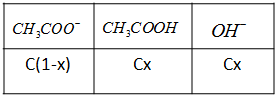
From this, we can write the value of hydrolysis constant as ${K_h} = \dfrac{{Cx \times Cx}}{{C\left( {1 - x} \right)}} = \dfrac{{C{x^2}}}{{1 - x}}$
Since the value of x is extremely small, we can approximate the value of $1 - x$ to be $1$ and hence the equation becomes ${K_h} = C{x^2}$
Now, we know that ${K_h} = \dfrac{{{K_w}}}{{{K_a}}}$ where ${K_w} = {10^{ - 14}}$ and the ${K_a}$ value is already given. By substituting these values, we get ${K_h} = \dfrac{{{{10}^{ - 14}}}}{{1.8 \times {{10}^{ - 5}}}} = 0.55 \times {10^{ - 9}}$
From this, we can write $C{x^2} = 0.55 \times {10^{ - 9}}$
We have already calculated the concentration as $0.1mol{L^{ - 1}}$ and by substituting this, we get ${x^2} = 5.5 \times {10^{ - 9}}$
This gives $x = 7.42 \times {10^{ - 5}}$
From the above table, the concentration of $O{H^ - }$ is $Cx = 0.1 \times 7.42 \times {10^{ - 5}} = 7.42 \times {10^{ - 6}}$
We know that the product of concentration of ${H^ + }$ and $O{H^ - }$ of a solution gives the value of dissociation constant of water.
$\left[ {{H^ + }} \right]\left[ {O{H^ - }} \right] = {K_w}$
From this, we can calculate the concentration of ${H^ + }$ as $\left[ {{H^ + }} \right] = \dfrac{{{K_w}}}{{\left[ {O{H^ - }} \right]}} = \dfrac{{{{10}^{ - 14}}}}{{7.42 \times {{10}^{ - 6}}}} = 1.347 \times {10^{ - 9}}M$
Now we can calculate the pH value as $ - \log \left[ {{H^ + }} \right] = 8.87$
Hence the pH value is $8.87$
Note: It is to be noted that we can also find the value of pOH first and derive the value of pH. This is because of the relation $pH + pOH = 14$ and hence the value of pH can be calculated. Therefore the pOH of this solution would be $14 - pH$ which is $14 - 8.87 = 5.13$ .
Complete step-by-step solution:The above reaction between acetic acid and sodium hydroxide can be written as follows.
$C{H_3}COOH + NaOH \rightleftarrows C{H_3}COONa + {H_2}O$
$0.2M$ of acetic acid would give $0.2M$ of sodium acetate and $0.5$ liters of water. So the concentration of sodium acetate would be $0.1mol{L^{ - 1}}$
Given to us the association constant of acetic acid as ${K_a} = 1.8 \times {10^{ - 5}}$
Let us write the association reaction for acetic acid $C{H_3}CO{O^ - } + {H_2}O \rightleftarrows C{H_3}COOH + O{H^ - }$
For the above equilibrium reaction, we can write the concentrations as:
From this, we can write the value of hydrolysis constant as ${K_h} = \dfrac{{Cx \times Cx}}{{C\left( {1 - x} \right)}} = \dfrac{{C{x^2}}}{{1 - x}}$
Since the value of x is extremely small, we can approximate the value of $1 - x$ to be $1$ and hence the equation becomes ${K_h} = C{x^2}$
Now, we know that ${K_h} = \dfrac{{{K_w}}}{{{K_a}}}$ where ${K_w} = {10^{ - 14}}$ and the ${K_a}$ value is already given. By substituting these values, we get ${K_h} = \dfrac{{{{10}^{ - 14}}}}{{1.8 \times {{10}^{ - 5}}}} = 0.55 \times {10^{ - 9}}$
From this, we can write $C{x^2} = 0.55 \times {10^{ - 9}}$
We have already calculated the concentration as $0.1mol{L^{ - 1}}$ and by substituting this, we get ${x^2} = 5.5 \times {10^{ - 9}}$
This gives $x = 7.42 \times {10^{ - 5}}$
From the above table, the concentration of $O{H^ - }$ is $Cx = 0.1 \times 7.42 \times {10^{ - 5}} = 7.42 \times {10^{ - 6}}$
We know that the product of concentration of ${H^ + }$ and $O{H^ - }$ of a solution gives the value of dissociation constant of water.
$\left[ {{H^ + }} \right]\left[ {O{H^ - }} \right] = {K_w}$
From this, we can calculate the concentration of ${H^ + }$ as $\left[ {{H^ + }} \right] = \dfrac{{{K_w}}}{{\left[ {O{H^ - }} \right]}} = \dfrac{{{{10}^{ - 14}}}}{{7.42 \times {{10}^{ - 6}}}} = 1.347 \times {10^{ - 9}}M$
Now we can calculate the pH value as $ - \log \left[ {{H^ + }} \right] = 8.87$
Hence the pH value is $8.87$
Note: It is to be noted that we can also find the value of pOH first and derive the value of pH. This is because of the relation $pH + pOH = 14$ and hence the value of pH can be calculated. Therefore the pOH of this solution would be $14 - pH$ which is $14 - 8.87 = 5.13$ .
Recently Updated Pages
Master Class 11 Social Science: Engaging Questions & Answers for Success

Master Class 11 Physics: Engaging Questions & Answers for Success
Master Class 11 Maths: Engaging Questions & Answers for Success
Master Class 11 Economics: Engaging Questions & Answers for Success
Master Class 11 Computer Science: Engaging Questions & Answers for Success
Master Class 11 Chemistry: Engaging Questions & Answers for Success
Trending doubts
One Metric ton is equal to kg A 10000 B 1000 C 100 class 11 physics CBSE
There are 720 permutations of the digits 1 2 3 4 5 class 11 maths CBSE
1 Quintal is equal to a 110 kg b 10 kg c 100kg d 1000 class 11 physics CBSE
State and prove Bernoullis theorem class 11 physics CBSE
Difference Between Prokaryotic Cells and Eukaryotic Cells
Discuss the various forms of bacteria class 11 biology CBSE