




$ ( + ) - $ Mandelic acid has a specific rotation of $ + {158^o} $ . What would be the observed specific rotation of a mixture of $ 25\% \;\left( - \right) - \; $ mandelic acid and $ 75\% \left( + \right) - \; $ mandelic acid:
Answer
 Verified
552.3k+ views
Hint: Mandelic acid is aromatic in nature and is alpha hydroxy acid. It has a molecular formula $ {C_6}{H_5}CH\left( {OH} \right)C{O_2}H $ . It is a chiral molecule and its racemic mixture is known as para mandelic acid. Specific rotation is a property of a chemical compound which is chiral in nature. Now, we will find the observed specific rotation for the mandelic acid.
Complete answer:
So, now we know that Mandelic acid is aromatic in nature and is alpha hydroxy acid. It has a molecular formula $ {C_6}{H_5}CH\left( {OH} \right)C{O_2}H $ . Its structure is:
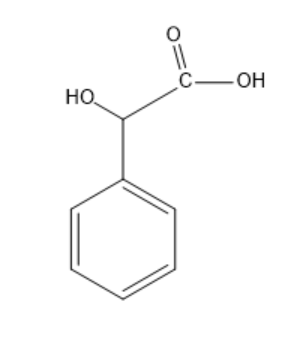
So we can clearly see that it is a chiral molecule and hence, shows specific rotation.
Specific rotation is defined as the change in the orientation of a monochromatic plane-polarized light as it passes through a sample of compound in the solution.
Formula used to find observed specific rotation is given as:
$ E.E = \dfrac{{[\alpha ]}}{{\alpha (pure( + )enantiomer)}} $
Here, E.E refers to enantiomeric excess.
$ [\alpha ] $ is the observed specific rotation.
$ \alpha $ is the specific rotation of pure $ ( + ) - $ Mandelic acid.
So, now we are given with:
Concentration of $ \;\left( - \right) - \; $ mandelic acid is $ 25\% $ .
Concentration of $ ( + ) - $ Mandelic acid is $ 75\% $ .
Enantiomeric excess of $ ( + ) - $ Mandelic acid is $ 75 - 25 $
$ = 50\% $
Putting these values in the formula, we get:
$ 50 = \dfrac{{[\alpha ]}}{{158}} \times 100\% $
$ [\alpha ] = + {79^o} $
Therefore, the observed specific rotation of the mixture is, $ [\alpha ] = + {79^o} $ .
Note :
Chiral compounds are those compounds in which at least one carbon atom is chiral (have four different groups attached to it). Chiral compounds can rotate monochromatic plane-polarized light. Achiral molecules are those in which there is no chiral carbon present and this type of molecule is not able to rotate the plane-polarized light.
Complete answer:
So, now we know that Mandelic acid is aromatic in nature and is alpha hydroxy acid. It has a molecular formula $ {C_6}{H_5}CH\left( {OH} \right)C{O_2}H $ . Its structure is:
So we can clearly see that it is a chiral molecule and hence, shows specific rotation.
Specific rotation is defined as the change in the orientation of a monochromatic plane-polarized light as it passes through a sample of compound in the solution.
Formula used to find observed specific rotation is given as:
$ E.E = \dfrac{{[\alpha ]}}{{\alpha (pure( + )enantiomer)}} $
Here, E.E refers to enantiomeric excess.
$ [\alpha ] $ is the observed specific rotation.
$ \alpha $ is the specific rotation of pure $ ( + ) - $ Mandelic acid.
So, now we are given with:
Concentration of $ \;\left( - \right) - \; $ mandelic acid is $ 25\% $ .
Concentration of $ ( + ) - $ Mandelic acid is $ 75\% $ .
Enantiomeric excess of $ ( + ) - $ Mandelic acid is $ 75 - 25 $
$ = 50\% $
Putting these values in the formula, we get:
$ 50 = \dfrac{{[\alpha ]}}{{158}} \times 100\% $
$ [\alpha ] = + {79^o} $
Therefore, the observed specific rotation of the mixture is, $ [\alpha ] = + {79^o} $ .
Note :
Chiral compounds are those compounds in which at least one carbon atom is chiral (have four different groups attached to it). Chiral compounds can rotate monochromatic plane-polarized light. Achiral molecules are those in which there is no chiral carbon present and this type of molecule is not able to rotate the plane-polarized light.
Recently Updated Pages
Master Class 11 Social Science: Engaging Questions & Answers for Success

Master Class 11 English: Engaging Questions & Answers for Success
Master Class 11 Accountancy: Engaging Questions & Answers for Success
Master Class 11 Physics: Engaging Questions & Answers for Success
Master Class 11 Computer Science: Engaging Questions & Answers for Success
Master Class 11 Business Studies: Engaging Questions & Answers for Success
Trending doubts
Find the value of the expression given below sin 30circ class 11 maths CBSE
One Metric ton is equal to kg A 10000 B 1000 C 100 class 11 physics CBSE
Draw a diagram of nephron and explain its structur class 11 biology CBSE
10 examples of friction in our daily life
Proton was discovered by A Thomson B Rutherford C Chadwick class 11 chemistry CBSE
The teeth used for biting and cutting food are called class 11 biology CBSE