









How to Represent Positive and Negative Integers on a Number Line Step by Step
Integers are a set of positive and whole numbers including 0. A number line is a visual representation of numbers on a straight line. This line is used to compare numbers that are placed at equal intervals on an infinite line that extends on both sides, horizontally or vertically. It’s a helpful tool for students wanting to learn the number system. This article will help you master the number line and may help you in your number line project.
What is the Number Line?
A one-dimensional graph of a line in which integers are shown as specially marked dots that are evenly spaced is called a number line. It is divided into two symmetrical halves by the origin, the number zero.

Number Line
Set of Integers
Integers are the set of numbers formed by all natural numbers (positive numbers) by zero and by negative numbers (those that are smaller than zero and have a minus sign in front)
The natural numbers: $1,2,3,4,5,6,7 \cdots$ so on to infinity ( $\infty$ ) are the positive numbers. They could be written as $+1,+2,+3,+4,+5, \ldots$.
The zero: 0 (It is neither positive nor negative, it is neutral)
The negative numbers: $-1,-2,-3,-4,-5,-6,-7 \ldots$ so on to minus infinity $(-\infty)$
You may ask yourself, are the numbers natural numbers or integers?
Well, it is inside the two sets because they belong to the natural numbers, but this set is contained in the integers. So, in other words, the natural numbers are a subset of the integers.
The set of integers is represented by the letter $Z$:
$Z=\{\ldots-6,-5,-4,-3,-2,-1,0,1,2,3,4,5,6 \ldots\}$
How to Represent Integers on a Number Line?
The representation of integers on number line is done in the following way:
1. We draw the line, divide into equal parts and put 0 in the centre.

A Line
2. We place the positive numbers to the right of zero, increasing their value by one unit, from left to right.
3. Now we place the negative numbers to the left of zero. They all have a minus sign in front of them.
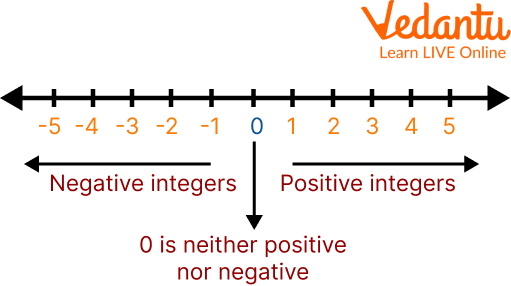
The Number Line
This can be clearly understood with the help of a number line. Now, after seeing how to represent integers on the number line, we are going to see how they are ordered.
Number Line Addition and Subtraction of Integers
Now that we understand how to add and subtract integers on a number line of integers, we can learn other arithmetic operations. To add a positive number means that we move the point to the right of the number line. Similarly, to add a negative number implies that we move the point to the left of the number line.

Number Line Addition and Subtraction of Integers
Multiplication of Integers on Number Line
The application of a multiplication operation on a given set of integers on a number line is known as multiplication of integers on a number line. Repeated addition is another name for multiplication. To conduct multiplication on a number line, we begin at zero and work our way to the right side of the number line for a certain number of times. Consider the following example. Using a number line, multiply 3 5 times.
On the number line, three sets of five identical intervals must be made beginning at zero. We will achieve 15 by organising three separate groups. Consider the following number line: 3 x 5 = 15.

Multiplication of Numbers on Number Line
Now let’s see some number line examples.
Solved Examples
Q 1. Perform the operation 3 + (-4) using a number line.
Ans:
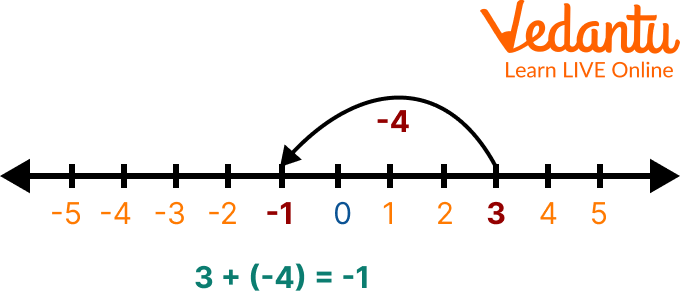
Addition on Number Line
Here, since the second number is $-4$ and the result is $-1$, we start with 3 and move 4 units to the left on the number line.
Q 2. How will you operate 7 + 12 using a number line? Explain in words.
Ans: The number 7 is marked on the number line. From there, we will proceed 12 units to the right on the number line, where we will eventually arrive at 19.
As a result, we use a number line to calculate 7 + 12 = 19.
Q 3. Add -5 and -2 using the number line.
Ans: Here, the first number is -5 and the second number is -2; both are negative. Locate -2 on the number line. Then moving 5 places to the left will give -7.

Addition on Number Line
Q 4. Subtract 5 from 2 using the number line
Ans: Here the first number is 2 and the second number is 5; both are positive. First, locate 2 on the number line. Then moving 5 places to the left will give us -3.

Subtraction on Number Line
Practice Questions
Q 1. When -2 is added to 8, keeping 8 as the reference, we move by ____ on the number line.
Ans: 2 units towards the left
Q 2. Which way do we move on the number line when we add a positive number?
Ans: Right of the number line
Q 3. Which way do the negative numbers are placed to the zero?
Ans: To the left
Q 4. Which way do the positive numbers lie to the zero?
Ans: To the right
Q 5. The addition of 8 and 1 in the number line is____
Ans: 9
Summary
Integers are plotted on a number line by adhering to the following fundamental guidelines: all positive numbers higher than zero, like $1,2,3, \ldots$, etc., are plotted to the right of zero, while all negative integers less than zero, like, $-1,-2,-3, \ldots$ etc., are plotted to the left of zero. The integer zero is precisely displayed in the middle. As an illustration, the integer 3 is plotted to the right of 0 , whereas the value $-4$ is drawn to the left of 0.
FAQs on Representation of Integers on a Number Line with Rules and Examples
1. What is the representation of integers on a number line?
The representation of integers on a number line means placing positive numbers, negative numbers, and zero at equal distances on a straight line according to their values.
- 0 is placed at the center (origin).
- Positive integers (1, 2, 3, ...) are placed to the right of 0.
- Negative integers (-1, -2, -3, ...) are placed to the left of 0.
- Each integer is equally spaced from the next.
2. How do you represent positive and negative integers on a number line?
Positive integers are placed to the right of zero, and negative integers are placed to the left of zero on a number line.
- Mark 0 at the center.
- Move right to mark +1, +2, +3, and so on.
- Move left to mark -1, -2, -3, and so on.
- Keep equal spacing between consecutive integers.
3. Where is zero located on a number line?
Zero is located at the origin, which is the center point of the number line separating positive and negative integers.
- It is neither positive nor negative.
- Numbers to the right are greater than 0.
- Numbers to the left are less than 0.
4. How do you compare integers using a number line?
On a number line, the integer that lies to the right is always greater than the one to the left.
- If 5 is to the right of 2, then 5 > 2.
- If -2 is to the right of -5, then -2 > -5.
- All positive integers are greater than 0 and negative integers.
5. How do you represent addition of integers on a number line?
To add integers on a number line, start at the first number and move right for positive addition or left for negative addition.
- Example: To calculate 2 + 3:
- Start at 2.
- Move 3 steps to the right.
- You reach 5.
- Example: 2 + (-4):
- Start at 2.
- Move 4 steps to the left.
- You reach -2.
6. How do you represent subtraction of integers on a number line?
To subtract integers on a number line, start at the first number and move left for positive subtraction or right for subtracting a negative number.
- Example: 5 - 3:
- Start at 5.
- Move 3 steps left.
- You get 2.
- Example: 5 - (-2):
- Start at 5.
- Move 2 steps right.
- You get 7.
7. What is the distance between two integers on a number line?
The distance between two integers on a number line is the absolute value of their difference.
- Formula: |a − b|
- Example: Distance between 3 and -2:
- |3 − (−2)| = |5| = 5
8. How do you plot -4 on a number line?
To plot -4 on a number line, move four equal steps to the left of zero and mark the point.
- Locate 0 at the center.
- Move left to -1, -2, -3.
- The next point is -4.
9. Why are negative integers placed to the left of zero?
Negative integers are placed to the left of zero because they are less than zero in value.
- Numbers increase as we move right.
- Numbers decrease as we move left.
- Example: -3 < -1 < 0
10. What are common mistakes when representing integers on a number line?
Common mistakes when representing integers on a number line include incorrect spacing and reversing directions.
- Not keeping equal spacing between integers.
- Placing negative numbers on the right side of 0.
- Confusing subtraction with movement direction.
- Forgetting that numbers increase to the right.
