


World Meditation Day 2026: Why Is It Observed on 21 December?
World Meditation Day 2026 will be observed on Monday, 21 December 2026, to raise awareness about meditation and its potential benefits for mental and physical well-being. The United Nations General Assembly established the observance on 6 December 2024 through Resolution A/RES/79/137. The day encourages people to explore meditation, practise mindfulness and understand the importance of inner peace.
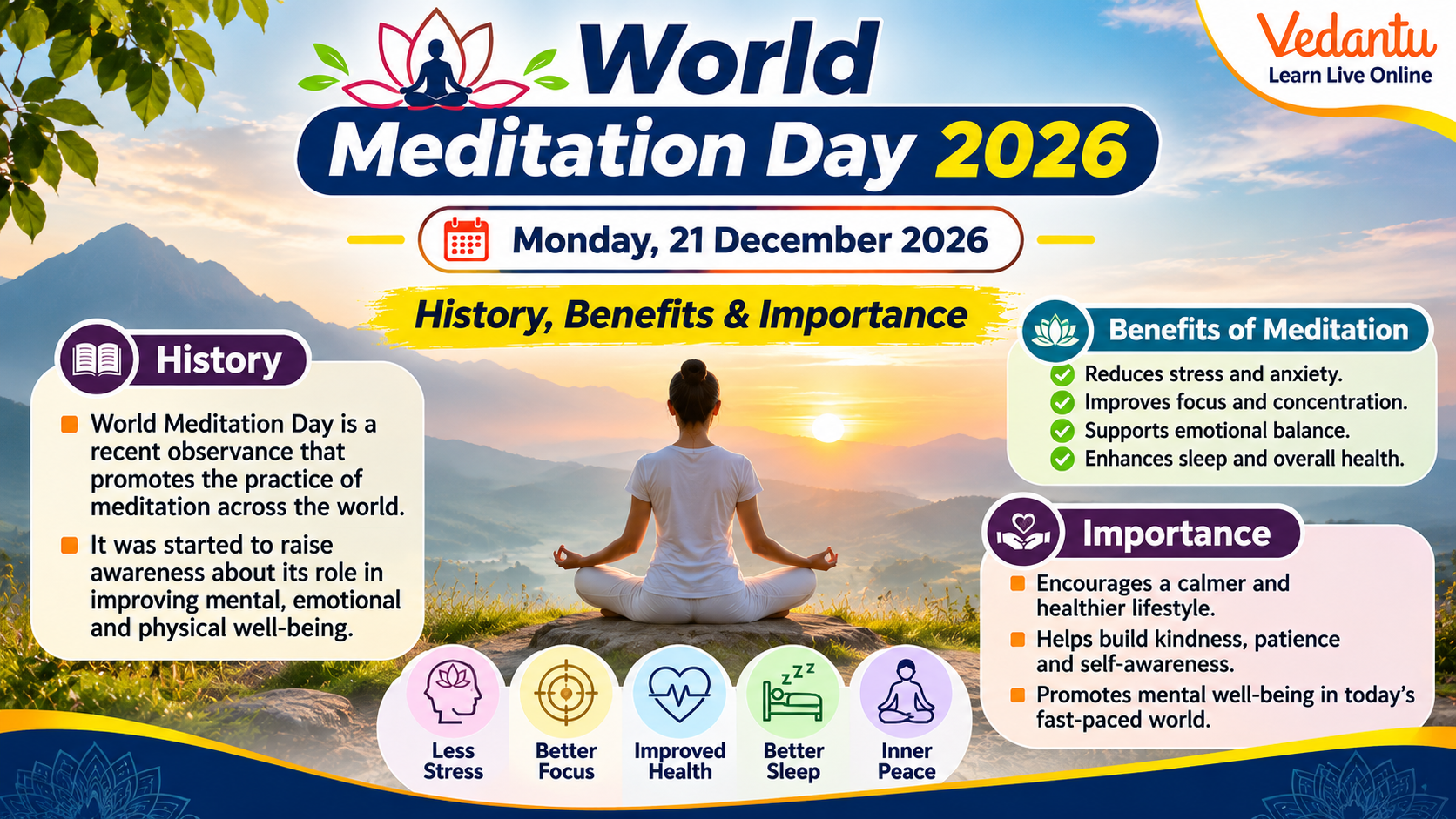
World Meditation Day also highlights how moments of quiet reflection can support awareness, concentration and emotional balance. Schools, colleges and communities can observe the occasion through optional meditation sessions, educational workshops and awareness activities. India played an important role in supporting the UN resolution that established this international observance.
World Meditation Day 2026: Key Facts
What Is the World Meditation Day Theme 2026?
A separate official World Meditation Day 2026 theme has not been confirmed by the United Nations in the available announcements.
However, the observance continues to focus on meditation, self-awareness, well-being and peaceful coexistence.
Educational institutions can organise activities around awareness topics such as:
Meditation and mental well-being.
Mindfulness in everyday life.
Finding time for quiet reflection.
Building concentration and self-awareness.
Promoting compassion and understanding.
These are suggested topics, not officially announced UN themes.
The main purpose of World Meditation Day is to make people aware of meditation practices and encourage informed, voluntary participation.
History of World Meditation Day
The United Nations General Assembly officially proclaimed 21 December as World Meditation Day through Resolution A/RES/79/137, adopted on 6 December 2024.
The resolution recognises meditation as a practice found in different regions and traditions worldwide. It also acknowledges that meditation can contribute to health and well-being.
Important Events in World Meditation Day History
The observance encourages people to learn about meditation while respecting its different cultural, spiritual and secular forms.
India's Role in Establishing World Meditation Day
India was among the countries that supported the UN resolution establishing World Meditation Day.
The core group involved in promoting the resolution included India, Andorra, Liechtenstein, Mexico, Nepal and Sri Lanka.
India's contribution is significant because meditation has a long history in Indian philosophical and spiritual traditions, including Hinduism, Buddhism and Jainism.
The United Nations also recognises the relationship between yoga and meditation as complementary approaches to well-being.
World Meditation Day on 21 December and International Day of Yoga on 21 June are separate UN observances.
What Is Meditation?
Meditation is a practice in which a person trains attention or awareness using techniques such as focusing on breathing, observing thoughts or repeating a word or sound.
People practise meditation for different purposes, including quiet reflection, spiritual development, mindfulness and relaxation.
Meditation does not require a particular religion or belief. However, its meaning and methods may differ between religious, philosophical and secular traditions.
For beginners, meditation can simply involve sitting comfortably and paying attention to breathing for a short period.
Benefits of Meditation for Students and Everyday Life
Meditation may support mental and emotional well-being when practised regularly and appropriately.
The effects of meditation vary between individuals. It should not replace professional treatment for physical or mental health conditions.
Different Types of Meditation
There are several approaches to meditation, each with different methods and purposes.
Students can learn about these methods and choose whether they wish to explore an appropriate practice.
How to Practise Meditation: Simple Steps for Beginners
Students who want to try meditation can begin with a short, comfortable activity.
Step 1: Find a quiet place
Choose a safe space where you are unlikely to be disturbed.
Step 2: Sit comfortably
Sit on a chair or the floor with a relaxed posture. You do not need to sit cross-legged.
Step 3: Relax your body
Keep your hands comfortable and your eyes open or closed, whichever feels better.
Step 4: Notice your breathing
Pay attention to your natural breathing without forcing it to become slower or deeper.
Step 5: Bring your attention back
If your mind wanders, gently return your attention to your breathing.
Step 6: Finish gradually
After two to five minutes, notice your surroundings and return to your normal activities.
Meditation should be voluntary. Anyone who feels uncomfortable can stop or choose another quiet activity.
How Is World Meditation Day Celebrated?
World Meditation Day is observed through educational and community activities that promote awareness of meditation.
Common activities include:
Meditation sessions: Groups organise optional introductory practices.
School workshops: Teachers explain meditation and its different approaches.
Community discussions: Participants learn about mindfulness and well-being.
Online programmes: Organisations conduct virtual talks or guided sessions.
Educational presentations: Students explore the history and cultural significance of meditation.
Quiet reflection: Individuals take time to reflect on their thoughts and experiences.
Organisations may hold programmes on or near 21 December. However, the official UN observance date remains unchanged.
World Meditation Day 2026 Activities for Students
Schools can organise age-appropriate activities to help students understand meditation and mindfulness.
Mindfulness activity: Offer a short, optional attention exercise.
Poster-making competition: Create drawings about peace, awareness and well-being.
Classroom discussion: Explore how people manage distractions and practise attention.
Meditation awareness quiz: Ask questions about the history and purpose of the observance.
Reflection writing: Encourage students to write about activities that help them feel calm.
Educational presentations: Explain different meditation traditions and their cultural backgrounds.
Students who do not wish to meditate can participate through reading, drawing or quiet observation.
World Meditation Day Poster Ideas and Slogans
Students can create World Meditation Day posters to spread awareness about meditation and peaceful reflection.
World Meditation Day 2026 Poster Ideas
World Meditation Day Slogans
A Moment of Stillness, A Moment of Awareness.
Find Peace in the Present Moment.
Make Time for Mindfulness.
Pause, Reflect and Reconnect.
Small Moments of Calm Matter.
Meditation Begins with Awareness.
Practise Mindfulness, Encourage Kindness.
These are original awareness messages rather than official UN campaign slogans.
World Meditation Day: 21 May vs 21 December
Some calendars also mention World Meditation Day on 21 May, which can create confusion.
21 December is the officially recognised United Nations World Meditation Day. The 21 May observance is separate.
Conclusion
World Meditation Day 2026 will be observed on Monday, 21 December, to promote awareness of meditation and its potential role in supporting well-being. Established by the United Nations in 2024, the day also recognises meditation's presence across different cultures and traditions.
Students can observe the occasion through educational activities, short optional meditation sessions, posters and discussions. Learning about mindfulness and making time for reflection can encourage greater self-awareness and understanding.
FAQs on World Meditation Day 2026: Date, History, Benefits & Importance
1. When is World Meditation Day 2026?
World Meditation Day 2026 will be observed on Monday, 21 December 2026. The United Nations officially recognises 21 December as the annual date.
2. Why is World Meditation Day celebrated?
World Meditation Day raises awareness about meditation and its potential benefits for mental and physical well-being. It encourages people to learn about meditation and practise it voluntarily.
3. What is the World Meditation Day theme 2026?
No separate official UN theme for World Meditation Day 2026 has been confirmed. The observance promotes meditation awareness, mindfulness, well-being and peaceful coexistence.
4. Who started World Meditation Day?
The United Nations General Assembly established World Meditation Day by adopting Resolution A/RES/79/137 on 6 December 2024. The first official observance took place on 21 December 2024.
5. Is World Meditation Day on May 21 or December 21?
The official United Nations World Meditation Day is observed on 21 December. Some communities also recognise a separate meditation occasion on 21 May, but it is not the UN-designated date.
6. What are the benefits of meditation for students?
Meditation may help students practise attention, manage everyday stress and develop awareness of their thoughts and feelings. Its effects vary, and it is not a replacement for medical or mental health care.
7. How can schools celebrate World Meditation Day?
Schools can organise optional meditation sessions, poster-making competitions, quizzes, reflection-writing activities and educational discussions about meditation traditions.
8. How can beginners practise meditation?
Beginners can sit comfortably, notice their natural breathing and gently return their attention when distracted. Starting with two to five minutes can make the activity manageable.


