



Key Differences Between One-Year and Two-Year JEE Coaching Programs
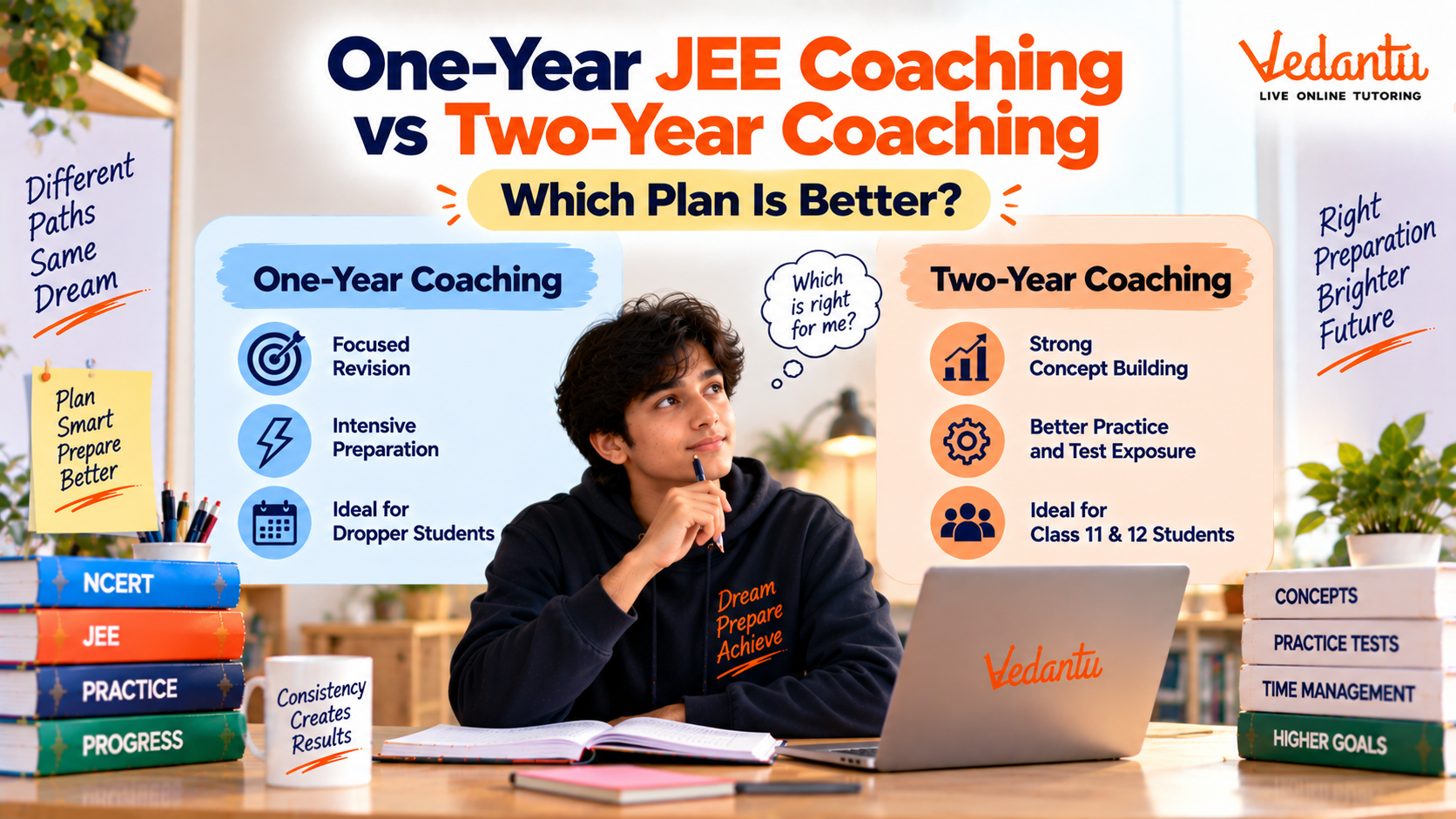
Starting in Class 11 usually makes two-year JEE coaching the more manageable choice: it gives you time to build concepts, practise and revisit difficult chapters alongside school. A one-year course can suit a Class 12 student or dropper, but its faster pace demands a realistic understanding of existing strengths and gaps. Neither duration guarantees a better result. The right decision depends on your starting level, time before the examination and ability to practise independently between classes.
Visit Our Vedantu Learning Centres Near You
One-Year vs Two-Year JEE Coaching: The Main Differences
Both routes need to address the relevant JEE syllabus across Physics, Chemistry and Mathematics. The important difference is how much time is available for learning, application and correction—not whether one route needs less preparation. The comparison below describes typical planning needs, not guaranteed features of every coaching programme.
| Decision Factor | One-Year Coaching | Two-Year Coaching |
|---|---|---|
| Usual starting stage | Class 12 or after Class 12, with different needs for each group. | Beginning of Class 11, continuing through Class 12. |
| Learning pace | Less time per topic if both classes’ content needs substantial teaching. | More room to introduce concepts gradually and build prerequisites. |
| Revision approach | Revision must run alongside syllabus completion from the beginning. | Allows more spaced revision, provided earlier chapters stay in rotation. |
| School workload | Class 12 students balance current lessons, boards and Class 11 repair. | Preparation can follow the progression from Class 11 to Class 12. |
| Main preparation risk | Rushing through lessons without enough independent problem-solving. | Postponing revision because the examination feels far away. |
| Recovery from backlogs | Requires quick prioritisation and protected catch-up time. | Offers more recovery time, but unchecked gaps can still accumulate. |
| Cost comparison | Compare the complete payable amount and included support. | Compare the full two-year commitment, not only an instalment amount. |
Which Duration Suits Your Preparation Stage?
Class 11: Two Years Usually Provides the Better Foundation
Two-year JEE coaching for Class 11 students generally offers a better planning fit because many higher-secondary concepts are still new. For example, comfort with algebra, graphs and trigonometry supports later mathematical work, while mechanics requires careful development of physical reasoning. More time allows students to move from understanding a solved example to solving an unfamiliar problem independently.
The extra year is useful only if it includes regular practice and revision. Do not treat Class 11 as a trial year and leave serious preparation for Class 12. Vedantu’s resource on two-year JEE preparation from Class 11 is a relevant planning companion for students choosing this route.
Class 12: Choose a One-Year Plan That Addresses Class 11 Gaps
A Class 12 student needs to distinguish between a course teaching the current class and a course explicitly addressing the full JEE syllabus. A one-year label alone does not tell you how much Class 11 revision or reteaching is included. If your earlier preparation is uneven, the timetable must leave room for those gaps without repeatedly sacrificing current lessons.
For example, a student who understands most Class 11 concepts but lacks timed practice needs a different plan from someone learning large portions for the first time. When school and board work are major constraints, Vedantu’s eight-month JEE Main preparation resource alongside boards offers a closely related planning reference.
Droppers: One Year Works Best When It Changes the Method
One-year JEE coaching for droppers should address why the previous preparation fell short. Students who have already studied the syllabus may need selective concept repair, more independent solving and better test analysis rather than equal teaching time for every chapter. Others may need substantial rebuilding; completing Class 12 does not automatically mean the fundamentals are secure.
Before committing to a drop year, identify whether the main problem was incomplete coverage, weak understanding, inconsistent practice or examination execution. Build the new plan around that diagnosis. Also check the applicable eligibility and attempt rules through NTA for JEE Main and the official JEE Advanced information brochure for your intended examination year.
Does Your JEE Main or JEE Advanced Goal Change the Choice?
Your target changes the depth and type of practice required, but it does not create a universal rule that one year is for JEE Main and two years is for JEE Advanced. A well-prepared dropper may use one year for demanding, multi-concept practice. A beginner may benefit from two years simply to build reliable understanding and application.
For JEE Main, build syllabus coverage, accuracy and efficient question selection through suitable practice. If you also target JEE Advanced, allow sustained time for unfamiliar problems and connections between concepts rather than postponing all such work until the end. Vedantu’s JEE Main and JEE Advanced comparison is a useful next resource when deciding what your coaching plan needs to prepare you for.
How to Organise Each Coaching Timeline
Plan backwards from the examination, not from the course label. A “one-year” batch may leave fewer than twelve months before your target attempt. The following phase structure is illustrative; adjust it to your starting level, school calendar and actual time available.
- Two-year route, Class 11 phase: Learn the current topics thoroughly, solve questions after each lesson and include older chapters in weekly revision. Use the transition to Class 12 to repair unresolved gaps.
- Two-year route, Class 12 phase: Continue new learning while reserving recurring blocks for Class 11 revision. Gradually add mixed-topic tests so earlier knowledge remains usable.
- One-year route, opening phase: Diagnose the syllabus and separate chapters into secure, partly understood and largely unstudied groups. Repair essential prerequisites while starting the current batch work.
- One-year route, middle phase: Continue coverage while revising completed topics and taking cumulative tests. Avoid restarting strong chapters from scratch unless testing reveals a genuine gap.
- Both routes, final phase: Shift more time towards full-syllabus mocks, targeted revision and recurring errors. Keep limited time for unresolved concepts instead of opening several new resources.
A workable weekly routine for either route includes lesson-linked practice, scheduled revision of older topics, one planned assessment and a backlog buffer. Distribute these around school and sleep rather than imposing the same daily study-hour target on every student. If assignments consistently consume all available time, the teaching pace and your independent-work capacity are not aligned.
After a test, classify lost marks into concept gaps, incorrect setup, calculation mistakes and time-management problems. Relearn only what needs repair, solve a few related questions and retry the original problem later without the solution. Repeated errors are more useful signals than a single unusually high or low score.
Choose the Learning Format Separately from the Duration
One-year and two-year describe the timeline; live online, classroom and recorded-only describe how you learn. A longer course does not automatically provide more useful interaction, and a shorter course is not automatically more focused. Judge the format by how it protects practice time and helps you resolve mistakes.
- Live online coaching: Removes the need to travel to class, but requires reliable connectivity and attention at home. Scheduled sessions can provide routine; the type of interaction and doubt support depends on the course.
- Traditional classroom coaching: Provides a physical study setting and an attendance routine. Travel and fixed timings must still leave enough time for independent solving, while support varies by institute and batch.
- Recorded-only courses: Let students control lesson timing and replay explanations where access permits. They require self-imposed deadlines, and students may need a separate way to resolve doubts.
- Self-study with a test series: Gives control over pace and resources. It suits students who can diagnose gaps and maintain a schedule, but teacher-led explanations and doubt resolution may need separate arrangements.
Vedantu’s linked preparation resources can support the planning side of this decision: use the Class 11 resource for a longer preparation horizon and the boards-linked resource when balancing Class 12 responsibilities. These resources are not substitutes for understanding a paid course’s teaching plan. If considering a Vedantu batch, compare it with other coaching institutes on the same practical requirements rather than assuming that every programme has identical features.
Before enrolling anywhere, request the current syllabus schedule, intended learner stage, class timings, teaching language, doubt-resolution arrangement, tests and access validity. Compare the total fee, taxes, materials, any separately charged support and refund terms together. For a two-year commitment, understand what continues into the second year; for a one-year course, establish how Class 11 gaps will be handled.
Make the Final Decision with a Short Preparation Audit
Choose the duration after examining what you can currently do, not just how confident or anxious you feel. A short audit makes the decision more concrete.
- Measure the available time: Count the weeks before your target examination and account for school assessments, practical work and other fixed commitments.
- Sample your understanding: Attempt representative questions from previously studied Physics, Chemistry and Mathematics chapters without notes. Record where you cannot begin, where your method fails and where you only need more speed.
- Map the course to those gaps: A fast revision batch is a poor fit if you need first-time teaching across many chapters. Conversely, repeated basic lectures may crowd out practice for an already-prepared student.
- Check a realistic week: Put proposed classes, school, travel and assignments into your calendar. Ensure that independent solving, revision, rest and a small catch-up buffer still fit.
- Review the plan after the opening weeks: Look for completed practice, fewer recurring errors and manageable backlogs—not attendance alone. Adjust the workload early if these indicators are moving in the wrong direction.
If you are beginning Class 11 with limited higher-secondary preparation, two years is usually the more suitable route. If you are in Class 12 or repeating, a targeted one-year plan is often the practical choice, but it must match your actual learning needs. Do not take an additional year merely because a longer course sounds safer; that is a separate academic, financial and personal decision.
Summary
Two-year JEE coaching usually suits Class 11 beginners who need steady concept building, while one-year coaching can suit Class 12 students and droppers with a carefully targeted plan. Neither duration replaces regular solving, revision and test analysis. Start by auditing your preparation and weekly capacity, then compare the actual teaching schedule and total commitment. Vedantu’s linked preparation resources can help you plan around your starting stage before evaluating a suitable course.
FAQs on Which JEE Coaching Plan Fits You Best: One Year or Two Years?
1. What is the main difference between One-Year and Two-Year JEE Coaching plans?
The primary difference between the One-Year and Two-Year JEE Coaching plans is the duration and depth of exam preparation.
- One-Year JEE Coaching is designed for students who start their preparation in Class 12 or after completing Class 11. It offers an intensive, fast-paced syllabus coverage focused on exam strategies, revision, and practice.
- Two-Year JEE Coaching starts from Class 11 and covers concepts in greater detail over a longer period, allowing thorough understanding, regular revision, and consistent practice.
2. Who should choose the One-Year JEE Coaching program for JEE 2027?
The One-Year JEE Coaching program is ideal for:
- Students who begin preparation after Class 11 or in Class 12.
- Learners who are quick at grasping concepts and can handle a condensed curriculum.
- Repeaters aiming to improve their JEE score within a year.
3. What are the benefits of enrolling in a Two-Year JEE Coaching plan?
Two-Year JEE Coaching offers several key advantages:
- Deeper and gradual coverage of JEE syllabus, supporting concept clarity.
- More time for doubt resolution, regular revisions, and mock tests.
- Balanced study along with Class 11 and 12 academics.
- Stronger foundation for long-term academic and exam success.
4. Is it possible to switch from a Two-Year to a One-Year coaching plan or vice versa?
Switching plans is sometimes possible, but depends on the coaching institute's policies.
- Contact administrative support for guidance on plan upgrades or changes.
- Ensure your preparation timeline aligns with JEE 2027 goals.
5. How do I decide which JEE coaching plan is better for me?
Choose your JEE coaching plan based on your academic readiness, time availability, and learning pace:
- Two-Year Plan: For students seeking a structured, detailed approach starting from Class 11.
- One-Year Plan: For fast learners or repeaters with a strong foundation.
6. What is covered in the JEE coaching syllabus for 2027?
The JEE 2027 coaching syllabus aligns with the latest NTA guidelines:
- Comprehensive Physics, Chemistry, and Mathematics topics from Class 11 and 12.
- Regular mock tests, previous year paper practice, and doubt-clearing sessions.
- Updated modules to match any changes in JEE Main or JEE Advanced exam pattern.
7. Are both the One-Year and Two-Year JEE Coaching plans available online at Vedantu?
Yes, Vedantu offers both One-Year and Two-Year JEE Coaching plans online for JEE 2027. Students can attend live interactive sessions, access study material, attempt mock tests, and discuss doubts with experts from home.
8. Will I get enough time for revision and practice with a One-Year JEE program?
The One-Year JEE program is intensive and includes regular revision sessions, but time for in-depth practice is limited compared to a Two-Year plan.
- Suitable for students with a strong grasp of basic concepts.
- Requires disciplined self-study and frequent practice.
9. Can I prepare for board exams and JEE simultaneously with Vedantu's Two-Year program?
Yes, Vedantu's Two-Year JEE Coaching is structured to support students in preparing for both board exams and JEE. The curriculum is planned so that Class 11 and 12 board topics are covered along with JEE syllabus, maximizing preparation efficiency.
10. What support does Vedantu provide for doubt-solving during JEE preparation?
Vedantu provides multiple options for personalized doubt resolution:
- Live doubt-solving classrooms and separate doubt-clearing sessions.
- Access to expert teachers and instant chat for subject-specific queries.
- Discussion forums for peer learning and collaborative problem-solving.
11. Are scholarships available for Vedantu's JEE Coaching programs?
Yes, Vedantu offers scholarships and financial aid based on eligibility criteria:
- Scholarship tests are conducted regularly for meritorious students.
- Need-based aid may also be available for eligible students.
- Contact Vedantu's admission team to know about latest scholarship programs.
12. What is the best time to start JEE coaching for JEE 2027?
The ideal time to start JEE coaching is at the beginning of Class 11 for comprehensive preparation. However, students can also start in Class 12 with a One-Year program depending on individual learning readiness and goals.



