



How to Build the Best 2-Year Study Plan for JEE from Class 11
Starting JEE preparation in Class 11 gives you time to build concepts, practise increasingly demanding questions and revise before the examination. A useful two-year coaching plan connects all three rather than postponing practice or revision until Class 12. The key decision is whether a course leaves enough room for school, independent problem-solving and recovery. Choose a manageable teaching pace, then judge progress by what you can solve without help—not by how many lectures you finish.
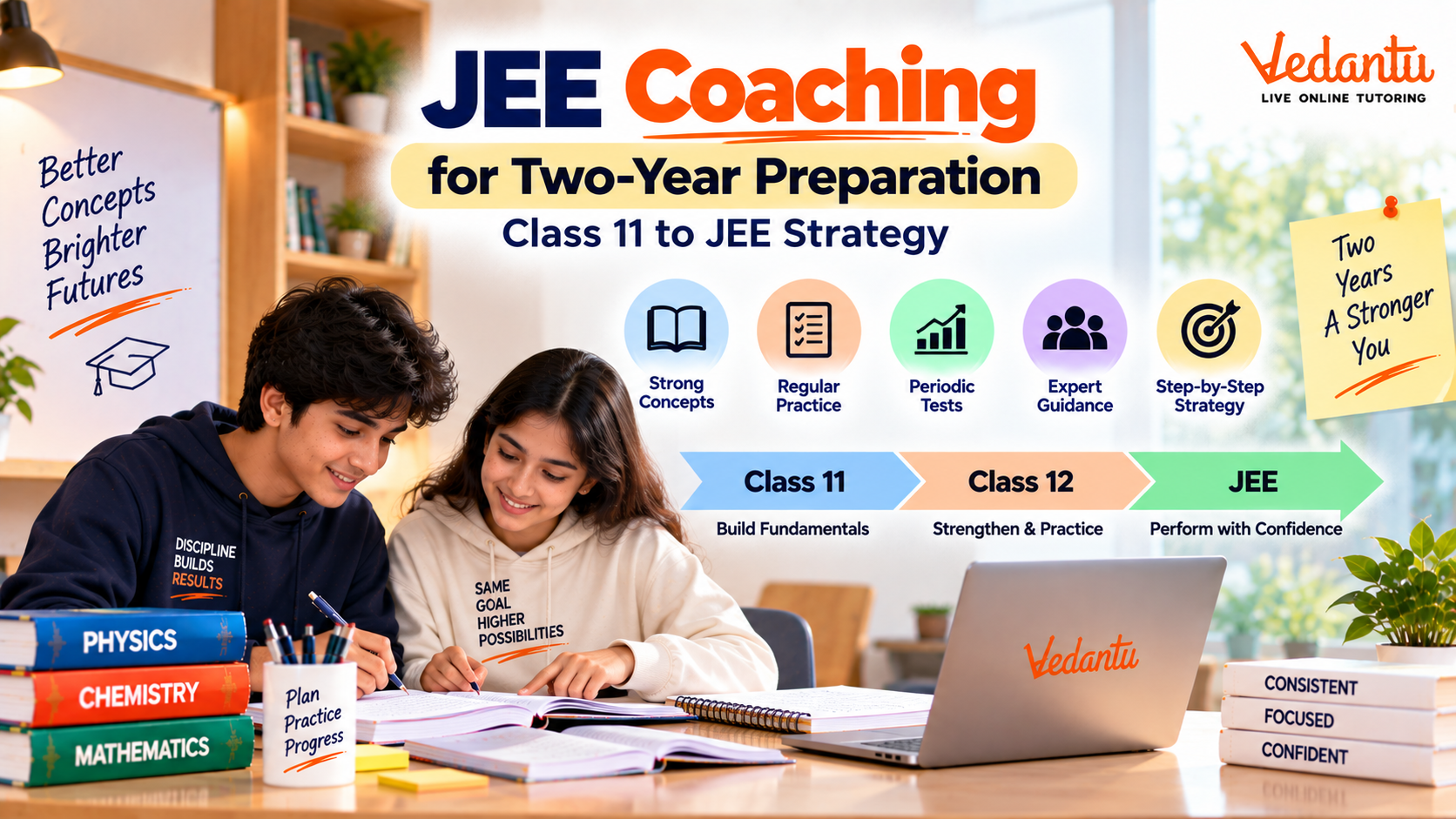
What a Two-Year JEE Coaching Plan Should Achieve
A two-year JEE coaching programme should provide a workable sequence for Physics, Chemistry and Mathematics while leaving you responsible for active practice. Its long-term benefit is the opportunity to revisit difficult ideas after feedback. Simply spreading lectures across two academic years does not create that benefit.
- Build prerequisites before dependent chapters: algebra and trigonometry support later Mathematics and Physics; chemical bonding supports much of Chemistry.
- Connect teaching with independent work: each topic needs examples, unaided attempts, doubt resolution and a short assessment.
- Keep older chapters active: cumulative revision should begin in Class 11, not after the Class 12 syllabus ends.
- Prepare for the intended exam scope: a JEE Main-focused plan needs reliable coverage and timed application. Students targeting JEE Advanced should also practise deeper, multi-concept reasoning throughout preparation.
Use the official NTA JEE Main syllabus and, if relevant, the official JEE Advanced syllabus and information brochure for your attempt year to check coverage and rules. Coaching notes and textbook chapter lists should support that syllabus, not replace it.
Discover Our Classes With A Guided Centre Tour
A Two-Year Study Roadmap from Class 11
The following roadmap is illustrative, not an examination calendar. Start with your school calendar and work backwards from the relevant examination dates. A “two-year” course does not necessarily give you 24 full months before your first JEE Main examination, so protect a revision window rather than planning new chapters until the last week.
| Preparation Phase | Main Work | Progress Check |
|---|---|---|
| Opening weeks of Class 11 | Diagnose gaps in algebra, trigonometry, graphs, units and basic chemical calculations; establish a weekly routine. | Explain basic methods and solve introductory questions without copying examples. |
| Main Class 11 teaching period | Follow the chapter sequence, practise after lessons and include older topics in weekly revision. | Complete chapter tests and track recurring mistakes across cumulative tests. |
| Class 11–12 transition | Audit Class 11 learning and repair weak prerequisites before the next teaching cycle. | Retest repaired topics using unfamiliar questions. |
| Main Class 12 teaching period | Study current chapters while reserving a fixed weekly block for Class 11 retrieval and practice. | Check both years through mixed tests rather than only recent-chapter scores. |
| Protected pre-exam revision window | Consolidate notes, practise relevant previous-year questions and take full-syllabus mocks. | Assess accuracy, time allocation and repeated errors across several comparable papers. |
| Between relevant examination stages | Adjust practice to the next examination while maintaining revision and school commitments. | Use practice papers appropriate to the next examination’s demands. |
How to Study Physics, Chemistry and Mathematics
Physics: Move from the Situation to the Equation
Develop comfort with vectors, graphs, units and basic mathematical tools alongside mechanics. Before substituting values, draw the situation, identify the relevant system and state the principle you will use. This makes later work in areas such as electricity and magnetism less dependent on memorised question patterns.
After solving a numerical problem, check dimensions, signs and whether the answer is physically sensible. If you cannot begin, identify the missing step: understanding the situation, choosing a law or carrying out the mathematics. Each requires a different repair.
Chemistry: Use Different Methods for Different Demands
- Physical Chemistry: practise setting up equations, handling units and completing calculations. Keep the conditions behind each formula in your notes.
- Organic Chemistry: strengthen nomenclature, isomerism and general organic chemistry before relying on reaction summaries. Explain how structure and conditions affect a reaction.
- Inorganic Chemistry: use careful NCERT reading where it matches the official syllabus, followed by closed-book recall of trends, reactions and exceptions. Strengthen chemical bonding to support understanding.
Mathematics: Practise Choosing a Method
Secure algebra, functions and trigonometry early because weaknesses here can slow later chapters. Alternate focused practice with mixed sets: focused sets teach a method, while mixed sets test whether you can recognise when to use it. Write complete reasoning during learning instead of jumping between memorised shortcuts.
For all three subjects, begin with one main learning resource and one planned practice sequence. Use Vedantu’s guidance on preparing for JEE using its study materials as a relevant next step when organising resource use. Keep any additional material tied to a specific gap rather than collecting unfinished books or worksheets.
A Weekly Routine That Fits Around School and Coaching
Plan independent study after placing school, coaching, travel, meals and sleep on the calendar. The sample below uses roughly two hours on an ordinary school day, but it is a starting template—not a universal requirement. On coaching-heavy days, shorten the blocks and move longer practice to lighter days.
- 20 minutes of retrieval: recall an older topic’s formulae, definitions or methods without opening notes, then check omissions.
- 50 minutes of current-topic practice: attempt a manageable assignment segment independently. Alternate the priority subject across days.
- 40 minutes for a second subject: solve questions or complete active Chemistry recall, depending on the week’s needs.
- 10 minutes of review: record unresolved doubts and choose the next task so tomorrow’s session starts promptly.
- One weekly test block: use a chapter or cumulative test during teaching phases. Move towards full-length papers as coverage grows, with separate time for analysis.
- One weekly repair block: address a weak topic or missed assignment and retain some buffer for school deadlines.
During school examination weeks, reduce new entrance-level workload while retaining brief retrieval sessions. School assessments may require descriptive answers and written derivations, so practise those separately rather than assuming objective-question practice is enough. Avoid building a schedule that works only by sacrificing sleep.
Keep Class 11 Revision Alive and Control Backlogs
A chapter is not secure just because its lectures are complete. Use a simple chapter tracker with four stages: understood, practised independently, tested and revised. A gap between the first and second stages signals passive learning; a gap between testing and revision signals unfinished correction.
An illustrative revision cycle is a brief recall session within a few days, mixed questions the following week and another check several weeks later. Shorten the interval for weak chapters. In Class 12, reserve a recurring block for Class 11 material instead of waiting for a long holiday.
- Define the backlog narrowly: write “cannot apply conservation of momentum in collisions” rather than “mechanics is weak”.
- Prioritise dependencies: repair gaps that are blocking current lessons before polishing already manageable chapters.
- Use a limited repair task: revisit the relevant explanation, attempt a small graded set and record remaining doubts.
- Retest without notes: solve fresh questions after a gap. Reproducing the solution you just read does not demonstrate retention.
Turn Tests into a Better JEE Main and Advanced Strategy
Tests should reveal what to change next. Begin with topic tests, add cumulative papers as coverage expands and use full-syllabus mocks during revision. For JEE Main, practise accurate application and question selection under time limits; for JEE Advanced, also sustain practice in unfamiliar, multi-concept problems rather than leaving depth entirely to the final stage.
- Classify each lost opportunity: concept gap, incorrect setup, calculation error, misreading, time pressure or an unstudied topic.
- Reattempt before reading the solution: an untimed successful attempt may indicate pacing trouble rather than missing knowledge.
- Make a targeted correction: review the exact idea and solve a few related questions. Avoid rereading an entire chapter for one arithmetic slip.
- Check the correction later: revisit the question type in the next mixed set or test.
- Track trends: compare accuracy, avoidable errors and time use across papers of similar scope and difficulty, not just raw marks.
A useful error-log entry is specific: “I selected the wrong system before applying energy conservation; redraw and label the system before writing equations.” For further preparation reading, use Vedantu’s JEE Main preparation tips alongside your own test evidence, choosing advice that addresses an observed weakness.
Choosing a Coaching Format for Two Years
Choose the format you can sustain during an ordinary school week, not only during holidays. The comparison below describes learning formats; individual course and centre arrangements vary. None removes the need for independent problem-solving.
| Option | Routine and Interaction | Main Trade-off | Works Well When |
|---|---|---|---|
| Live online coaching | Scheduled online lessons; participation and doubt arrangements depend on the course. | Avoids class-related commuting but requires reliable connectivity and a focused study space. | You can attend regularly and actively seek clarification online. |
| Traditional classroom coaching | Fixed attendance at a centre; individual interaction depends on batch arrangements. | Provides a separate study setting but adds travel and fixed-location commitments. | An in-person routine helps you stay accountable and travel is manageable. |
| Recorded-only courses | Lessons are watched within access terms; separate doubt support may or may not be included. | Allows control over viewing time but makes postponement easier without firm deadlines. | You follow a self-set schedule and have a reliable way to resolve doubts. |
| Self-study with planned tests | You organise resources, practice, assessment and correction. | Offers control over pace but requires independent diagnosis of learning gaps. | Your foundations and study habits are strong, with access to help when needed. |
How to Consider Vedantu Within Your Two-Year Plan
Vedantu’s linked JEE preparation guidance can support resource planning and preparation decisions while you build your Class 11 routine. Treat this reading as a supplement to actual study: select one relevant action, apply it for a week and review whether it improved completion, recall or accuracy. Preparation advice is useful only when it changes how you work.
If you are considering a Vedantu two-year batch, compare the specific offering with other coaching institutes, recorded-only study and your current self-study arrangement. A scheduled course may suit a student who needs external structure; a more self-paced option may suit someone with strong study habits and an irregular school timetable. Decide from the actual course arrangements rather than assuming every offering under a brand has identical features.
Before enrolling, obtain the current details from Vedantu or the institute concerned in one place: Class 11–12 and JEE Main/Advanced coverage, teaching language, weekly timetable, completion target, doubt process, tests, feedback, access period and total fee with inclusions and refund terms. Ask how Class 11 revision continues during Class 12. Then place the proposed timetable into your real week; if it leaves little time to solve and review questions, the workload needs reconsideration.
Summary
A sustainable two-year JEE strategy combines Class 11 foundations, steady Class 12 progress, cumulative revision and test-led correction. Choose coaching that fits school commitments and protects independent practice rather than filling every available hour with lectures. Vedantu’s linked preparation guidance offers a relevant starting point for organising resources and reviewing study habits. Begin with a chapter diagnostic and a realistic weekly schedule, then evaluate any proposed batch against the gaps you actually need help closing.
FAQs on JEE Coaching Strategy for Two-Year Preparation: Class 11 to JEE 2027
1. What is the ideal two-year JEE preparation strategy for students starting in Class 11?
Starting your JEE 2027 preparation in Class 11 is highly effective for building strong fundamentals and mastering the syllabus.
Here’s a structured strategy:
- Divide syllabus into Class 11 and 12 topics, following the latest JEE curriculum.
- Focus on conceptual clarity in Physics, Chemistry, and Mathematics.
- Allocate daily time to each subject for balanced preparation.
- Practice NCERT and advanced problems regularly.
- Take mock tests and sample papers for time management and self-assessment.
- Revise periodically to reinforce key formulas and concepts.
2. How should I balance Class 11 school studies and JEE coaching?
Balancing board studies with JEE coaching requires good planning and discipline.
Tips include:
- Combine school syllabus and JEE topics for efficient learning.
- Use weekends for revision and practice tests.
- Prioritize weaker subjects while keeping up with school assignments.
3. Which subjects need more focus during the first year of JEE coaching?
Physics, Chemistry, and Mathematics are equally important; however, focus on the basics in the first year.
- Physics: Mechanics, waves, and optics fundamentals.
- Chemistry: Organic, inorganic, and physical basics from NCERT.
- Mathematics: Algebra, coordinate geometry, and calculus basics.
4. What are some common mistakes to avoid during a 2-year JEE preparation?
Avoiding key pitfalls helps ensure steady progress in JEE preparation.
Common mistakes:
- Ignoring NCERT textbooks
- Over-reliance on shortcuts
- Lack of revision
- Skipping mock tests
- Neglecting weak topics
5. How often should I take mock tests during my JEE 2-year preparation?
Regular mock tests are crucial for exam readiness.
- Once a month in the first year of preparation
- Increase to weekly in the second year
- Analyze performance to identify and improve weak areas
6. Are online or offline JEE coaching classes better for two-year preparation?
Both online and offline coaching have distinct advantages.
- Online: Flexible schedules and access to recorded lectures
- Offline: Face-to-face interaction and immediate doubt resolution
- Choose based on your learning style and daily routine
7. What resources are recommended for strong JEE 2027 preparation from Class 11?
Using high-yield resources builds a solid JEE foundation.
- NCERT textbooks (Physics, Chemistry, Maths)
- Standard reference books (as recommended by faculty)
- Previous years’ JEE Main and Advanced papers
- Online practice tests and question banks
8. How do I revise the complete JEE syllabus effectively before the exam?
Systematic revision maximizes retention before JEE 2027.
- Create a revision timetable covering all important topics
- Solve previous years’ papers and sample papers for practice
- Revise formulas, theorems, and reactions regularly
- Shorten notes for quick last-minute review
9. Is it necessary to join a test series in the final year of JEE preparation?
Joining a test series is highly recommended in the second year before JEE 2027.
- Simulates the real exam environment
- Improves time-management and accuracy
- Identifies strengths and areas needing improvement
10. Can I crack JEE with two years of focused coaching and self-study?
Yes, dedicated two-year preparation combining coaching and self-study greatly increases your chances of success in JEE 2027.
- Follow a structured study plan and regular practice schedule
- Take help for doubts and weak areas promptly
- Stay consistent and motivated throughout both years
11. How do I manage stress and avoid burnout during long-term JEE preparation?
Effectively managing stress ensures better learning and performance.
- Maintain a healthy sleep routine
- Include regular breaks and physical activity
- Stay connected with family and friends
- Practice relaxation techniques like meditation or hobbies
12. What is the benefit of starting JEE coaching from Class 11 versus Class 12?
Beginning JEE coaching in Class 11 provides more time to develop strong fundamentals and cover the syllabus thoroughly.
- Reduces exam pressure
- Allows consistent revision and practice
- Improves retention and application of concepts



