



How Does the DP Curriculum Work for Class 11 and 12 Students?
Many students and parents hear the term DP while researching international schools and wonder what it means. In simple words, what is DP in IB Board? DP stands for the Diploma Programme in the International Baccalaureate system, and it is described in the research brief as a two-year academic programme for older school students.
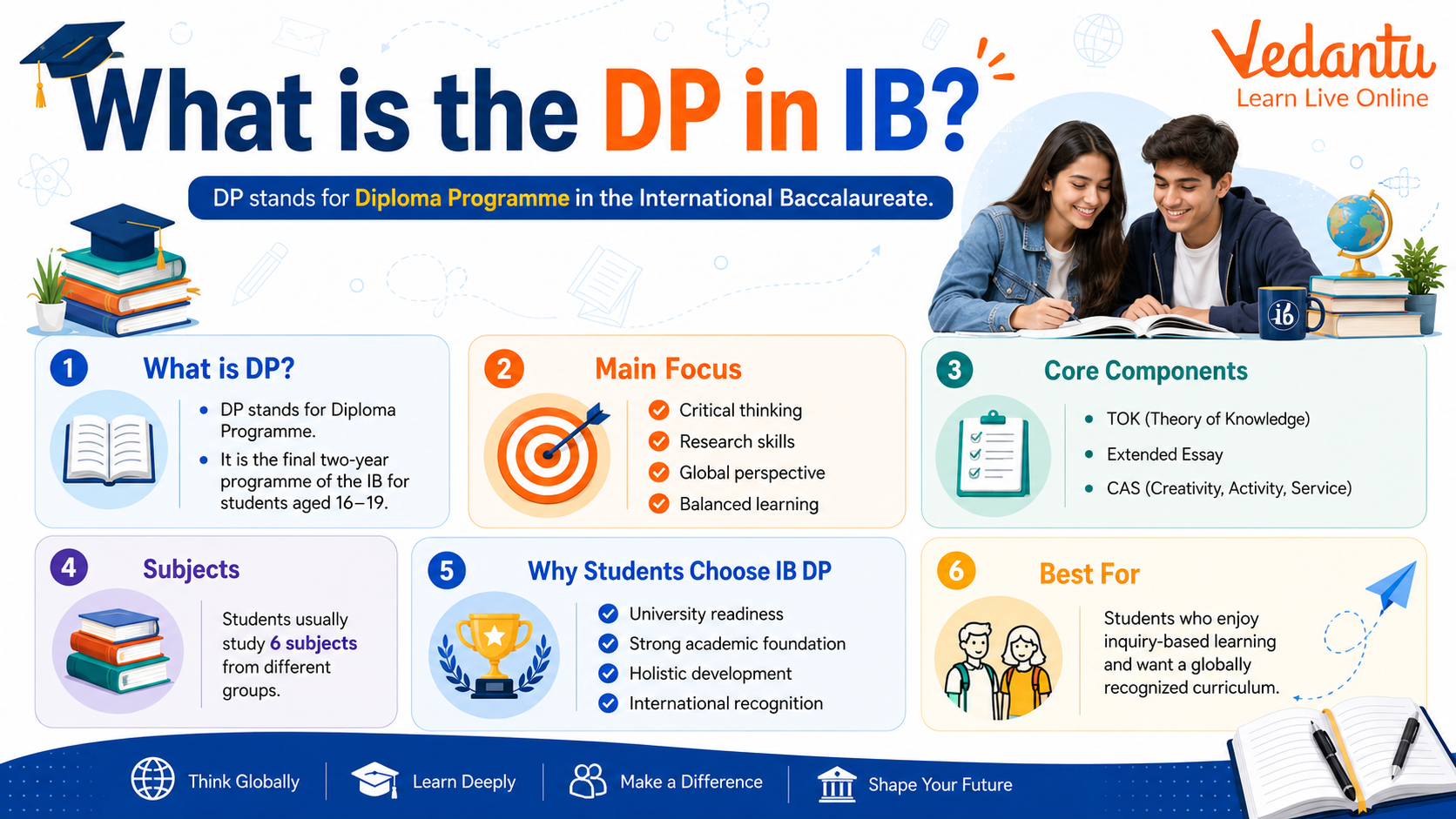
Understanding the IB DP matters because it affects subject choices, workload, and future study planning. This guide explains what the DP in IB is, how the dp curriculum works, what subjects are included, what the IB Diploma requirements involve at a high level, and how students can decide whether this pathway suits them.
What Is DP in IB Board?
DP in IB Board means Diploma Programme. It is part of the International Baccalaureate and is meant for older school students. The research brief describes it as a two-year academic programme that includes six subjects, internal and external assessment, and core parts such as TOK, EE, and CAS.
If someone asks, “What is the DP in IB in English?”, the simplest answer is this: it is an advanced school programme in which students study a balanced set of subjects while also building research, thinking, and time-management skills. It is often discussed when families compare school boards and international curricula.
What Is the IB Diploma Programme for Students?
The IB DP is for students who are moving through the later stage of school and want a broad but academically demanding programme. The report highlights that students usually explore this option when planning higher studies, comparing international school pathways, or choosing subjects with long-term goals in mind.
For students, the programme is often valued because it combines subject learning with wider academic development.
- It encourages study across multiple subject areas instead of a very narrow focus.
- It includes structured thinking, writing, and reflection through the core components.
- It is commonly associated with preparation for higher education and independent learning.
- It helps students build habits such as research, planning, and managing deadlines.
How Does the DP Curriculum Work?
The dp curriculum is built around six subject groups and a core. Students study subjects at two levels: Higher Level (HL) and Standard Level (SL). Along with this, they complete the core elements that are central to the full diploma.
| Part of IB DP | What It Includes | Why It Matters |
|---|---|---|
| Subject study | Six subjects chosen from the IB subject groups | Keeps learning broad and balanced |
| Levels | Higher Level and Standard Level | Lets students balance depth and workload |
| Core | TOK, EE, and CAS | Builds thinking, research, and wider participation |
| Assessment | Internal and external assessment | Measures learning in more than one way |
Parents sometimes search for an ib curriculum pdf when they want official details. This article gives a simple overview, but families should always read their school’s subject booklet and the official IB information for the exact courses available at that school.
What Subjects Are Offered in IB DP?
The research brief confirms that the IB DP is organised into six subject groups. Schools may not offer every subject in every group, so the exact list can vary by school. The table below shows the group structure and examples in a general, non-school-specific way.
| Subject Group | General Examples | Notes |
|---|---|---|
| Studies in language and literature | First-language literature or language-based courses | Supports reading and analytical writing |
| Language acquisition | Additional language study | Useful for multilingual learning |
| Individuals and societies | Humanities and social science subjects | Develops interpretation and argument |
| Sciences | Science-based courses | Common for STEM pathways |
| Mathematics | Math options within the IB framework | Important for many university routes |
| The arts | Creative and performance-related subjects | May be chosen where available |
HL generally means a subject studied in greater depth, while SL means a standard level of study within the programme. Students usually think carefully about which subjects to take at HL because those choices can affect workload and future course options.
What Are the IB Diploma Requirements?
At a high level, the research brief says that the full diploma involves subject study, assessment, and completion of the core. Because diploma rules are important and can be updated officially, this article keeps the explanation broad rather than giving unverified school-by-school detail.
| Requirement Area | High-Level Meaning |
|---|---|
| Six subjects | Students complete study across the subject groups within the programme structure |
| HL and SL combination | Students balance deeper and standard study levels |
| Core completion | TOK, EE, and CAS form an essential part of the full diploma |
| Assessment | Students are assessed through internal and external components |
IB Diploma vs IB Certificate
A common area of confusion is the difference between taking the full IB Diploma and taking individual IB courses or certificates. The research brief specifically notes that users want clarity here, so the simplest distinction is whether a student is completing the whole diploma framework or only selected parts of it.
| Feature | IB Diploma | IB Certificate / Individual Courses |
|---|---|---|
| Scope | Full programme pathway | Selected IB subjects or courses |
| Core | Includes the DP core structure | May not involve the complete diploma core framework |
| Purpose | For students pursuing the full diploma route | For students taking particular IB subjects |
What Is an IB Diploma Equivalent To?
In practical terms, the report suggests describing the IB Diploma as a senior secondary or pre-university qualification. It is also linked in search behaviour to questions like “Is IB DP the same as Class 11 and 12?” This comparison is useful for understanding stage, but it should not be treated as a blanket legal equivalence claim in every country or institution.
A careful way to understand it is this: IB DP covers the later school stage and is commonly used for progression to higher education. Students and parents should still check the current recognition rules of the universities, boards, or regulators relevant to their own country and admission plans.
How to Choose IB Subjects
Subject choice in IBDP should be thoughtful because it affects workload and future options.
- Start with your stronger subjects and the areas you genuinely enjoy studying.
- Think about future goals such as university courses or career directions.
- Choose HL subjects carefully because they usually require deeper study.
- Balance demanding subjects with ones you can manage consistently.
- Check what your school actually offers before making assumptions from general IB lists.
- Discuss options with teachers, counsellors, and parents before finalising choices.
Students who are still exploring streams may also find it useful to read science stream decision-making tips after Class 10, points to consider while choosing a stream after 10, and a broader look at Indian boards and international boards.
Is IB DP a Good Choice for Every Student?
The IB DP can be a strong fit for students who are comfortable with reading, writing, reflection, and independent academic work. The report also notes that users want an honest view of difficulty and suitability, so it is important to keep the answer balanced.
The programme may suit students who:
- can manage a steady workload across different subjects,
- are ready for writing and research tasks,
- want a broad curriculum instead of studying only a narrow set of subjects,
- are willing to build planning and time-management habits.
It may feel more challenging for students who prefer a simpler routine or are still developing strong study habits. In such cases, support with planning, basics, and revision can make a big difference. For broader study support, readers can explore the Vedantu blog and time management tips for students.
Common Terms Students and Parents Should Know in IB DP
| Term | Simple Meaning |
|---|---|
| DP | Diploma Programme |
| IB DP / IBDP | Short form for the IB Diploma Programme |
| HL | Higher Level subject study |
| SL | Standard Level subject study |
| TOK | Theory of Knowledge, part of the DP core |
| EE | Extended Essay, part of the DP core |
| CAS | Core component linked to wider student participation |
| DP teacher | A teacher working within the Diploma Programme context at school |
| Coordinator | A school staff member who helps oversee the programme |
Conclusion
DP in IB Board means the Diploma Programme, a two-year International Baccalaureate pathway for older school students. It combines six subjects, HL and SL choices, assessment, and the core elements of TOK, EE, and CAS. For families comparing curricula, the best way to understand IB DP is to look at its structure, subject balance, and workload together. Once students know their strengths and goals, they can decide whether the programme is the right academic fit for them.
FAQs on IB Diploma Programme Explained: Meaning, Subjects and Requirements
1. what is the dp in ib in english
DP in IB stands for Diploma Programme. It is a two-year, pre-university programme offered by the International Baccalaureate (IB) for students generally aged 16 to 19. The IB DP combines six academic subjects with three core components: Theory of Knowledge (TOK), the Extended Essay (EE), and Creativity, Activity, Service (CAS).
2. what is the dp in ib for students
The IB Diploma Programme is an academically demanding senior-secondary pathway that helps students prepare for university and independent learning. Students complete:
- Six subjects at Higher Level (HL) and Standard Level (SL).
- The TOK, Extended Essay, and CAS core.
- Internal assessments, coursework, and final examinations.
- Research, critical-thinking, communication, and time-management activities.
3. how to choose ib subjects
Choose IB subjects by matching your strengths and interests with university entry requirements. Follow these steps:
- Identify the subjects you understand and enjoy most.
- Check the prerequisites for your intended university course.
- Select Higher Level subjects that support your academic goals.
- Balance demanding subjects to keep the overall workload manageable.
- Review the IBDP subjects available at your school.
- Consult teachers, the DP coordinator, and your parents before finalising the combination.
4. dp teacher meaning in school
A DP teacher is a teacher who teaches a subject within the IB Diploma Programme. A DP teacher plans lessons according to IB course requirements, supports internal assessments, develops subject-specific skills, and prepares students for external examinations. This role is different from that of the DP coordinator, who oversees the programme's administration and implementation across the school.
5. what is an ib diploma equivalent to
The IB Diploma is a senior-secondary or pre-university qualification completed during the final two years of school. In terms of educational stage, it broadly corresponds to Years 12 and 13 or Classes 11 and 12, depending on the national system. However, formal equivalence and admission rules vary by country, university, and course, so students should confirm the latest requirements with the relevant institution.
6. ib curriculum pdf
An IB curriculum PDF usually provides details about the Diploma Programme structure, subjects, core components, and assessment. Students should use the latest programme documents and their school's subject-selection booklet because available IB subjects, HL and SL options, deadlines, and course combinations can differ between IBDP schools. Always verify that a downloaded document applies to the current teaching and assessment cycle.
7. What is the DP curriculum?
The DP curriculum consists of six subjects and the IB Diploma core. Students normally take three subjects at Higher Level and three at Standard Level, although four HL subjects may be permitted. The six subject groups cover:
- Studies in language and literature.
- Language acquisition.
- Individuals and societies.
- Sciences.
- Mathematics.
- The arts, or an eligible additional subject from another group.
Students also complete TOK, the Extended Essay, and CAS.
8. What are the IB Diploma requirements?
To earn the full IB Diploma, students must complete six subjects, the three core components, and all required assessments. The principal requirements include:
- Completing an approved combination of HL and SL subjects.
- Completing Theory of Knowledge and the Extended Essay.
- Meeting the learning outcomes for Creativity, Activity, Service.
- Completing internal and external assessments.
- Earning at least 24 points while satisfying the IB's additional passing conditions.
The maximum Diploma Programme score is 45 points: up to 42 from subjects and up to three additional points from TOK and the Extended Essay.
9. What is the difference between an IB Diploma and an IB certificate?
The IB Diploma represents completion of the full Diploma Programme, while individual IB course results cover selected subjects. Diploma candidates study six subjects, complete TOK, EE, and CAS, and meet all diploma-award conditions. Students who take individual DP courses receive results for those completed subjects but do not receive the full IB Diploma. The term IB certificate is commonly used informally for this course-based route.
10. What is IB in high school?
IB in high school refers to International Baccalaureate programmes taught during the secondary-school years. For older high-school students, this usually means the IB Diploma Programme or individual DP courses. The curriculum combines subject knowledge with research, inquiry, intercultural understanding, communication, and independent study skills.
11. What subjects are included in the IBDP subjects list?
The IBDP subjects list is organised into six subject groups. Depending on the school, options may include languages and literature, additional languages, history, geography, economics, business management, psychology, biology, chemistry, physics, computer science, mathematics, visual arts, music, theatre, and other approved courses. Each IBDP school offers its own selection, so students must check local availability before choosing their HL and SL subjects.



