



Key Features of Effective NEET 2027 Study Modules and Practice Sets
Good NEET coaching study material should help you understand a chapter, practise it independently and identify what still needs work. Modules need clear explanations and worked examples; daily practice problems need focused questions with useful solutions; question banks need varied, syllabus-aligned practice rather than inflated question counts. Before choosing a package, examine how these resources work together. A manageable set that you can complete, review and revise is more useful than a large collection you rarely revisit.
Discover Our Classes With A Guided Centre Tour
Modules, DPPs and Question Banks Should Do Different Jobs
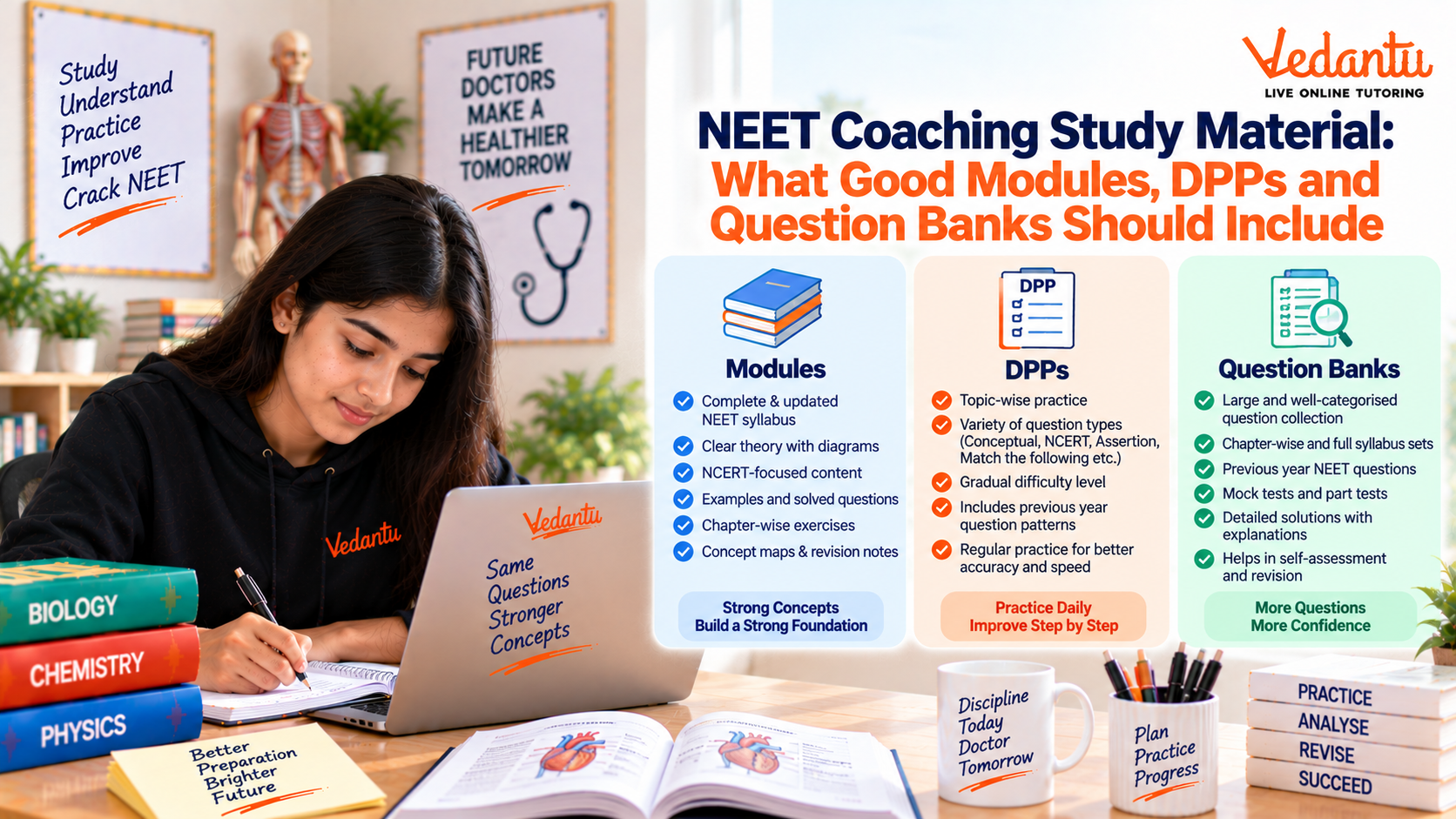
These resources should form a learning sequence, not repeat the same exercise under different names. A module teaches and organises a chapter. A DPP, or daily practice problem sheet, checks the topics recently studied. A question bank broadens practice and helps you return to weak areas after the first round of learning.
| Resource | What It Should Include | How to Judge Its Usefulness |
|---|---|---|
| Chapter module | Theory, diagrams, worked examples, graded exercises and revision notes | Can you understand the method and attempt a fresh question without copying? |
| DPP | Defined topic coverage, a manageable question set, suggested time and explanations | Does it reveal gaps in the lesson while leaving time to correct them? |
| Question bank | Topic tags, varied questions, labelled previous-year questions and mixed practice | Can you select questions for a specific weakness and later test transfer? |
| Revision and test sets | Cumulative coverage, clear instructions, solutions and a review record | Can you recall and apply concepts when the chapter is not announced? |
Chapter-wise practice is valuable while learning, but it gives away which concept to use. Mixed sets remove that clue. A complete material package should support both stages rather than stopping at chapter completion.
A Practical NEET Coaching Module Content Checklist
Start with coverage and clarity, not the thickness of the books. For NEET 2027 preparation, compare the contents with the official NMC syllabus and use NTA’s information bulletin for the applicable examination instructions. A year printed on the cover does not establish that every chapter or practice set has been updated.
- A clear syllabus map: Chapters and subtopics should be easy to locate. Optional enrichment should be separated from material required for the syllabus.
- Prerequisite support: A chapter should identify earlier ideas needed to understand it, such as vectors before force problems or mole calculations before stoichiometry.
- Readable theory: Definitions, reasoning, conditions and exceptions should appear together. Short notes should not remove the explanation needed by a first-time learner.
- Worked examples: Examples should explain why a method applies, not merely substitute values into a formula.
- Progressive exercises: Basic concept checks should lead to application and mixed-concept questions. Difficulty labels should guide practice, not make every exercise appear advanced.
- Revision support: Formula sheets, concept maps and mistake warnings should help recall after learning, rather than pretend to replace the chapter.
- Reliable solutions and corrections: Question numbering should match the solutions, and students should have a clear way to report errors and obtain corrections.
NCERT textbooks and coaching modules serve related but different purposes. Use NCERT for careful reading, terminology, diagrams and textbook examples, especially in Biology and relevant Chemistry topics. Use modules to clarify difficult ideas and organise practice. Neither a module’s “NCERT-based” label nor a collection of highlighted lines proves complete coverage of the official syllabus.
What to Look for in Each Subject
- Physics: Look for diagrams, units, sign conventions, assumptions, graph interpretation and multi-step reasoning. Numerical practice should vary the setup, not just the numbers.
- Chemistry: Physical Chemistry needs worked calculations and units. Organic Chemistry needs reaction conditions, reasoning and distinctions between similar reactions. Inorganic Chemistry needs accurate statements, comparisons and clearly explained exceptions.
- Biology: Look for precise terminology, readable labelled diagrams, process sequences and questions that distinguish closely related concepts. Explanations should correct misleading statements rather than only identify the right option.
For a student with weak basics, a concise module can become difficult if it skips intermediate steps. Vedantu’s discussion of NEET coaching for students with weak basics is a relevant next read when deciding whether the material’s pace and assumed knowledge match your starting point.
What Good NEET DPP Practice Sheets Should Include
A useful DPP checks whether you can apply a lesson independently while there is still time to repair misunderstandings. It should identify the topics covered and fit the teaching sequence. A sheet dominated by concepts not yet taught is a poor daily diagnostic, even if the questions themselves are accurate.
- Focused coverage: Most questions should relate to recently studied topics, with selected earlier concepts included for recall.
- Purposeful variety: Include direct concept checks, applications and common misconceptions rather than many near-identical questions.
- A realistic time guide: Timing should reflect the question type and learning stage. First attempts may reasonably take longer.
- Explanations after the attempt: Solutions should be accessible for review but separate enough to discourage accidental peeking.
- A follow-up route: Wrong answers should point you towards a concept, example or related exercise to revisit.
There is no universal ideal DPP question count. A short set of demanding Physics numericals may require more time than a longer set of direct Biology questions. Judge NEET coaching daily practice problems by the learning they produce and whether you can review them before the next assignment.
For example, after studying Newton’s laws, a focused sheet might move from identifying forces to drawing free-body diagrams, then applying equations to different situations. If every question merely changes the mass in the same setup, it checks repetition more than understanding.
A Question Bank Needs Variety, Traceability and Strong Solutions
A question bank should make targeted practice easy. Chapter and subtopic tags help you find questions on a weak concept; difficulty labels help sequence them; mixed sets show whether the improvement survives outside a familiar exercise. Thousands of unclassified questions can create more work without improving diagnosis.
- Accurate question construction: Wording, diagrams, data and options should support an unambiguous intended answer.
- Meaningful variation: Questions should change the context, representation or reasoning demand, not repeatedly test one memorised shortcut.
- Clearly labelled previous-year questions: Actual papers should retain their original year. Adapted questions should be identified as adapted rather than presented as exact reproductions.
- Syllabus-aware older questions: Historical questions that fall outside the applicable syllabus should be flagged or separated.
- Useful explanations: Numerical solutions need steps and units. Conceptual solutions need the governing idea; explanations of tempting wrong options are particularly helpful.
- Reattempt tracking: A digital filter or a simple printed marking system should let you return to incorrect, guessed and unusually slow questions.
An answer key is not the same as a solution. For a body starting from rest with constant acceleration of 2 m/s2 for 3 s, a helpful solution identifies constant acceleration, uses s = ut + ½at2, substitutes u = 0 and obtains 9 m. It also makes clear why distance = final speed × time would be incorrect: the speed changes during the interval.
If a solution still leaves you unsure, the next step is to identify the exact difficulty: interpreting the question, selecting the principle or performing the calculation. Vedantu’s explanation of the importance of doubt solving in NEET coaching can help you judge why solution access and opportunities to clarify reasoning should be considered separately.
Review a Sample Chapter Before Choosing the Full Package
A useful NEET coaching modules review examines the learning experience, not just a contents page. Request a complete sample chapter with its exercises and solutions. If possible, also inspect material from a subject you find difficult, since a polished sample from your strongest subject may hide a mismatch.
- Read one unfamiliar subtopic: Check whether the explanation introduces new terms and makes diagrams understandable.
- Study an example, then close it: Attempt a related question independently. This tests whether the example teaches a method.
- Try different question types: Include a straightforward question, an application and a previous-year question where available.
- Inspect the solutions: Look for skipped steps, unexplained exceptions, mismatched options and inconsistent notation.
- Test retrieval: After a gap, attempt a fresh question on the same concept without rereading first.
- Assess the workload: Estimate whether assignments leave enough time for NCERT reading, schoolwork, revision and error correction.
Warning signs include frequent answer-key errors, unreadable diagrams, copied exercises presented as new practice and large amounts of unexplained advanced content. One difficult question is not a reason to reject a resource. Repeated obstacles that prevent independent learning are more important.
Printed Material, Digital Resources and Coaching Support
NEET coaching printed study material can suit students who prefer writing beside questions and studying away from a screen. Digital resources can make searching, filtering and tracking easier when those functions are included. Neither format guarantees better questions, and both need readable diagrams, usable solutions and a practical revision system.
With self-study, the student selects exercises, schedules revision and finds help for unresolved doubts. Recorded-only courses offer recorded explanations, but interaction, assignment checking and additional support depend on the package. In live online or classroom coaching, the key question is whether lesson-linked assignments and discussion actually help you correct mistakes; the teaching format alone does not establish that.
If you are considering Vedantu alongside other coaching institutes or self-study, apply the same sample-chapter test to every option. Use Vedantu’s online NEET course checklist to connect material quality with your broader learning needs. Before enrolling, confirm the current course’s material format, sample access, solution support, doubt process, access validity and any separate printing or delivery charges.
The practical benefit of a coaching-linked package is strongest when explanations, assignments and feedback address the same learning gaps. A student who understands theory but struggles to apply it needs different support from one who mainly needs organised revision. Choose according to that need rather than assuming that more books or more class hours will solve it.
Turn the Material into a Repeatable Study Routine
Material quality matters only if practice leads to correction and recall. Use one main module and question bank consistently before adding another source. Keep revision notes selective: record missing conditions, confusing distinctions and errors you actually make, rather than rewriting every page.
- After learning: Recall the key ideas without looking, then attempt the relevant DPP independently.
- During review: Classify errors as concept gaps, recall failures, calculation or reading mistakes, or time-management problems. Mark correct guesses too.
- Repair the cause: Revisit the relevant explanation, write a brief correction and solve a fresh related question.
- After a gap: Reattempt marked questions without the solution. A next-day check and another later in the week are useful starting points, adjustable to your workload.
- During cumulative revision: Use mixed questions and tests to check whether you can select the method without a chapter label.
Class 11 students should prioritise foundations and sustainable daily practice. Class 12 students need material that allows current chapters and earlier-topic revision to run together. Droppers should use diagnostic practice to decide which chapters need full relearning and which need targeted correction. Across all stages, improvement on fresh questions is a stronger sign of progress than recognition of familiar answers.
Summary
Good NEET study material combines clear chapter teaching, focused DPPs, varied question-bank practice and solutions that explain the reasoning. Choose resources aligned with the applicable syllabus and manageable within your routine, then judge progress through delayed recall and fresh questions. Vedantu’s linked guidance on course selection and doubt solving offers useful support for evaluating these needs. Start by reviewing a complete sample chapter before committing to a larger package.
FAQs on What Makes Good NEET 2027 Coaching Study Material: Modules, DPPs & Question Banks
1. What should high-quality NEET coaching study material for NEET 2027 include?
High-quality NEET coaching material should cover all essential exam topics with detailed explanations and varied practice problems. Key components include:
• Concept modules for Physics, Chemistry, and Biology
• Daily Practice Problems (DPPs) for regular assessment
• Topic-wise question banks with previous years’ NEET questions
• NCERT-centric notes aligned to the latest syllabus
• Revision mind maps and summary sheets
• Mock tests and full-length test series
2. How do Daily Practice Problems (DPPs) benefit NEET 2027 aspirants?
DPPs help NEET students build strong concepts and improve problem-solving speed. Benefits include:
• Consistent daily practice on core syllabus areas
• Exposure to variety of NEET pattern questions
• Progressive difficulty to boost confidence
• Immediate self-assessment with provided solutions
• Improved focus on important chapters and weak areas
3. Are question banks with previous years’ NEET questions necessary for NEET 2027 preparation?
Yes, question banks with past NEET questions help students
• Understand common question patterns
• Identify important topics based on frequency
• Practice time management
• Get familiar with NEET exam difficulty levels
• Boost accuracy and confidence in real exam scenarios
4. What are the key features of effective NEET modules for NEET 2027?
Effective NEET modules are:
• Aligned with the latest NEET syllabus
• Written in simple, clear language
• Include illustrations, charts, diagrams
• Provide examples for each concept
• End-chapter exercises with solutions
• Focused on NCERT and high-weightage topics
5. How should students use study material, DPPs, and question banks for best results?
For optimal NEET preparation:
1. Read modules and make revision notes
2. Solve DPPs daily to reinforce new concepts
3. Attempt topic-wise question banks regularly
4. Analyze mistakes and revise weak chapters
5. Take full-length mock tests under exam conditions
6. Are mock tests and solutions important in NEET study material?
Yes, mock tests and detailed solutions are essential for NEET because they:
• Provide real exam experience
• Help with time management and accuracy
• Allow analysis of performance and weak areas
• Teach correct approaches with step-wise solutions
7. How do NEET 2027 modules address frequently asked Biology concepts?
NEET modules cover key Biology chapters in detail by:
• Summarizing NCERT points and diagrams
• Providing high-yield facts and memory aids
• Including assertion-reason and MCQ formats
• Focusing on Genetics, Plant Physiology, Human Physiology, Ecology
8. Does Vedantu’s NEET 2027 study material follow the updated NEET syllabus?
Yes, Vedantu’s NEET study materials are
• Strictly aligned with the latest NEET exam pattern
• Updated according to the latest NMC and NTA guidelines
• Centered around NCERT curriculum for all three subjects
9. What makes a NEET question bank effective for practice?
An effective NEET question bank will:
• Cover all chapters with a mix of easy, moderate, and tough questions
• Include objective types: MCQs, assertion-reason, and case-based MCQs
• Offer detailed solutions and explanations
• Regularly update with latest exam trends and important questions
10. How do students identify which modules and resources suit their NEET exam needs?
Students should choose modules that:
• Are syllabus-specific and organized by topic
• Provide ample practice through DPPs and mock tests
• Contain clear explanations and conceptual clarity
• Are curated by experienced NEET educators
• Offer progressive revision and self-assessment tools
11. What is the importance of including NCERT-based questions in NEET 2027 study materials?
Including NCERT-based questions ensures:
• Maximum alignment with actual NEET questions
• Strong conceptual foundation
• No syllabus gaps, as NEET is primarily based on NCERT textbooks
• Direct practice on expected exam patterns
12. Can NEET aspirants rely on coaching modules alone for NEET 2027 success?
While coaching modules provide structured preparation, students should:
• Complement them with NCERT textbook reading
• Regularly attempt mock tests and previous year questions
• Use personal notes for targeted revision
Relying only on modules without active practice and revision may limit exam readiness.



