



Key Features Every Top Online NEET 2027 Course Should Offer
A good online NEET course should connect clear teaching with regular practice, doubt resolution, testing and revision—not simply provide a large library of videos. For students and parents, the key is to judge what happens after each lesson: can the student solve questions independently and get help when stuck? Choose a course that covers the required syllabus, fits the student’s preparation stage and leaves enough time to study without a teacher.
Visit Our Vedantu Learning Centres Near You
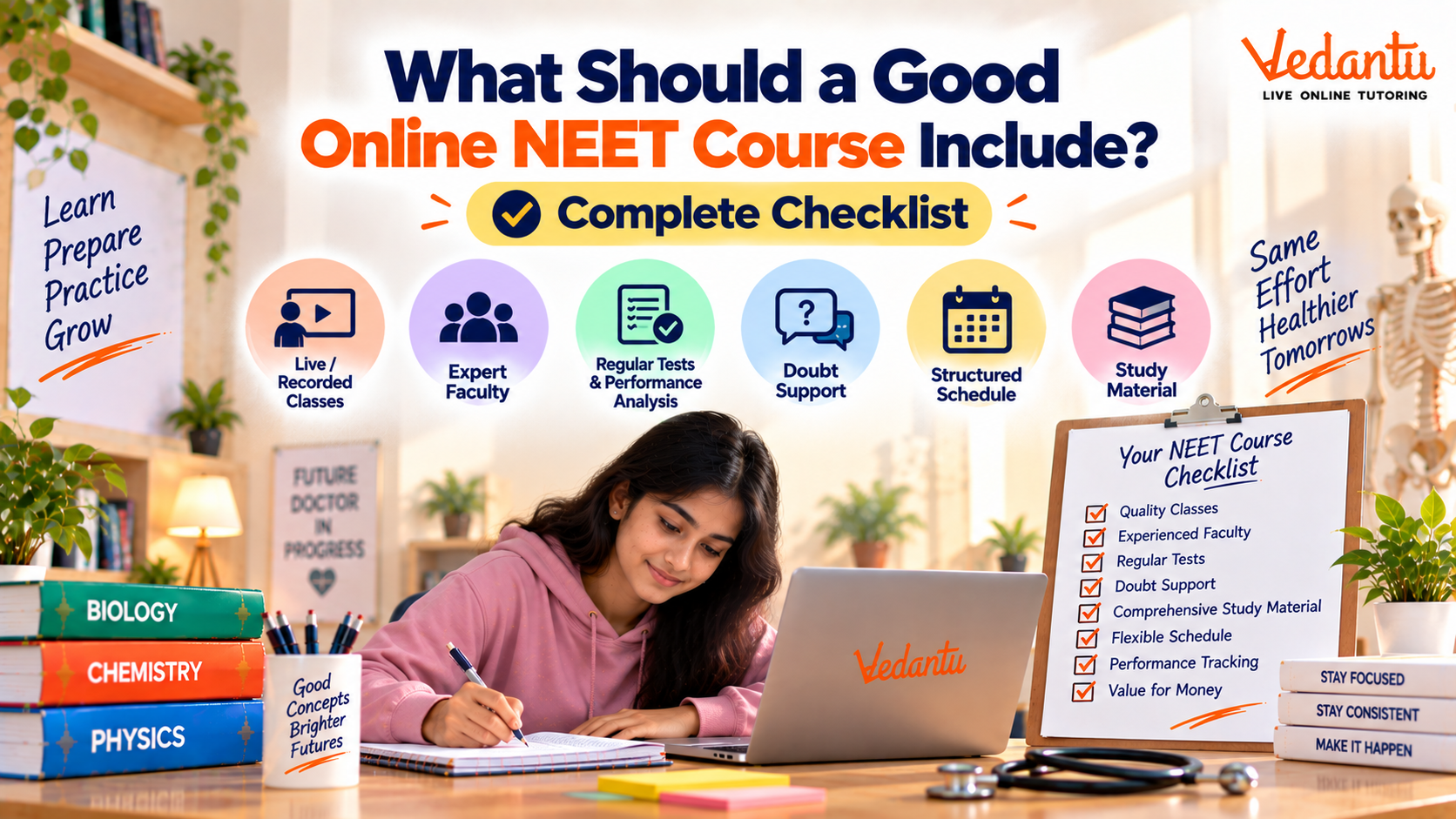
Online NEET Course Checklist: What to Look For
Use this checklist to compare the exact batches you are considering, rather than judging an entire institute by its advertisements. A feature counts only when its scope is clear: “doubt support”, for example, should explain who answers questions, how students submit them and when help is available.
| Essential feature | What a useful course should include | Evidence to request |
|---|---|---|
| Syllabus coverage | Physics, Chemistry and Biology mapped to the applicable official NEET syllabus. | Chapter plan with completion and revision milestones. |
| Teaching quality | Concept explanations, worked examples and independent questions. | A representative lesson from the intended batch teacher. |
| Learning materials | Readable notes, NCERT-linked study guidance and explained practice questions. | A chapter module and its answer explanations. |
| Interaction and doubts | A practical way to ask questions and clarify unresolved answers. | The submission process, support hours and follow-up rules. |
| Practice and tests | Chapter tests, cumulative tests, previous-year questions and full-syllabus mocks. | Test calendar, sample paper and solutions. |
| Actionable feedback | Topic-level performance information that supports corrective practice. | A sample report and explanation of how students use it. |
| Revision and catch-up | Spaced revision and a workable method for recovering missed lessons. | Revision timetable and recording or replacement-lesson terms. |
| Schedule and language | Manageable teaching hours and explanations the student understands. | Weekly timetable, teaching language and material language. |
| Technical access | Usable classes, readable diagrams and accessible tests on the student’s device. | Device requirements, access restrictions and technical-help process. |
| Transparent cost | A written breakdown of inclusions, exclusions and access validity. | Total payable fee and cancellation, refund and batch-transfer terms. |
Check Content Quality Across All Three Subjects
A long chapter list does not prove that a course teaches each chapter well. Compare its coverage with the applicable official NEET syllabus published by the National Medical Commission, and use the National Testing Agency’s information bulletin for the relevant attempt’s examination requirements. NCERT should be a central study resource, but a course still needs to develop understanding and question-solving ability.
- Physics: Look for explanations of assumptions, diagrams, units and the reasoning behind equations. After a worked example, students should solve a related question independently—not only copy the teacher’s steps.
- Chemistry: Physical Chemistry needs numerical practice and conceptual reasoning. Organic Chemistry should connect reactions through underlying ideas, while Inorganic Chemistry needs careful reading, factual accuracy and repeated recall.
- Biology: Teaching should explain NCERT terminology, diagrams, processes and exceptions. Practice should help students distinguish closely worded statements rather than rely only on memorised answer patterns.
Inspect a sample module for clear diagrams, correct answer keys and explanations of why an answer is right. Previous-year questions should retain their actual examination year, with any relevance to a changed syllabus made clear. More questions are not automatically better if they repeat the same task or contain unresolved errors.
Evaluate Live Classes by Participation, Not Just Duration
Useful online NEET course live class features make understanding visible. A teacher should be able to check whether students can apply an idea through questions, polls or another response mechanism. A live broadcast with no usable interaction may offer little advantage over a recording for a student who needs frequent clarification.
- Understandable pace: There should be time to think, take essential notes and attempt questions before the solution appears.
- Accessible questions: Find out whether questions go to the teacher, a support educator or a separate doubt channel, and how unanswered questions are handled.
- Consistent teaching: Evaluate the faculty assigned to the intended batch, not only a promotional lesson delivered by someone else.
- Missed-class recovery: If recordings are included, establish when they become accessible, how long they remain available and whether access continues through revision.
When a sample lesson is available, choose a topic you find moderately difficult. Afterwards, explain the idea without looking at your notes and attempt a few related questions. This gives a more useful indication of teaching fit than entertainment value or lecture length.
Doubt Support Should Help You Solve the Next Question
Good doubt resolution identifies the missing step in your thinking. Receiving the correct option alone is not enough; the explanation should help you understand why your approach failed and how to handle a similar question independently.
For example, a student confused about friction may need help identifying its direction before substituting values into an equation. A useful support process allows the student to share their attempted solution and ask a follow-up question. Vedantu’s resource on the importance of doubt solving in NEET coaching is a relevant next step when deciding how much academic interaction you need.
Tests Must Lead to Correction, Not Just Scores
A good test programme progresses from recently taught chapters to mixed-topic and full-syllabus papers. Chapter tests reveal immediate gaps; cumulative tests check whether older learning is retained. Full-length mocks should reflect the applicable official examination pattern and leave time for review before the next test.
Look for solutions and performance reports that support this practical review process:
- Review wrong, skipped and guessed answers: A correct guess can hide a weak concept just as easily as a wrong answer reveals one.
- Classify the cause: Separate conceptual gaps, forgotten facts, calculation errors, misread wording and time-pressure mistakes.
- Repair the specific gap: Revisit the relevant explanation or NCERT passage, then solve a small set of similar questions.
- Retest later: Include the topic in a subsequent mixed practice session to see whether the improvement lasts.
A dashboard showing only marks and rank is less useful than feedback that helps you decide what to study next. For turning those findings into a regular study routine, use Vedantu’s NEET preparation tips alongside your own error log.
Match the Course Structure to Your Preparation Stage
The same course pace will not suit every NEET aspirant. Calculate the full weekly workload—classes, homework, tests and test analysis—before deciding whether a batch fits. A timetable that leaves no room for independent practice is not a workable preparation plan.
- Starting in Class 11: Prioritise gradual concept building, regular homework and revision of previously completed chapters. Early testing should identify gaps before they grow.
- Studying in Class 12: Look for a clear way to balance current topics with Class 11 revision and school commitments. Avoid a plan that postpones all earlier chapters until the end.
- Taking a drop year: Begin with a diagnostic assessment. Choose between detailed reteaching and faster revision according to your actual gaps, rather than assuming every dropper needs the same pace.
As an illustrative weekly structure, keep a short review after each class, question practice before the next related lesson, one older-topic revision block and a test-analysis block. Include some catch-up time. Recordings can support recovery, but repeatedly postponing live lessons can create a backlog that becomes difficult to clear.
Compare Online Coaching with Other Learning Options
Choose the format that solves your main preparation problem. Some students need scheduled teaching and accountability; others already understand the syllabus and mainly need practice. Features vary by provider and batch, so these are format-level trade-offs, not promises about any particular course.
| Learning option | Interaction | Schedule and access | Main trade-off |
|---|---|---|---|
| Live online coaching | Real-time teaching; question handling depends on the batch. | Scheduled classes without a commute; recordings are course-dependent. | Provides structure but needs reliable connectivity and attention at home. |
| Recorded-only courses | No live interaction within lessons; separate support may vary. | Self-paced viewing within access terms. | Offers pacing control but requires stronger self-management. |
| Traditional classroom coaching | In-person teaching; individual access depends on class arrangements. | Fixed venue and timetable; catch-up arrangements vary. | Provides a physical study setting but involves travel. |
| Self-study with a test series | Teaching and doubt help must be arranged separately if needed. | Student-led study around the chosen test schedule. | Allows targeted preparation but requires independent planning and correction. |
If commuting is the main obstacle, Vedantu’s discussion of the benefits of NEET online coaching can help you consider the format. Balance potential time savings against your home study environment and ability to stay focused on a device.
How to Evaluate Vedantu for Your NEET Preparation
If you are considering Vedantu, use its NEET Online Course Guide to organise questions about classes, faculty, tests, doubts, schedules and fees. These questions help distinguish between needing a complete teaching programme and needing targeted revision or practice support.
Compare the specific Vedantu option under consideration with a recorded course, classroom batch or self-study plan using the same checklist. For a Class 11 learner, examine the chapter sequence and teaching pace; for a Class 12 learner, examine the balance between current learning and earlier topics; for a dropper, examine how the proposed workload addresses identified weaknesses.
Before enrolling, obtain the current batch details and written terms directly from Vedantu, including the teaching format, faculty, language, academic support, access period and total payable fee. Do not assume that a feature described for one programme is included in another. The useful choice is the one whose actual provisions fit your study needs.
Final Selection: Essential Requirements and Warning Signs
First eliminate courses that fail your essential requirements: understandable teaching, correct syllabus coverage, workable timing and affordable total cost. Then compare the remaining options on the support you need most. Extra materials or attractive add-ons should not compensate for a poor fit on these basics.
- Calculate the total cost: Include applicable taxes and any separately charged materials, tests or support. If a scholarship or instalment offer is involved, read its conditions rather than comparing only the advertised amount.
- Test practical access: Check whether equations and Biology diagrams are readable on your usual device and whether the class format works with your internet connection.
- Watch for vague promises: Unclear doubt-support arrangements, missing access dates and no sample academic material make the offering difficult to evaluate.
- Reject guaranteed outcomes: A course can support preparation; it cannot guarantee a particular score, rank or admission.
- Choose a sustainable workload: More daily lectures are not better if they remove the time needed to practise, revise and sleep adequately.
Summary
A good online NEET course should combine syllabus-aligned teaching, subject-specific practice, meaningful doubt resolution, progressive testing and planned revision. Judge these features through sample lessons, materials, reports and written terms—not promotional claims alone. Vedantu’s linked NEET course and preparation resources can help you organise that evaluation. Shortlist options that suit your preparation stage, then compare their actual workload, academic support, access conditions and total cost before enrolling.
FAQs on What Should a Good Online NEET Course Include? Complete Checklist
1. What should a good online NEET 2027 course include?
A good online NEET 2027 course should provide comprehensive preparation, covering all syllabus topics and exam formats. Key inclusions are:
- Live interactive classes led by expert NEET faculty
- Comprehensive study material (NCERT-aligned)
- Recorded lectures for flexible revision
- Regular practice tests & full mock tests
- Doubt-solving sessions with instant resolution
- Personalized progress tracking & performance analysis
- Access to previous years’ papers and detailed solutions
2. Are NEET online courses effective for self-study?
Yes, NEET online courses are highly effective for self-study due to flexible schedules and diverse learning resources. Benefits include:
- Self-paced learning with access to recorded sessions
- Regular assessments for tracking improvements
- Doubt-clearing forums and mentor support
3. What is the importance of doubt-solving features in online NEET courses?
Doubt-solving features are crucial in online NEET courses because they:
- Ensure clear understanding of complex concepts
- Provide instant expert guidance
- Boost student confidence by resolving queries quickly
- Encourage interactive learning
4. How are mock tests structured in top NEET online courses?
Mock tests in leading NEET online courses are structured to closely replicate actual exam conditions. They usually include:
- Subject-wise and full-length tests
- Varied question patterns based on latest NEET exam blueprint
- Allotted time limits for each section
- Detailed performance analytics to assess strengths and weaknesses
5. Can students access previous NEET question papers through online courses?
Most reputable NEET online courses provide access to previous years’ NEET question papers with detailed solutions for thorough exam practice and deeper understanding of the exam pattern.
6. What technology requirements do students need for an effective NEET online course?
Students need basic technology requirements for a smooth NEET online learning experience, such as:
- Reliable internet connection
- Smartphone, tablet, or computer
- Updated browser or learning app provided by the platform
- Headphones and microphone for interactive classes
7. How is progress monitored in NEET 2027 online courses?
Progress in NEET 2027 online courses is tracked using:
- Personalized dashboards showing completed topics and test scores
- Performance analytics for each subject
- Regular feedback from expert mentors
8. Do NEET online courses offer performance analysis after tests?
Yes, most NEET online courses offer detailed performance analysis after each test, helping students identify strong and weak areas and devise targeted revision strategies.
9. Are NEET course materials updated as per the latest syllabus?
Leading NEET online courses ensure that all study materials, test papers, and lectures are regularly updated according to the latest NEET 2027 syllabus and exam pattern.
10. How does an online NEET course support students’ time management?
An online NEET course supports efficient time management by offering:
- Flexible learning schedules and study planners
- Recorded sessions for convenient revision
- Timed practice tests to build exam stamina and speed
11. Does Vedantu offer free trial classes for NEET courses?
Yes, Vedantu often provides free trial classes for NEET online courses. This allows students to experience interactive learning, expert teaching methods, and platform features before enrolling fully.
12. Can I interact with NEET mentors or teachers directly during the online course?
In most NEET online courses, including Vedantu’s, students can directly interact with teachers and mentors during live sessions and through doubt-solving features for personalized guidance and support.



