



When Is Govardhan Puja 2026? November 9 or 10?
Govardhan Puja 2026 falls during Kartik Shukla Pratipada, which starts on Monday, 9 November at 12:31 PM and ends on Tuesday, 10 November at 2:00 PM. According to Drik Panchang, the auspicious Govardhan Puja Pratahkal Muhurat in New Delhi is 6:40 AM to 8:50 AM on 10 November 2026.
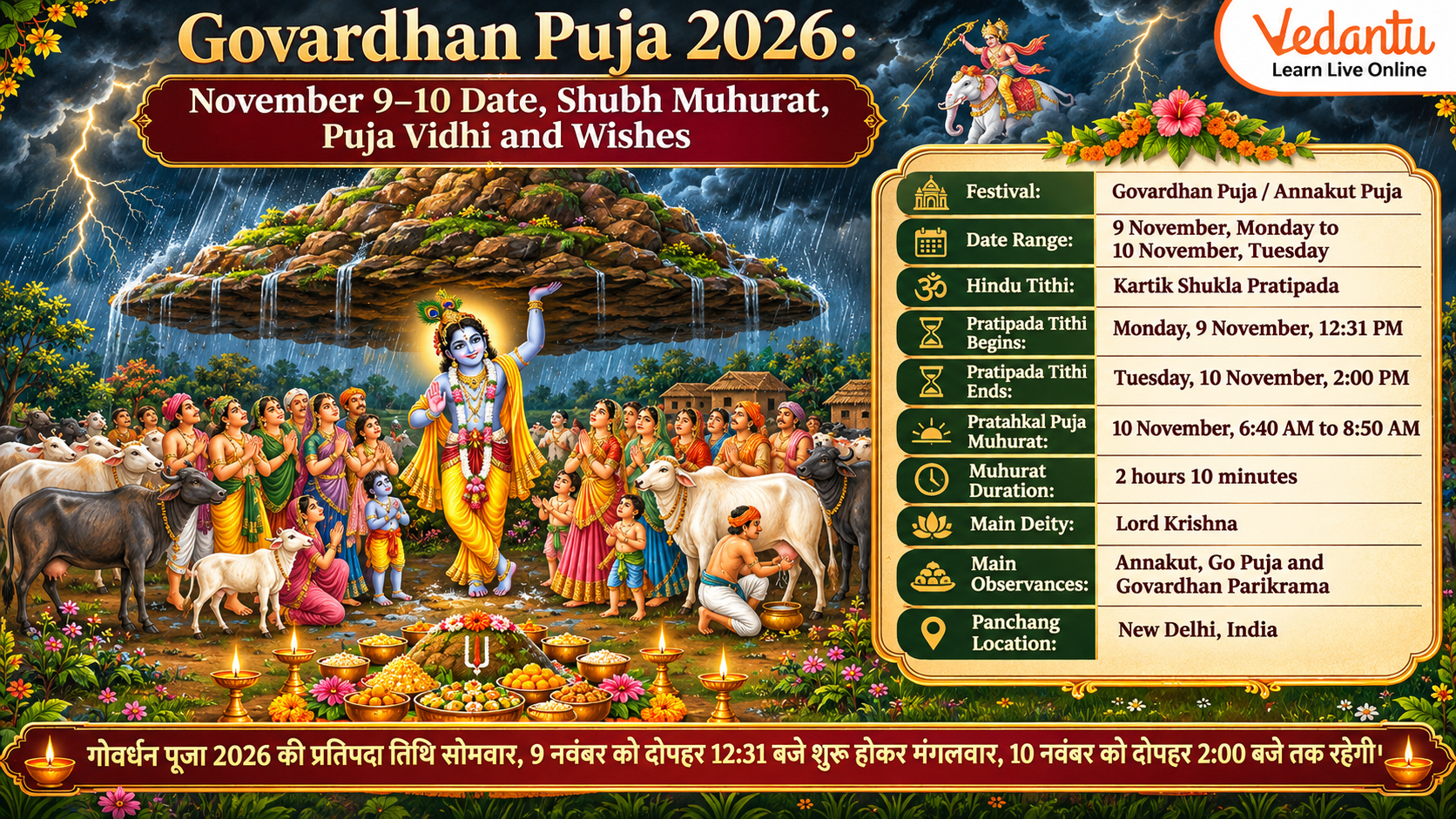
Also called Annakut Puja or Goverdhan Pooja, the festival honours Lord Krishna's protection of the people of Braj. Families worship Govardhan Hill, prepare food offerings, perform Go Puja and express gratitude towards nature.
Those searching for “Govardhan Puja kab hai 2026?” should note the full 9–10 November Pratipada Tithi period, while following the prescribed morning puja muhurat and regional traditions.
Govardhan Puja 2026 Date, Shubh Muhurat and Pratipada Tithi
The following Govardhan Puja 2026 date and time details are based on Drik Panchang for New Delhi, India.
Note: The date range refers to the period when Kartik Shukla Pratipada Tithi is present. The recommended morning worship takes place on 10 November in New Delhi. Muhurat timings vary by location.
Why Does Govardhan Puja 2026 Fall Between 9 and 10 November?
The Govardhan Puja date can appear confusing because the Hindu lunar day does not always begin at midnight.
In 2026, Kartik Shukla Pratipada begins at 12:31 PM on 9 November and continues until 2:00 PM on 10 November.
The date is determined using the relevant Pratipada Tithi at sunrise. Since Pratipada is present at sunrise on 10 November, the morning puja muhurat is assigned to that day in the New Delhi Panchang.
This explains the difference between:
Tithi period: 9 November afternoon to 10 November afternoon.
Morning worship: 10 November, 6:40 AM to 8:50 AM.
Govardhan Puja is traditionally associated with the period following Diwali Amavasya. However, the 2026 calendar has a gap between the main Diwali celebration on 8 November and the Govardhan Puja morning observance.
To understand how the celebrations fit together, read Five Days of Diwali: Dates and Significance.
What Is Govardhan Puja and Why Is It Celebrated?
Govardhan Puja is a Hindu festival that honours Lord Krishna's protection of the people and animals of Braj by lifting Govardhan Hill.
According to Hindu religious tradition, Krishna encouraged the residents of Braj to recognise the importance of Govardhan Hill, which provided grass, water and natural resources for their daily lives.
The festival is especially important in the Braj region of Uttar Pradesh, including Mathura, Vrindavan and Govardhan.
People celebrate through Krishna worship, Annakut offerings, Govardhan Parikrama and traditions associated with caring for cows.
Significance of Govardhan Puja
Govardhan Puja highlights several important values:
Gratitude towards nature: Land, forests, rainfall and mountains support life.
Faith and protection: Krishna's story symbolises divine protection.
Humility: The narrative reminds devotees to avoid pride and arrogance.
Community support: The people of Braj remained together during the storm.
Respect for animals: Cows and cattle are honoured through traditional Go Puja.
For students, the festival also provides an opportunity to learn about India's religious traditions and the importance of environmental responsibility.
Govardhan Puja Katha: The Story of Lord Krishna and Govardhan Hill
The Govardhan Puja Katha is associated with Lord Krishna's childhood in the Braj region.
According to the Bhagavata Purana tradition, the villagers of Braj prepared offerings for Lord Indra because they believed he controlled the rainfall needed for agriculture.
Young Krishna encouraged them to recognise the importance of Govardhan Hill and the natural surroundings that supported their lives.
The hill provided grass for cattle, water for people and animals, and resources that helped the community survive.
Following Krishna's advice, the villagers honoured Govardhan Hill instead of performing their customary worship of Indra.
Why Did Lord Krishna Lift Govardhan Hill?
According to the traditional story, Indra became angry when the villagers stopped worshipping him.
He sent heavy rainfall and storms over Braj. The continuous rain threatened people's homes, cattle and agricultural land.
To protect them, Lord Krishna lifted Govardhan Hill with the little finger of his left hand.
The villagers and their animals gathered beneath the hill and remained sheltered for seven days.
Eventually, Indra recognised Krishna's greatness, abandoned his pride and stopped the storm.
This episode is remembered during Govardhan Puja as an example of protection, humility and devotion.
What Does the Govardhan Puja Story Teach Us?
The story highlights the importance of protecting nature, helping others and showing gratitude.
Students can connect its message with simple actions such as conserving water, caring for animals, protecting plants and supporting people during difficulties.
Govardhan Puja Samagri: Items Required for Worship
Families usually prepare the puja materials before the auspicious morning muhurat.
The materials and worship procedures may differ according to family traditions. Preparing exactly the same items is not compulsory for every household.
Govardhan Puja Vidhi 2026: How to Perform Puja at Home
Govardhan Puja Vidhi generally includes preparing a symbolic Govardhan Hill, offering prayers to Lord Krishna and presenting Annakut Bhog.
Families can follow these commonly practised steps.
Step 1: Clean the Puja Area
Clean the courtyard, prayer room or another suitable area before the puja.
Arrange the puja materials, flowers, lamps and offerings.
Step 2: Prepare a Symbolic Govardhan Hill
In some traditions, families use cow dung to create a small symbolic representation of Govardhan Hill.
Decorate it with flowers, leaves and other customary materials.
Step 3: Place Lord Krishna's Idol or Picture
Place an image or idol of Lord Krishna near the symbolic hill.
Arrange flowers, akshat, roli and other offerings.
Step 4: Offer Prayers to Lord Krishna
Begin the worship according to family customs.
Devotees may offer flowers, rice, sweets and prayers while remembering Krishna's protection of the people of Braj.
Step 5: Prepare Annakut Bhog
Arrange homemade vegetarian dishes, grains, fruits or sweets as offerings to Lord Krishna.
The variety and quantity of food depend on household traditions and available resources.
Step 6: Perform Govardhan Parikrama
Walk around the symbolic Govardhan Hill where customary.
Some devotees recite Krishna prayers or sing devotional songs during the Parikrama.
Step 7: Perform Aarti
Light a diya safely and perform the customary aarti.
Offer prayers for the well-being of family members and the community.
Step 8: Distribute Prasad
After completing the worship, distribute the offered food among family members and other devotees.
Note: This is a general explanation of commonly followed rituals. Families should follow their regional and religious traditions.
What Is Annakut Puja and Chappan Bhog?
Annakut means a mountain or large arrangement of food offered to Lord Krishna. It is one of the main traditions associated with Govardhan Puja.
Devotees prepare vegetarian dishes and arrange them as an offering representing gratitude for the food and natural resources that support life.
After worship, the food is distributed as prasadam.
What Is Chappan Bhog?
Chappan Bhog is a traditional offering of 56 food preparations associated with Krishna worship in some temples and households.
Common offerings may include:
Rice and other grain preparations
Seasonal vegetable dishes
Poori and traditional breads
Kheer and milk-based sweets
Fruits and dry fruits
Laddoo and other traditional desserts
Annakut and Chappan Bhog are related, but they are not identical requirements.
A family can prepare a simple Annakut offering without making exactly 56 dishes. The tradition emphasises gratitude and devotion rather than a compulsory number of preparations.
What Is Go Puja and Why Is It Performed?
Go Puja is a traditional practice of honouring cows and cattle, which have an important place in Krishna's life and the agricultural culture of Braj.
Lord Krishna is also known as Govinda and Gopala, names associated with his care for cows.
During Govardhan Puja, some devotees honour cows by:
Cleaning and decorating them gently.
Applying a customary tilak where appropriate.
Offering flowers and prayers.
Providing suitable food and clean water.
Caring for their health and well-being.
The tradition reflects gratitude towards animals and their role in rural communities.
Proper animal care and safe handling should always come before decorative or ceremonial practices.
Govardhan Parikrama: Meaning and Significance
Govardhan Parikrama is the traditional practice of walking around Govardhan Hill as an act of devotion.
Govardhan Hill is located near Govardhan town in the Mathura district of Uttar Pradesh, within the Braj region.
Devotees visit the area to offer prayers, participate in devotional activities and perform the sacred circumambulation.
Families who cannot visit Govardhan Hill may follow a smaller symbolic Parikrama around a representation made at home.
The practice is associated with faith, gratitude and remembrance of Krishna's protection.
How Is Govardhan Puja Celebrated in Different Parts of India?
Govardhan Puja traditions vary across regions and communities.
Not every household follows the same rituals. Local temple practices and family traditions may also differ.
Govardhan Puja Rangoli Designs and Poster Ideas
Govardhan Puja rangoli designs often use symbols associated with Lord Krishna, nature, cows and the festival's traditional food offerings.
These ideas can be used for home decorations and school activities.
1. Krishna Lifting Govardhan Hill Rangoli
Draw Lord Krishna holding Govardhan Hill above the villagers.
Add clouds, trees and flowers to represent the story.
2. Cow-Themed Govardhan Rangoli
Draw a simple cow outline surrounded by flowers and diyas.
This design represents Go Puja and respect for animals.
3. Annakut Rangoli Design
Create a mountain-shaped pattern using colourful grains, fruits and food symbols.
Use yellow, green and orange colours for a festive appearance.
4. Easy Diya and Flower Rangoli
Arrange a simple circular flower pattern with a diya in the centre.
This is suitable for students and beginners.
For additional ideas, explore Rangoli Designs for Diwali.
Govardhan Puja Images and Drawing Ideas
Images of Govardhan Puja can help students understand the religious story and traditions.
Useful illustration ideas include:
Lord Krishna lifting Govardhan Hill on his little finger.
Villagers and cattle taking shelter beneath the hill.
Annakut food offerings arranged in a mountain shape.
A traditional symbolic Govardhan Hill decorated with flowers.
Go Puja showing people caring for and honouring cows.
For a Govardhan Puja poster, students can combine one clear illustration with a short message such as "Respect Nature, Celebrate Govardhan Puja."
Happy Govardhan Puja Wishes 2026 in English
Share these Govardhan Puja wishes with family members, friends and classmates.
Happy Govardhan Puja! May Lord Krishna bless your family with peace, happiness and prosperity.
Wishing you a joyful Annakut celebration filled with love and gratitude.
May Govardhan Puja inspire everyone to respect nature and care for living beings.
May Lord Krishna's blessings bring happiness and harmony to your home.
Wishing you a beautiful Govardhan Puja filled with devotion and togetherness.
May this festival encourage kindness, humility and gratitude.
Happy Govardhan Puja 2026! May every day bring hope and positivity.
Celebrate the spirit of Govardhan Puja with faith, care and happiness.
Govardhan Puja Wishes in Hindi
गोवर्धन पूजा की हार्दिक शुभकामनाएँ! भगवान श्रीकृष्ण की कृपा आपके परिवार पर बनी रहे।
गोवर्धन पूजा के पावन अवसर पर आपके जीवन में सुख, शांति और समृद्धि आए।
भगवान श्रीकृष्ण आपके घर में खुशियाँ और सकारात्मकता बनाए रखें।
अन्नकूट महोत्सव की हार्दिक शुभकामनाएँ!
गोवर्धन पूजा हमें प्रकृति और सभी जीवों का सम्मान करना सिखाती है।
श्रीकृष्ण की कृपा से आपके परिवार में प्रेम और खुशहाली बनी रहे।
Short Govardhan Puja Quotes and WhatsApp Status
"Celebrate Govardhan Puja with gratitude and devotion."
"Respect nature and care for every living being."
"May Krishna's blessings bring peace and happiness."
"Faith, humility and gratitude make Govardhan Puja meaningful."
"गोवर्धन पूजा की हार्दिक शुभकामनाएँ!"
Govardhan Puja 2026 in Hindi: गोवर्धन पूजा कब से कब तक है?
गोवर्धन पूजा 2026 की प्रतिपदा तिथि सोमवार, 9 नवंबर को दोपहर 12:31 बजे शुरू होकर मंगलवार, 10 नवंबर को दोपहर 2:00 बजे तक रहेगी।
द्रिक पंचांग के अनुसार, नई दिल्ली में गोवर्धन पूजा का प्रातःकाल शुभ मुहूर्त 10 नवंबर को सुबह 6:40 बजे से 8:50 बजे तक रहेगा।
यह त्योहार भगवान श्रीकृष्ण द्वारा गोवर्धन पर्वत उठाकर ब्रजवासियों और उनके पशुओं की रक्षा करने की पौराणिक कथा से जुड़ा है।
इस अवसर पर श्रद्धालु अन्नकूट का भोग लगाते हैं, गोवर्धन पर्वत की प्रतीकात्मक पूजा करते हैं और अपने पारिवारिक रीति-रिवाजों के अनुसार परिक्रमा करते हैं।
Govardhan Puja and Bhai Dooj 2026: Start and End Dates
Govardhan Puja and Bhai Dooj are important observances during the closing part of the Diwali festival period. Their lunar tithis extend across two calendar dates.
Govardhan Puja Pratipada Tithi
Begins: 9 November 2026, 12:31 PM
Ends: 10 November 2026, 2:00 PM
Bhai Dooj Dwitiya Tithi
Begins: 10 November 2026, 2:00 PM
Ends: 11 November 2026, 3:53 PM
These ranges describe when the lunar tithis are present. They should not be confused with the shorter auspicious windows for performing Govardhan Puja or the Bhai Dooj Tilak ceremony.
Conclusion
Govardhan Puja 2026 follows Kartik Shukla Pratipada from 9 November at 12:31 PM to 10 November at 2:00 PM. The New Delhi morning puja muhurat is from 6:40 AM to 8:50 AM on 10 November.
The festival remembers Lord Krishna's protection of the people and cattle of Braj. Annakut offerings, Go Puja and Govardhan Parikrama express gratitude towards nature, food and living beings.
Families can follow their regional traditions while using the local Panchang to check the relevant worship timings.
FAQs on Govardhan Puja 2026: November 9–10 Corrrect Date, Shubh Muhurat, Puja Vidhi and Wishes
1. When does Govardhan Puja 2026 start and end?
Govardhan Puja 2026 follows Kartik Shukla Pratipada, which begins on 9 November at 12:31 PM and ends on 10 November at 2:00 PM. The prescribed morning puja muhurat in New Delhi falls within this period on 10 November.
2. Govardhan Puja kab se kab tak hai 2026 mein?
गोवर्धन पूजा की प्रतिपदा तिथि 9 नवंबर 2026 को दोपहर 12:31 बजे से 10 नवंबर 2026 को दोपहर 2:00 बजे तक रहेगी। नई दिल्ली में पूजा का शुभ मुहूर्त 10 नवंबर को सुबह 6:40 बजे से 8:50 बजे तक है।
3. Why does Govardhan Puja 2026 cover 9 and 10 November?
Kartik Shukla Pratipada begins on the afternoon of 9 November and continues until the afternoon of 10 November. Since the tithi is present at sunrise on 10 November, the New Delhi Panchang assigns the morning observance to that date.
4. What is the Govardhan Puja 2026 Shubh Muhurat?
According to Drik Panchang, the Govardhan Puja Pratahkal Muhurat in New Delhi is 6:40 AM to 8:50 AM on 10 November 2026.
5. What is the Hindu Tithi of Govardhan Puja?
Govardhan Puja is associated with Kartik Shukla Pratipada, the first lunar day of the bright fortnight of Kartik.
6. Why is Govardhan Puja celebrated?
According to Hindu religious tradition, Govardhan Puja commemorates Lord Krishna lifting Govardhan Hill to shelter the people and cattle of Braj from heavy rainfall sent by Indra.
7. How is Govardhan Puja performed at home?
Families may prepare a symbolic Govardhan Hill, decorate it with flowers, offer prayers to Lord Krishna, prepare Annakut Bhog, perform Parikrama and Aarti, and distribute prasad.
8. What is Annakut Puja?
Annakut Puja involves preparing and offering a variety of vegetarian dishes to Lord Krishna. The food is sometimes arranged in a mountain-like form to represent Govardhan Hill.
9. What is Chappan Bhog during Govardhan Puja?
Chappan Bhog is a traditional offering of 56 food items followed in some devotional communities. Preparing exactly 56 dishes is not compulsory for every household.
10. What is Go Puja on Govardhan Puja?
Go Puja involves honouring and caring for cows through customary prayers, decoration and suitable food offerings. It reflects the importance of cows in Krishna traditions and rural life.
11. Where is Govardhan Hill located?
Govardhan Hill is located near Govardhan town in the Mathura district of Uttar Pradesh, within the Braj region.
12. What is Govardhan Parikrama?
Govardhan Parikrama is the traditional practice of walking around Govardhan Hill as an act of devotion. Some families also perform symbolic Parikrama at home.
13. What are some easy Govardhan Puja rangoli designs?
Easy designs include a Govardhan Hill outline, a Krishna-themed rangoli, a cow illustration, an Annakut-inspired design and a simple diya-and-flower pattern.
14. What are good Govardhan Puja wishes in Hindi?
You can share: "गोवर्धन पूजा की हार्दिक शुभकामनाएँ! भगवान श्रीकृष्ण आपके जीवन में सुख, शांति और समृद्धि बनाए रखें।"
15. When does Bhai Dooj 2026 start and end?
Bhai Dooj follows Kartik Shukla Dwitiya, which begins on 10 November 2026 at 2:00 PM and ends on 11 November 2026 at 3:53 PM. In New Delhi, the Aparahna Tilak Muhurat is from 1:10 PM to 3:20 PM on 11 November.


