



When Is World Rabies Day 2026 and What Is Its Theme?
World Rabies Day is a global health awareness day observed every year on 28 September to spread awareness about rabies prevention, vaccination, responsible animal care, and the importance of timely action after animal bites. In 2026, World Rabies Day will be observed on 28 Sep 2026.
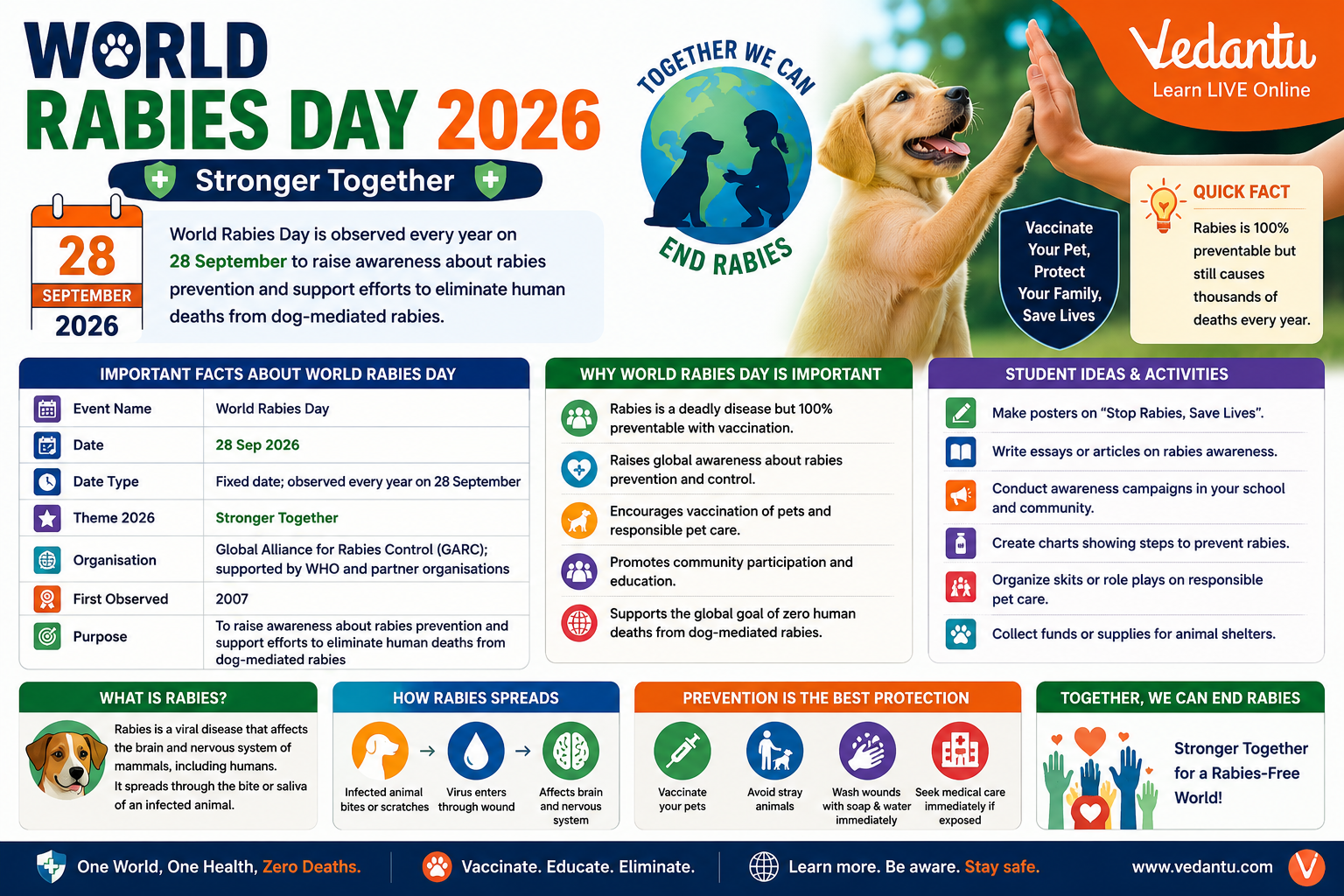
This observance matters because rabies is a preventable but often fatal viral disease. The day also highlights cooperation between communities, health workers, governments, and animal welfare groups, reflected in the official World Rabies Day theme 2026: Stronger Together. Students, teachers, and families can use the day to learn about prevention and support public awareness in safe, informed ways.
Important Facts About World Rabies Day
| Particular | Details |
|---|---|
| Event Name | World Rabies Day |
| Date | 28 Sep 2026 |
| Date Type | Fixed date; observed every year on 28 September |
| Theme 2026 | Stronger Together |
| Organisation | Global Alliance for Rabies Control (GARC); supported by WHO and partner organisations |
| First Observed | 2007 |
| Purpose | To raise awareness about rabies prevention and support efforts to eliminate human deaths from dog-mediated rabies |
What is World Rabies Day?
World Rabies Day is an international awareness day focused on preventing rabies through education, vaccination, and responsible care of animals. It encourages people to understand rabies as a public health issue and to recognize that prevention depends on awareness, community action, and access to appropriate health support.
The observance is especially connected with efforts to end human deaths from dog-mediated rabies. It is led by the Global Alliance for Rabies Control, with support from the WHO and other partner organisations working in public health, veterinary care, and community outreach.
When is World Rabies Day Celebrated?
World Rabies Day 2026 date is 28 Sep 2026. If you are asking, “when is World Rabies Day celebrated?”, the answer is simple: it is observed every year on 28 September.
Because it follows a fixed date, schools, health groups, and local organisations can plan awareness programmes in advance. This makes World Rabies Day on 28 September an important annual moment for public education and prevention messaging.
History and Origin of World Rabies Day
The documented history of World Rabies Day begins in 2007, when it was first observed as a global awareness campaign. It was established to improve understanding of rabies prevention and to unite health, veterinary, and community efforts around a common public health goal.
The date 28 September is significant because it is linked with Louis Pasteur, whose work is historically associated with the development of the first rabies vaccine. This gives the observance both scientific and educational importance.
Timeline
| Year | Event |
|---|---|
| 2007 | World Rabies Day was first observed |
| Every year | Observed globally on 28 September |
| 2026 | Official theme: Stronger Together |
World Rabies Day Theme 2026
The official World Rabies Day 2026 theme is Stronger Together. This theme stresses that progress in rabies prevention depends on partnership among communities, governments, educators, health workers, and animal welfare groups.
The message is clear: awareness alone is not enough unless different groups work together. In the context of rabies prevention, collaboration helps improve education, animal vaccination efforts, responsible pet care, and wider public understanding.
Why World Rabies Day is Important
The significance of World Rabies Day lies in its focus on prevention. Rabies is often fatal, but it is also preventable, which makes awareness especially valuable. Public understanding can help people respond responsibly to animal bite risks and support safer communities.
Another important aspect is animal vaccination and responsible ownership. The day encourages people to think about pet vaccination, community animal care, and the role of families in reducing avoidable risk.
World Rabies Day also matters in education. Schools can use it to teach students about zoonotic disease awareness, public health responsibility, and the value of science-based prevention. Related health awareness reading on Vedantu, such as World Health Day and World First Aid Day, can help students connect this topic with wider health learning.
How World Rabies Day is Observed
Around the world, World Rabies Day is usually marked through awareness-based and educational activities such as these:
- Rabies awareness campaigns in schools and communities
- Public talks by health and veterinary professionals
- Vaccination drives for animals
- Poster, drawing, and slogan competitions
- Social media messages on rabies prevention
- Educational programmes on responsible pet care
- Community outreach focused on dog-mediated rabies prevention
World Rabies Day Activities for Students
Students often search for World Rabies Day poster, speech, essay, or drawing ideas. The best activities are simple, accurate, and focused on awareness rather than fear. They should help students understand prevention, empathy toward animals, and responsible citizenship.
Here are practical and low-cost activity ideas for schools and homes:
- Create a World Rabies Day drawing or poster on prevention and pet vaccination
- Write a short World Rabies Day speech in English for assembly
- Prepare an essay on the importance of rabies awareness
- Organise a classroom quiz on key facts such as date, purpose, and history
- Make an awareness pledge wall using the theme Stronger Together
- Hold a group discussion on responsible pet ownership and community care
- Design neat awareness charts with help from project presentation ideas and creative classroom resources from the Vedantu blog
Poster, Drawing, Slogan, and Speech Ideas
For student work, the most effective messages are short, factual, and easy to remember. A good World Rabies Day poster or speech should mention prevention, awareness, vaccination, and care for animals without making unsupported medical claims.
You can build your creative work around these safe awareness lines:
- Stronger Together for rabies prevention
- Awareness saves lives
- Vaccinate pets, support safer communities
- Responsible pet care is public health care
- Learn, share, and protect
Educational Takeaways for Schools
World Rabies Day helps schools connect science, health awareness, and social responsibility. It is not only about learning what rabies is, but also about understanding why community cooperation matters in preventing avoidable harm.
Teachers can combine this topic with broader awareness-day learning. Students interested in similar observances may also explore World Animal Welfare Day to understand how animal care and public awareness often support each other.
Conclusion
World Rabies Day is observed every year on 28 September to promote awareness, prevention, vaccination, and responsible animal care. In 2026, it will be marked on 28 Sep 2026 with the official theme Stronger Together. For students and families, the day is a meaningful reminder that public health improves when knowledge, care, and community action come together in informed and responsible ways.
FAQs on World Rabies Day 2026: Meaning, Importance and Student Ideas
1. What is World Rabies Day?
World Rabies Day is a global health awareness day that promotes rabies prevention, animal vaccination, responsible pet care, and timely medical attention after an animal bite. Led by the Global Alliance for Rabies Control (GARC) with support from public health partners, it also encourages coordinated action to eliminate human deaths caused by dog-mediated rabies.
2. When is World Rabies Day celebrated?
World Rabies Day is celebrated every year on 28 September. It has a fixed annual date, and in 2026, World Rabies Day will be observed on Monday, 28 September 2026.
3. Why is 28 September chosen as World Rabies Day?
28 September was chosen because it marks the death anniversary of Louis Pasteur, the scientist whose work contributed to the development of the first successful rabies vaccine. The date honours his scientific contribution while drawing global attention to rabies prevention and vaccination.
4. What is the theme for World Rabies Day in 2026?
The World Rabies Day theme 2026 is “Stronger Together.” It emphasises cooperation among communities, governments, health workers, veterinarians, educators, and animal welfare groups to improve awareness, increase animal vaccination, and prevent human deaths from rabies.
5. When was World Rabies Day first observed?
World Rabies Day was first observed in 2007. It was established by the Global Alliance for Rabies Control as an international campaign to improve public understanding of rabies and unite human health, veterinary, and community organisations around prevention.
6. Why is World Rabies Day important?
World Rabies Day is important because rabies is preventable but is almost always fatal after clinical symptoms appear. The observance highlights essential preventive actions:
- Vaccinating dogs and other eligible pets against rabies
- Promoting responsible animal care and community awareness
- Teaching people to seek urgent medical care after a possible exposure
- Supporting efforts to eliminate deaths from dog-mediated rabies
7. What should a person do after a dog or animal bite?
After a dog or other potentially rabid animal bite, wash the wound immediately and seek urgent medical care. Recommended first-response steps include:
- Wash and flush the wound thoroughly with soap and running water for about 15 minutes.
- Apply an antiseptic, if available, without delaying medical care.
- Contact a qualified healthcare professional immediately for assessment and rabies post-exposure prophylaxis.
- Do not apply chilli, soil, oil, or other home remedies to the wound.
Do not wait for symptoms to appear, and do not attempt to capture an unfamiliar animal yourself.
8. What country dies from rabies the most?
India has the highest estimated number of human rabies deaths worldwide. The disease burden is linked mainly to dog-mediated transmission, limited vaccination coverage in some areas, delayed post-bite treatment, and underreporting. Estimates can vary, so the key prevention measures remain dog vaccination, immediate wound washing, and prompt medical care after exposure.
9. What is a funny fact about rabies?
Rabies is not a humorous disease, but an interesting fact is that its name comes from the Latin word rabere, meaning “to rage.” Another notable fact is that rabies can affect mammals, including dogs, bats, cats, and humans, but it can be prevented through animal vaccination and timely treatment after exposure.
10. How can students observe World Rabies Day?
Students can observe World Rabies Day through safe, factual, and awareness-focused educational activities. Suitable ideas include:
- Creating a World Rabies Day poster or drawing about prevention and pet vaccination
- Delivering a short speech on the theme “Stronger Together”
- Writing an essay about rabies awareness and responsible animal care
- Organising a classroom quiz on the date, history, purpose, and prevention of rabies
- Sharing verified awareness messages without frightening or harming animals



