



Key Differences Between Online and Offline NEET Coaching for 2027 Aspirants
Online NEET coaching can suit students who need to save travel time and can manage independent study, while offline coaching can suit those who benefit from a fixed routine and face-to-face interaction. Neither format is automatically better for understanding concepts or improving test performance. The important decision is which setting helps you attend consistently, resolve doubts and practise independently. Your home environment, school workload and current study habits matter more than the label on the course.
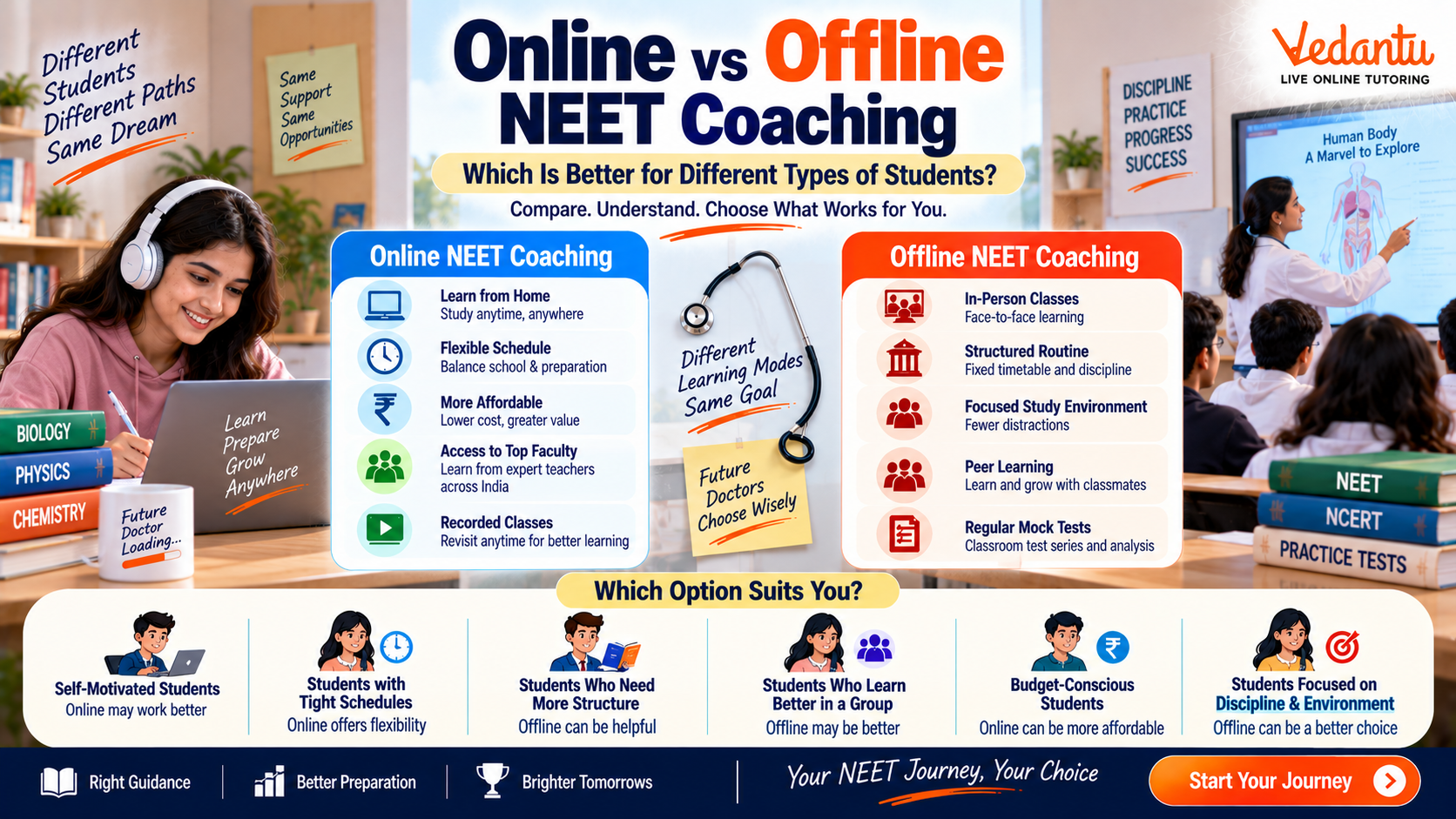
Online vs Offline NEET Coaching: The Practical Differences
First, separate live online classes from recorded-only courses. Live teaching follows a timetable and may allow questions during or after class; recorded lessons offer more control over pace but do not, by themselves, provide interaction. Offline coaching brings students and teachers into a classroom, although access to individual help still depends on batch size and the centre’s arrangements.
| Factor | Live Online Coaching | Offline Classroom Coaching | Recorded-Only Courses |
|---|---|---|---|
| Daily schedule | Scheduled classes without a commute | Scheduled classes plus travel time | Usually self-paced within access conditions |
| Asking questions | Interaction tools and doubt arrangements vary by course | In-person questions; individual access varies by batch | Requires a separate doubt channel if not included |
| Revisiting explanations | Possible through recordings only if included | Uses notes or additional revision support, where offered | Replay lessons within the permitted access period |
| Study environment | Needs a workable device, connectivity and quiet space | Provides a classroom setting; home study is still necessary | Needs strong control over distractions and lesson backlogs |
| Accountability | Depends on attendance follow-up and assignment review | Physical attendance adds structure; follow-up still varies | Largely student-managed unless extra support is included |
| Tests and feedback | Frequency, supervision and feedback are course-dependent | Frequency, supervision and feedback are centre-dependent | Do not assume tests or feedback accompany the videos |
| Costs beyond tuition | Device, internet, printing and any additional support | Transport, meals or accommodation where needed | Device, internet and any separately purchased tests or help |
Teaching quality and delivery mode are separate decisions. A well-organised online course may provide more useful feedback than an overcrowded classroom, while a supportive classroom teacher may help more than a video library with no doubt support. Compare the actual batch, not an ideal version of one format against a weak version of another.
Discover Our Classes With A Guided Centre Tour
Which Coaching Mode Suits Different Types of Students?
Use your recent behaviour rather than a permanent label such as “disciplined” or “weak”. Look at whether you completed assignments, asked for help and revised without reminders over the past few weeks. These habits can change, and the right support can make a format workable.
- Students who already follow a study plan: Live online coaching can preserve more time for practice by removing travel. Recorded lessons may also work, provided there is a reliable way to resolve doubts and take tests.
- Students who repeatedly postpone work: Offline classes can provide an external routine, but attendance alone will not fix unfinished homework. Choose a batch with meaningful follow-up; structured live online coaching is also worth considering if it provides the accountability you need.
- Students with a long or tiring commute: Online learning may be the more sustainable choice. For example, an illustrative 45-minute journey each way adds 90 minutes on every coaching day—time that could otherwise support revision, practice or rest.
- Students without a quiet study space or dependable connectivity: A nearby offline centre may reduce interruptions during lessons. However, you will still need a practical arrangement for independent study outside class.
- Students hesitant to speak in front of others: Online question tools may lower the barrier to asking doubts if the course offers them. Offline support can work equally well when teachers allow approachable, individual discussions.
- Students who benefit from peer interaction: Offline classes provide regular in-person contact. This is useful when peers encourage problem-solving, but less useful if comparison creates anxiety or group study becomes distracting.
- Students who need repeated explanations: Recorded access can help revisit one difficult step at a manageable pace. It should supplement active practice, not become a cycle of replaying entire chapters without solving questions.
How Class 11, Class 12 and Dropper Priorities Differ
Class 11: Build a Routine You Can Maintain
At the start of NEET preparation, prioritise clear explanations, regular assignments and a manageable pace. Online coaching can fit well when school and travel already occupy much of the day; offline coaching can help establish a new study routine. In either case, address confusing concepts early rather than carrying a growing backlog into Class 12.
Class 12: Protect Revision Time Around School
Choose a timetable that leaves room for current lessons, earlier NEET topics and school responsibilities. Flexibility matters, but access to recordings is useful only if missed lessons have a definite catch-up slot. A nearby classroom batch may be more effective than online learning if home distractions regularly consume the time saved on travel.
Droppers: Match the Course to the Reason for Repeating
A dropper with substantial conceptual gaps needs teaching and guided practice, not just more mock tests. Someone with sound concepts but poor accuracy may need targeted revision, timed practice and detailed error review instead of repeating every lecture. Choose the mode that addresses the previous attempt’s problems while providing a sustainable routine and enough human interaction.
Is Online NEET Coaching Effective?
Online coaching can be effective when lessons lead to independent problem-solving, timely doubt resolution and regular revision. Merely watching more videos is not evidence of learning. Offline students face the same issue when they copy classroom solutions but cannot reproduce the reasoning later.
Use a chapter-level check to judge either format. After a lesson, close the notes and explain the main idea, attempt questions independently, then identify what still needs help. Apply this differently across the three subjects:
- Physics: Solve a fresh numerical without viewing the worked solution. If you get stuck, identify whether the difficulty is choosing the principle, setting up equations or completing the calculation.
- Chemistry: Separate calculation errors from gaps in concepts, reactions or factual recall. Revisit the relevant explanation or NCERT passage rather than rewatching everything.
- Biology: Combine relevant NCERT reading with closed-book recall and MCQs. For an incorrect answer, locate the statement, diagram or distinction you misunderstood.
After a test, group mistakes into concept gaps, recall gaps, misreading and time-management problems. Correct the cause, solve a few related questions and revisit the topic later. The better coaching mode is the one in which this learning-and-correction cycle actually happens.
When Hybrid NEET Coaching Makes Sense
Hybrid preparation combines online and in-person elements, but the arrangement varies by provider. It may also be a student-organised combination, such as online teaching with an independently chosen in-person test series. Do not assume that both services share a timetable, syllabus sequence or feedback system.
- Online teaching plus in-person testing: Can suit students who want to avoid daily travel but need an external testing routine.
- Offline teaching plus recorded revision: Can help revisit selected weak topics, provided it does not create a second full lecture schedule.
- Self-paced lessons plus scheduled doubt discussions: Can suit independent learners who need occasional guidance rather than another complete course.
Keep one main syllabus plan, one primary set of notes and a coordinated test calendar. Hybrid coaching becomes counterproductive when duplicate classes leave little time to practise. Add a second resource only to solve a specific problem that the main arrangement does not address.
Compare Total Cost and Usable Study Time
Online coaching is not automatically cheaper once all expenses are counted, and a higher classroom fee does not establish better teaching. Compare the total cost over the same preparation period. Include tuition, taxes, materials, tests, device or connectivity needs, and travel or accommodation where applicable.
Before paying, obtain the current batch fee, inclusions, schedule, teaching language, access validity, doubt arrangements and refund terms in writing from the provider. For Vedantu or any other coaching institute, establish whether recordings, tests and additional academic support belong to the specific course you are considering rather than assuming they are standard.
Also calculate what remains of a typical weekday after school, coaching, travel, meals and adequate sleep. A course that leaves no realistic slot for independent questions is a poor fit even if its lectures are excellent. Saved commuting time is a benefit only when it improves study, recovery or both.
Using Vedantu Resources to Make the Choice
Vedantu’s NEET coaching checklist for students and parents is a relevant starting point for organising discussions before enrolment. Use it alongside a weekly timetable and a list of your present difficulties. A Class 11 student might prioritise pace and concept support, while a dropper might focus on revision needs and test feedback.
If you are considering Vedantu alongside classroom coaching or a recorded-only course, judge each option against the same tasks: understanding a difficult chapter, getting a doubt resolved and receiving useful feedback after a test. Ask for course-specific details rather than treating a brand name or teaching format as proof of suitability. This keeps the choice centred on the support you will actually use.
A Practical Way to Decide Before Committing
- Name your main obstacle. Identify whether it is unclear concepts, inconsistent work, unresolved doubts, travel fatigue or an unsuitable study environment.
- Rule out unworkable arrangements. Reject schedules that clash with school, require an unsustainable commute or depend on connectivity you cannot maintain.
- Examine a representative lesson where available. Choose a topic you find moderately difficult. Afterwards, attempt a small set of fresh questions without notes and identify what you understood.
- Examine the support process. Find out how an actual subject doubt is handled and what feedback follows a test. A score alone does not explain how to improve.
- Review the routine after joining. Over an illustrative two-week period, track attendance, planned versus completed practice, unresolved doubts and fatigue. This checks whether the arrangement is workable, not whether it guarantees a future score.
If a course is not working, first distinguish a delivery problem from a study-process problem. Changing formats will not automatically correct skipped practice, while persistent timetable clashes or inaccessible doubt support may justify a change. Vedantu’s discussion of signs that your current NEET coaching is not working provides a relevant next step before making a disruptive switch.
Summary
Online NEET coaching can suit students who need less travel and can manage study at home; offline coaching can suit those who need a classroom routine and in-person contact. Hybrid preparation works when it fills a specific gap without duplicating lessons. Compare the actual teaching, doubt process, costs and time left for practice. Use Vedantu’s linked selection resources to organise your questions, then choose the arrangement that addresses your current preparation needs and remains manageable week after week.
FAQs on Online vs Offline NEET Coaching: Choosing the Right Option for Different Students
1. Which is better for NEET 2027 preparation: online or offline coaching?
Both online and offline NEET coaching have unique advantages—choosing the best mode depends on your learning preferences, schedule, and location.
- Online coaching offers flexible schedules, interactive sessions, and easy access to digital resources.
- Offline coaching provides face-to-face interaction, structured classes, and an offline peer community.
Consider your learning style, location, and discipline level to decide which format suits you best.
2. What are the main benefits of online NEET coaching for students appearing in NEET 2027?
Online NEET coaching offers several advantages for NEET 2027 aspirants:
- Flexible study schedules and recorded lectures
- Access to expert faculty from across India
- Interactive doubt-solving sessions
- Comprehensive digital study material and mock tests
- Time and travel saved for optimized preparation
These benefits make online coaching ideal for students needing flexibility and remote access.
3. What are the advantages of offline NEET coaching for NEET 2027?
Offline NEET coaching is beneficial for students who thrive in a classroom setting:
- Real-time, face-to-face interaction with teachers
- Immediate feedback and doubt resolution
- Structured study environment for disciplined learning
- Access to labs and practical sessions (where available)
- Peer group motivation and healthy competition
4. How do I decide between online and offline NEET 2027 coaching?
To choose between online and offline NEET coaching, consider these factors:
- Your personal learning style
- Availability of coaching centers in your area
- Comfort with technology and online platforms
- Requirement for schedule flexibility
- Need for direct in-person interaction
Evaluate these aspects to make the decision that aligns with your goals.
5. Can I get personalized attention with online NEET coaching in 2027?
Yes, many online NEET coaching platforms offer personalized attention through:
- Dedicated doubt-solving sessions
- 1-to-1 mentoring and academic guidance
- Customized study plans and performance tracking
Look for online courses that prioritize individualized support and progress analysis.
6. Are online NEET classes as effective as offline classes for NEET 2027?
Online NEET classes can be equally effective as offline classes when:
- The platform provides live interactive sessions
- Regular assessments and feedback are conducted
- Quality study material and mock tests are available
- Students maintain discipline and follow the study plan
Success relies on the student's commitment and quality of the online program.
7. What are the technical requirements for attending online NEET coaching?
To join online NEET coaching, you will need:
- A stable internet connection
- A computer, tablet, or smartphone
- Headphones/earphones for clear audio
- Access to relevant learning apps or websites
Ensure all your devices are updated and compatible with your coaching platform.
8. How does doubt-solving work in online NEET 2027 coaching?
Most online NEET coaching platforms offer:
- Live doubt-clearing during or after classes
- Exclusive doubt-solving sessions
- Forums or chats for posting questions
- Quick responses from expert faculty
Choose programs that guarantee timely support and clear explanations.
9. Is offline NEET coaching recommended for students needing extra supervision for NEET 2027?
Yes. Offline NEET coaching is suitable for students who need structured schedules, face-to-face supervision, and a disciplined classroom environment.
- Teachers monitor attendance and participation
- Progress is tracked physically
- Regular in-person motivation helps maintain focus
10. Can I switch from offline to online NEET coaching during my NEET 2027 preparation?
Yes, you can switch between offline and online NEET coaching if your needs or circumstances change.
- Check course transfer policies before enrolling
- Ensure the study material and syllabus remain consistent
- Plan a transition period for smooth adaptation
Switching modes is possible but should be planned to avoid learning disruption.
11. What types of students benefit most from online NEET coaching for NEET 2027?
Online NEET coaching is ideal for:
- Students in remote or rural locations
- Self-motivated learners
- Those needing flexible study hours
- Students balancing school and coaching
It's also suitable for those seeking access to top teachers from anywhere.
12. What types of students should prefer offline NEET 2027 coaching?
Offline NEET coaching suits:
- Students who need structured classroom learning
- Those benefiting from direct interaction with peers and teachers
- Learners who require constant supervision
- Students struggling with distractions at home
Choose offline coaching if you thrive in disciplined academic environments.



