



Key Differences Between Online and Offline JEE Coaching for 2027 Students
Choosing between online and offline JEE coaching is really about choosing the environment in which you can learn consistently and solve problems independently. Online classes can suit students who manage their time well or face a difficult commute; offline classes can suit those who need a separate study environment and face-to-face interaction. Neither format guarantees better results. The important decision is which option leaves you with effective teaching, usable doubt support and enough energy for daily practice.
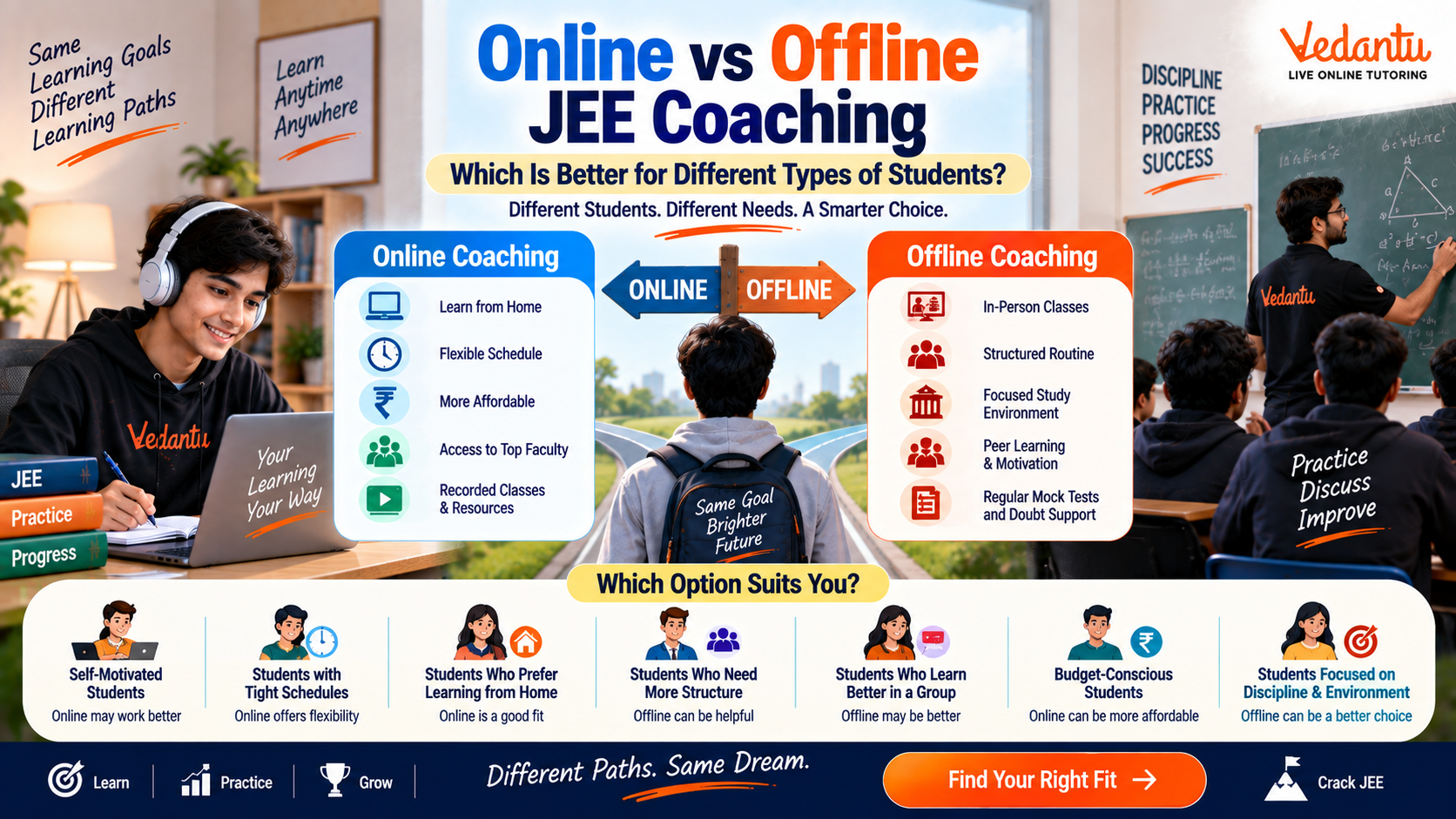
Online vs Offline JEE Coaching: The Practical Differences
Online coaching is not one uniform format. Scheduled live classes and recorded-only courses place different demands on a student, so they should not be treated as interchangeable. Offline coaching usually involves attending a physical classroom, but batch size, teacher access and academic follow-up still vary between centres.
| Factor | Live Online Classes | Offline Classroom Coaching | Recorded-Only Courses |
|---|---|---|---|
| Routine | Scheduled sessions; independent work happens at home. | Fixed attendance and travel create an external routine. | The student must organise most study sessions. |
| Doubt interaction | Depends on class interaction tools and available support. | Face-to-face discussion is possible; access depends on batch arrangements. | No live interaction within the recording; separate support may vary. |
| Pace and revision | Live teaching follows a timetable; replay depends on course access. | Teaching follows the batch pace; revision access varies. | Lessons can be revisited within the permitted access period. |
| Study environment | Needs a usable device, reliable connectivity and a workable study space. | Provides a classroom away from home; commuting is required. | Needs device access and strong control over distractions. |
| Peer contact | Depends on how discussion and group participation are organised. | Regular in-person contact; productive peer discussion is not automatic. | Limited unless a separate discussion arrangement exists. |
| Main risk | Logging in without actively solving or reviewing work. | Travel fatigue or batch pace reducing independent practice. | Postponing lessons and accumulating a backlog. |
Tests, useful feedback and individual attention are not guaranteed by any mode. A large classroom can make questions difficult to ask, while an online class without an effective doubt process can leave misconceptions unresolved. Judge the actual batch rather than assuming that its format provides these benefits.
Visit Our Vedantu Learning Centres Near You
Which Coaching Mode Suits Different Types of Students?
Choose according to your recent study behaviour, not the routine you hope to develop after admission. Needing external structure is not a weakness, and studying independently does not mean you never need a teacher. Your preferred format can also change as your preparation improves.
- Students who already follow a study plan: Live online coaching can work well when you complete assignments without repeated reminders. Recorded lessons may also support selected topics, provided you maintain deadlines and have a way to resolve doubts.
- Students who frequently postpone work: Offline coaching may provide a useful attendance routine. However, being physically present does not ensure homework completion; look for an actual follow-up process. A structured live online arrangement may also work if accountability is built into your weekly routine.
- Students with a long or tiring commute: Online classes can protect practice time and reduce travel fatigue. This advantage matters only if the saved time becomes problem-solving, revision or adequate rest rather than additional screen browsing.
- Students without a quiet home study space: Offline coaching may provide a more workable setting for lessons. You will still need somewhere to complete assignments afterwards, so assess the full day rather than just classroom hours.
- Students who need frequent clarification: Prioritise access to explanations over the online/offline label. Face-to-face discussion may suit some students; others may feel more comfortable submitting written questions. Find out how follow-up questions are handled.
- Students with weak foundations: Choose a pace that allows prerequisite concepts and basic questions to be addressed. Replaying a lesson can help with revision, but it cannot diagnose every misconception. Teacher feedback matters in either mode.
- Students comfortable with basics but seeking harder problems: Look for challenging assignments and discussion of reasoning, not simply more lecture hours. For JEE Advanced preparation, comparing approaches and understanding why a method fails can be particularly valuable.
How Class 11, Class 12 and Dropper Priorities Differ
Class 11: Build Habits Before Choosing Maximum Flexibility
If you are starting in Class 11, prioritise steady concept development and a manageable weekly workload. A completely self-paced course can become difficult if you have not yet learnt to plan revision and assignments. Offline or scheduled live online classes may provide a clearer starting structure, depending on your school timings and home environment.
Class 12: Protect Practice Time Alongside School
Class 12 students need to manage current topics while revisiting Class 11 concepts. Online learning may be useful when travel creates timetable clashes, but a fixed live class still requires attendance at its scheduled time. Choose a format that leaves room for school work, JEE questions and revision rather than filling every available hour with lectures.
Droppers: Match the Course to the Actual Gap
A dropper with incomplete fundamentals needs a different plan from one whose main problem is accuracy under time pressure. Online learning can support focused revision when the student already works independently; offline coaching may help someone who struggled with isolation or an inconsistent routine. Avoid repeating an entire lecture schedule without first identifying what went wrong in the previous attempt.
Is Online JEE Coaching Effective? Measure Learning, Not Attendance
Online JEE coaching can be effective when lessons lead to independent practice, resolved doubts and correction of mistakes. The same conditions apply to offline coaching. Understanding a teacher’s solution while watching it is different from selecting and applying a method on your own.
Use this learning cycle to evaluate either format:
- Attempt before viewing: After a lesson, try a small set of related questions without opening the solutions. Note where you become stuck.
- Identify the precise difficulty: Separate a missing concept from an algebra error, a misread condition or an unsuitable method.
- Ask an actionable doubt: Share your working and the step you cannot justify instead of only saying that you did not understand the chapter.
- Apply the correction: Solve a similar question without help to check whether the explanation changed your understanding.
- Revisit through a timed test: Review incorrect answers, guesses and unusually slow solutions. Decide whether each needs concept revision, additional practice or a better checking habit.
For example, if you can follow a mechanics solution but cannot draw the correct force diagram independently, watching more completed solutions may not fix the gap. You need targeted practice and feedback on the diagram itself. A useful coaching arrangement makes that correction possible, whether the teacher is on a screen or in a classroom.
Compare Total Cost and Time, Not Just Course Fees
Online coaching is not automatically the cheaper choice, and a higher classroom fee does not establish better value. Compare the full cost for the same preparation period: tuition, applicable taxes, materials, tests and any separate academic support. Add device and connectivity needs for online study, or travel and accommodation where relevant for offline study.
Time also has a cost. As an illustration, a 45-minute journey each way on four class days adds up to six hours of weekly travel. Removing that commute creates an opportunity for practice, but only a planned routine turns it into a benefit.
Vedantu’s JEE coaching cost and value comparison is a relevant next step when weighing expenses beyond tuition. For any shortlisted course, obtain the current fee, inclusions, access validity and refund terms directly before paying.
When Hybrid JEE Coaching Makes Sense
Hybrid preparation combines online and offline elements, but the term can describe very different arrangements. It may mean classroom teaching with digital revision resources, or online lessons supplemented by in-person tests or doubt sessions. Availability and inclusions depend on the provider.
Use a second format to fill a specific gap, not to duplicate your main course. A student attending classroom lessons might use selected recorded explanations for a weak chapter. An online learner might benefit from a planned in-person study or testing arrangement if working alone has become difficult.
- Keep one main syllabus sequence so that topics and assignments do not compete.
- Give each extra resource a defined purpose, such as revising one concept or taking a timed test.
- Remove the extra resource if it increases lecture backlog or reduces question practice.
Evaluating Vedantu Alongside Other Coaching Options
If Vedantu is on your shortlist, judge the specific option you are considering by the same standards as a local classroom institute or a recorded-only course. Focus on whether its schedule and teaching approach fit your preparation stage, and how you would move from a lesson to practice and feedback. Do not assume that every batch includes the same support.
Vedantu’s JEE coaching selection checklist for students and parents can support this decision by giving families a resource to use while shortlisting. For a Class 11 learner, the discussion should centre on pace and routine; for a Class 12 student or dropper, it should also address revision needs and existing gaps.
When assessing teaching, examine whether explanations make the reasoning clear and whether you can solve a related question afterwards. Vedantu’s resource on comparing JEE coaching faculty provides a relevant starting point for evaluating teachers rather than choosing on the format label alone.
Make the Final Choice Using a Realistic Weekly Routine
Before committing, map an ordinary school or study week with each shortlisted option. Include meals, sleep, travel and assignment time—not just teaching hours. Reject a plan that works only if every day goes perfectly.
- Identify non-negotiable constraints: Rule out schedules you cannot attend, unaffordable total costs and formats your study environment cannot support.
- Name your main learning obstacle: Is it weak concepts, procrastination, unresolved doubts, travel fatigue or insufficient practice? Choose the arrangement that addresses that obstacle most directly.
- Inspect a representative lesson where accessible: Check language, pace and clarity, then attempt related questions. Enjoying the presentation is not enough.
- Plan a weekly review: Track completed assignments, unresolved doubts and repeated test errors. If progress stalls, identify the failing part of the routine before switching modes.
Summary
Online coaching can suit independent students and those who need to avoid travel, while offline coaching can suit learners who benefit from a separate classroom environment and regular in-person contact. Recorded and hybrid options work best with a clear purpose and manageable workload. Choose according to your preparation stage, study habits and ability to practise consistently. Vedantu’s linked selection, faculty and cost resources can support shortlisting; compare the specific arrangements before enrolling.
FAQs on Online vs Offline JEE Coaching: Which is Better for Different Types of Students?
1. Which is better for JEE 2027 preparation: online or offline coaching?
Both online and offline JEE coaching have distinct benefits, and the best choice depends on a student's learning preferences and circumstances.
- Online coaching offers flexible schedules, live classes, doubt-solving, and access to recorded sessions.
- Offline coaching provides in-person teacher interaction, a traditional classroom environment, and peer learning.
- Choose online if you value convenience and flexibility.
- Choose offline for structured routines and in-person motivation.
2. What are the key advantages of online JEE coaching for 2027 aspirants?
Online JEE coaching offers unique advantages that support modern learning styles and exam preparation:
- Flexible study hours and location
- Instant access to high-quality digital resources
- Live and recorded lectures for revision
- Interactive doubt-solving sessions
- Personalized study plans and analytics
- Reduced commuting time, allowing more time for self-study
3. How does offline JEE coaching benefit certain students?
Offline JEE coaching is beneficial for students who:
- Prefer face-to-face interaction with teachers
- Benefit from a disciplined, classroom environment
- Thrive in group study and peer competition
- Need structured time management and routine
- Have limited access to reliable internet or digital devices
4. Can online JEE coaching offer doubt-solving as effectively as offline classes?
Yes, online JEE coaching platforms offer interactive doubt-solving sessions using various tools:
- Dedicated live doubt-clearing classes
- Chat support and instant doubt resolution
- 24/7 discussion forums and teacher access
- Uploading images of doubts for stepwise solutions
5. Does offline JEE coaching have any disadvantages compared to online?
Some challenges of offline coaching include:
- Fixed class schedules with less flexibility
- Commuting time and travel expenses
- Limited access to recorded lectures for revision
- Larger batch sizes may reduce personalized attention
- Subject to local facilities and teaching quality
6. Who should choose online JEE coaching for JEE 2027?
Online coaching is ideal for students who:
- Are self-motivated and disciplined
- Prefer learning at their own pace
- Live in remote or small towns with limited coaching options
- Need flexible timings due to other commitments
- Want access to diverse top faculty and digital study materials
7. Are study materials provided by online JEE coaching sufficient for JEE 2027?
Yes, leading online JEE coaching platforms offer comprehensive and regularly updated study materials covering the latest NTA JEE syllabus and pattern:
- Detailed topic-wise notes
- Practice questions and previous year papers
- Mock tests and performance tracking
- Quick revision modules and formula sheets
8. Can a student switch from offline to online coaching during JEE 2027 preparation?
Yes, students can seamlessly transition from offline to online JEE coaching if needed:
- Evaluate your learning needs before switching
- Take trial classes and explore platforms
- Make use of recorded content to catch up, if necessary
- Inform your offline instructors and collect any pending study material
9. What challenges might students face with online JEE coaching?
Common challenges of online JEE coaching include:
- Digital distractions at home
- Dependence on stable internet and devices
- Potential lack of in-person motivation
- Self-discipline required for regular study
- Limited peer interaction compared to classroom setting
10. Will online JEE coaching for JEE 2027 cover changes in exam pattern and syllabus?
Yes, reputed online JEE coaching platforms promptly update their curriculum to align with the latest NTA guidelines:
- Regularly revised modules
- Live updates on pattern changes
- Updated mock tests and sample papers
11. Can mock tests and performance analytics be accessed in both online and offline JEE coaching?
Most top coaching providers offer mock tests and performance trackers in both modes:
- Online: Instant feedback, AI-powered analytics, all-India test series
- Offline: Scheduled mock exams, manual performance reviews, progress charts
12. How do I decide between online and offline JEE coaching for my learning style?
Consider these factors to choose the best mode for JEE coaching:
- Your self-study habits and motivation level
- Need for direct teacher guidance
- Access to resources and internet
- Flexibility required due to other courses or travel
- Comfort with technology and online platforms



