



Which Is Better for Students—Online Tuition or Traditional Coaching for CBSE 2026-27?
Choosing between online tuition and traditional coaching is really about choosing the conditions in which a student learns well. Technology can make explanations clearer, feedback quicker and revision more accessible, but it does not automatically produce better results. Classroom coaching can be equally effective when teaching, practice and feedback are strong. The important question is which format helps the student understand concepts, resolve mistakes and work independently within a manageable routine.
We are Now Available in 47 Cities. Visit Your Nearest Centre📍 Check! Vedantu’s Interactive Online Tuitions Find the Best Home Tutors Near 📍You
What Counts as a Better Learning Outcome?
A learning outcome is what a student can demonstrate after studying, not simply how many classes they attend. A colourful animation, a full notebook or a long viewing history may show activity without proving understanding. Useful outcomes include:
- Conceptual understanding: Explaining why a method works rather than only remembering its steps.
- Retention: Recalling and using an idea several days after the lesson.
- Application: Solving an unfamiliar problem using the same underlying concept.
- Accuracy and independence: Completing work with fewer errors and less prompting.
Neither teaching format is universally better on these measures. Results depend on the teacher, lesson design, student participation, practice and access to support. Comparing the marks of two unrelated batches cannot isolate the effect of technology because their starting levels and study habits may differ.
Online Tuition vs Traditional Coaching: Practical Differences
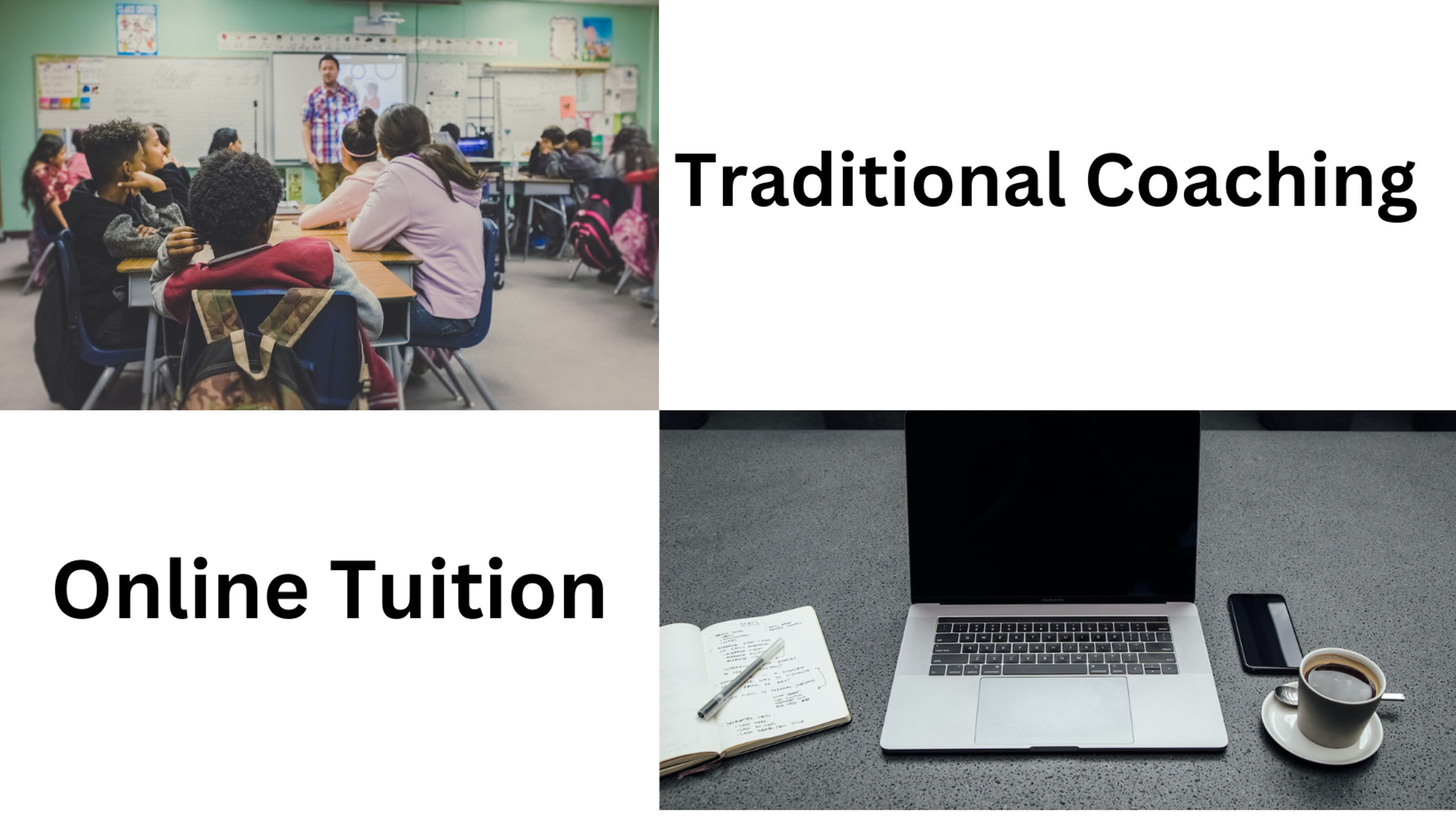
Online tuition connects students and teachers through the internet, while traditional coaching brings them together in a physical classroom. Live online teaching should also be distinguished from recorded-only courses: a video library does not provide the same immediate interaction as a live lesson. Specific facilities vary by provider, course and centre.
| Learning Factor | Live Online Tuition | Traditional Classroom Coaching |
|---|---|---|
| Teacher interaction | Questions may use audio, chat or a digital board; participation depends on class arrangements. | Face-to-face questions and visible student work can support immediate discussion; batch size matters. |
| Explanations | Screen sharing, diagrams and simulations can support teaching when used purposefully. | Board work, models and demonstrations support teaching; digital aids may also be used. |
| Revision access | Recordings can allow replay if included, subject to access conditions. | Revision may use notes, worksheets and repeat explanations; recordings are centre-dependent. |
| Tests and feedback | Digital tests can score suitable questions quickly; written reasoning still needs meaningful review. | Marked scripts can reveal reasoning errors; digital testing may supplement classroom assessment. |
| Routine and access | Avoids commuting but requires reliable connectivity, a suitable device and a workable study space. | Provides a separate learning environment but requires travel and attendance at a fixed location. |
| Total cost | Consider tuition fees alongside device, internet and any separately charged resources. | Consider tuition fees alongside transport, materials and any separately charged support. |
The distinction is therefore not “technology versus no technology”. Classroom coaching can use digital tools, and online tuition can still rely on one-way lectures. What matters is whether the teaching method makes students think, respond and improve.
How Technology Can Improve Learning Outcomes
Visual Explanations Make Hidden Processes Easier to Examine
An animation of blood moving through the heart can help a student follow the sequence of circulation. Its educational value increases when the teacher pauses, asks students to predict the next step and checks their explanations. Watching the movement alone does not establish understanding.
A useful follow-up is to draw the pathway from memory and explain how valves help prevent backflow. The same teaching approach can work on a shared online screen or a classroom projector: the activity around the visual matters as much as the visual itself.
Quick Checks Can Reveal Misunderstandings Earlier
A short digital quiz can show that several students have made the same sign error in an equation. The teacher can then revisit that step before moving ahead. However, a score alone may not distinguish a conceptual mistake from a calculation slip or a guess.
Effective feedback identifies the error, explains the correction and gives the student another opportunity to apply it. Classroom teachers can achieve this through questioning and marked work too; technology can make collecting responses quicker, but it cannot replace careful interpretation.
Replay Can Support Revision When Students Practise Alongside It
Where recordings are available, a student can revisit a difficult explanation without repeating an entire lesson. A productive routine is to pause before the solution, attempt the question independently and then compare the reasoning. Repeatedly watching a familiar solution can create confidence without the ability to reproduce it.
Progress Data Can Guide More Focused Practice
Topic-wise results can help direct revision towards recurring weaknesses instead of repeating everything equally. For example, a student who understands fractions but repeatedly mishandles negative signs needs different practice from someone who does not understand equivalent fractions. Personalised support requires the teacher to act on this distinction; a dashboard by itself is not personalised teaching.
Where Technology Can Become a Barrier
Digital access introduces its own demands. Connection failures can interrupt explanations, a small shared screen can make written work difficult to read, and notifications can break concentration. Removing the commute helps only if the saved time becomes rest, practice or revision rather than additional distraction.
- Reduce divided attention: Keep unrelated tabs closed and silence notifications during lessons.
- Make learning active: Keep a notebook ready, attempt questions before seeing answers and record unresolved doubts.
- Balance screen use: Complete suitable practice on paper and include breaks between extended study sessions.
- Match support to age and independence: Students who struggle to manage their routine may need adult guidance or a more structured learning environment.
Traditional coaching has limitations too, including travel fatigue, fixed pacing and the possibility of limited individual attention in large batches. Neither format removes the need for students to ask questions and practise outside class.
Which Format Fits the Student’s Needs?
- Online tuition may fit better when travel is difficult, the home study environment is suitable and the student can participate consistently through a screen.
- Traditional coaching may fit better when reliable internet is unavailable, home is distracting or the student works more steadily with face-to-face supervision and peer interaction.
- Recorded-only learning may suit targeted revision for an independent student, but it needs a separate way to resolve doubts and obtain feedback.
- A blended approach may help when classroom teaching is supplemented by focused digital revision. Avoid duplicating full courses if that leaves too little time for independent practice.
For a student who rarely asks questions, inspect how participation actually works rather than assuming one format will solve the problem. A manageable batch with regular questioning may matter more than whether the teacher is physically present.
How to Judge Whether the Chosen Format Is Working
Use a short review cycle to examine progress rather than judging a course only by its presentation. The following two-week approach is an illustrative starting point, not a scientific comparison of teaching methods.
- Record a starting point: Attempt a small set of questions on one topic without notes. Mark concept errors, calculation errors and questions needing help.
- Track meaningful participation: Note whether doubts are answered clearly and whether homework is completed independently.
- Check delayed recall: Several days after a lesson, explain the main idea and solve a question without replaying the explanation first.
- Test application: Attempt different questions of similar difficulty, including one unfamiliar variation. Do not simply repeat memorised answers.
- Review the routine: Compare accuracy, independence, fatigue and time available for self-study. Discuss persistent difficulties with the teacher before changing formats.
A promising sign is not merely a higher score immediately after class. It is being able to explain an idea later, correct a previous mistake and handle a new question with less help.
Using Vedantu Resources to Make an Informed Choice
Vedantu’s online tuition vs traditional coaching comparison offers a relevant next step for students and parents weighing the two formats. Use it alongside the student’s actual routine: identify whether the main difficulty is travel, understanding explanations, asking questions or maintaining regular practice.
For a closer look at areas where digital support may help, explore Vedantu’s discussion of learning gaps that online tuition can address. Treat the benefits as questions to investigate in a particular course, not as guarantees that every online option will provide the same support.
If considering a Vedantu course, confirm its current teaching format, schedule, doubt support, assessment feedback, recording access and total fee on the relevant course page. Compare those details with a classroom option using the same needs. Against recorded-only learning, examine opportunities for feedback; against offline coaching, weigh home-study conditions and saved travel time against the value of in-person structure.
Summary
Technology can strengthen learning through clearer explanations, timely feedback and focused revision, but it does not make online tuition automatically superior to classroom coaching. Choose the format that supports understanding, delayed recall and independent practice within a sustainable routine. Vedantu’s comparison resources can help frame that decision. Review the specific course arrangements, then track whether the student can explain concepts and solve unfamiliar questions with progressively less help.
FAQs on Online Tuition Vs Traditional Coaching: How Technology Shapes Learning Outcomes
1. What are the main differences between online tuition and traditional coaching in terms of learning outcomes?
Online tuition and traditional coaching differ in multiple ways that affect learning outcomes:
- Flexibility: Online tuition allows students to learn at their own pace and schedule.
- Personalization: Online platforms use technology to tailor lessons to individual needs.
- Accessibility: Students can access quality teachers and resources from anywhere.
- Interactive tools: Features like live quizzes, polls, and whiteboards support active learning.
- Immediate feedback: Most online programs provide instant feedback through assessments and tests.
2. How does technology improve learning outcomes in online tuition?
Technology enhances learning by providing:
- Live interactive classes with real-time doubt clearing
- Recorded sessions for revision at any time
- AI-powered assessments for personalized progress tracking
- Digital study materials such as notes, practice tests, and quizzes
- Performance analytics to help students identify and improve weak areas
3. Can online tuition be as effective as traditional classroom coaching?
Yes, online tuition can be equally or more effective than traditional methods when it offers:
- Experienced teachers skilled in digital instruction
- Engaging content aligned with the latest syllabus
- Regular assessments and feedback
- Access to doubt-solving sessions and study groups
4. What role does personalization play in online learning outcomes?
Personalization in online learning helps boost student performance by:
- Adapting content to individual learning speeds
- Tracking progress with detailed reports
- Customizing assignments for targeted practice
- Providing one-on-one attention through small group sessions or private tuition
5. What challenges exist with online tuition compared to traditional coaching?
Some challenges that students and parents may face include:
- Distraction risks at home environments
- Dependence on strong internet connectivity
- Less face-to-face interaction than physical classes
- Technical difficulties during live sessions
6. Does online tuition offer any advantages for students preparing for JEE 2027 and NEET 2027?
Online tuition provides key benefits for students preparing for JEE 2027 and NEET 2027:
- Access to updated syllabus and exam patterns
- Regular mock tests with instant analysis
- All-India test series to gauge competition level
- Time-saving with no commute required
7. How can students ensure maximum benefit from online tutoring sessions?
To gain the most from online tutoring, students should:
- Set up a distraction-free study environment
- Follow a consistent timetable for attending sessions and revision
- Actively participate in interactive elements during classes
- Regularly practice with provided resources
- Communicate doubts promptly to teachers
8. Are there any essential features to look for in an online tuition platform?
Key features students should look for include:
- Qualified and experienced faculty
- Support for live and recorded classes
- Interactive tools like digital whiteboards and quizzes
- Doubt-solving support and peer discussion forums
- Comprehensive syllabus coverage for targeted exams
9. How do online and traditional coaching compare for students in remote areas?
Online coaching offers major advantages for remote students:
- Bridges geographical limitations by connecting to top educators
- Provides access to updated resources and exam materials
- Flexible scheduling for students with limited local options
10. What are some best practices for balancing screen time and effective learning in online tuition?
To balance screen time while maximizing learning benefits:
- Take regular short breaks between classes
- Follow the 20-20-20 rule: every 20 minutes, look at something 20 feet away for 20 seconds
- Use printed notes or handwritten practice when possible
- Limit unnecessary device usage outside study sessions
11. Can parents track their child's progress and performance in online tuition compared to traditional classes?
Yes, online tuition platforms often provide detailed tools for parents, including:
- Real-time performance analytics
- Regular progress reports
- Direct communication channels with teachers
- Alerts and reminders for upcoming classes and assessments
12. How does Vedantu support personalized learning in online tuition?
Vedantu promotes personalized learning through:
- AI-driven recommendations for study plans
- Differentiated assignments based on performance
- One-on-one sessions for students needing extra help
- Continuous feedback to address learning gaps quickly



